Wedding Attire Around the World · Japan
Wedding Attire in Japan
A Japanese bride marries in pure white and celebrates in colour. Between the Shinto ceremony in the all-white shiromuku and the reception entrance in a vivid iro-uchikake stands one of the great costume changes in world dress. This guide explains the layers, the hood and the cap, the groom’s five-crest montsuki, and the sake rite the clothes were made for. For kimono in general, begin with our kimono of Japan guide; this page is about the separate, formal bridal register at its summit.
The Shape of It
White First, Then Colour
A traditional Japanese wedding is built in two movements: a short, solemn ceremony — most distinctively the Shinto rite, shinzen-shiki, held before the kami at a shrine, with close family present — and then the hiroen, the reception banquet at which the marriage is announced to the wider world of relatives, friends and colleagues. The bride's dress follows the same arc exactly: she marries in pure white, and she celebrates in colour. Between the two stands one of world dress's great costume changes, the oshiro-naoshi, and understanding it is understanding the whole wardrobe.
It should be said clearly that the wedding kimono is its own world. The bride's layered silk ensemble — its trailing outer robe worn unbelted, its prescribed accessories, its specialist dressing — is a separate formal register from everyday and even ordinary formal kimono: different garments, different rules, different hands required to put it on. Our Traditional Dress guide to the kimono explains kimono in general; this page is about the bridal system that sits at its summit. The tailors, silk merchants and rental houses behind it appear on our Japan clothing industry page.
The Ceremony
San-San-Kudo: Three Cups, Nine Sips
The Shinto ceremony lasts only about twenty to thirty minutes, though the dressing, hair and photographs around it take hours. Its order is fixed and formal: the deities are invited, the couple is purified, prayers are read, and at the rite's centre comes san-san-kudo — literally "three, three, nine times." Three lacquered sake cups, small, medium and large, pass between bride and groom; each takes three sips from each cup, nine sips in all, the groom drinking first from the first and third cups, the bride first from the second. Traditionally this shared sake, not any exchange of rings, is the binding act of the marriage — the couple drinking to sharing joys and hardships alike — and a further sharing of cups among both families seals the joining of the two houses. The couple then read their vow and offer a tamagushi, a sakaki branch with paper streamers, to the kami. Through all of it the bride is in white and the groom in black crested silk: the rite's stillness is part of its dress.
The Bride
The Shiromuku: All in White
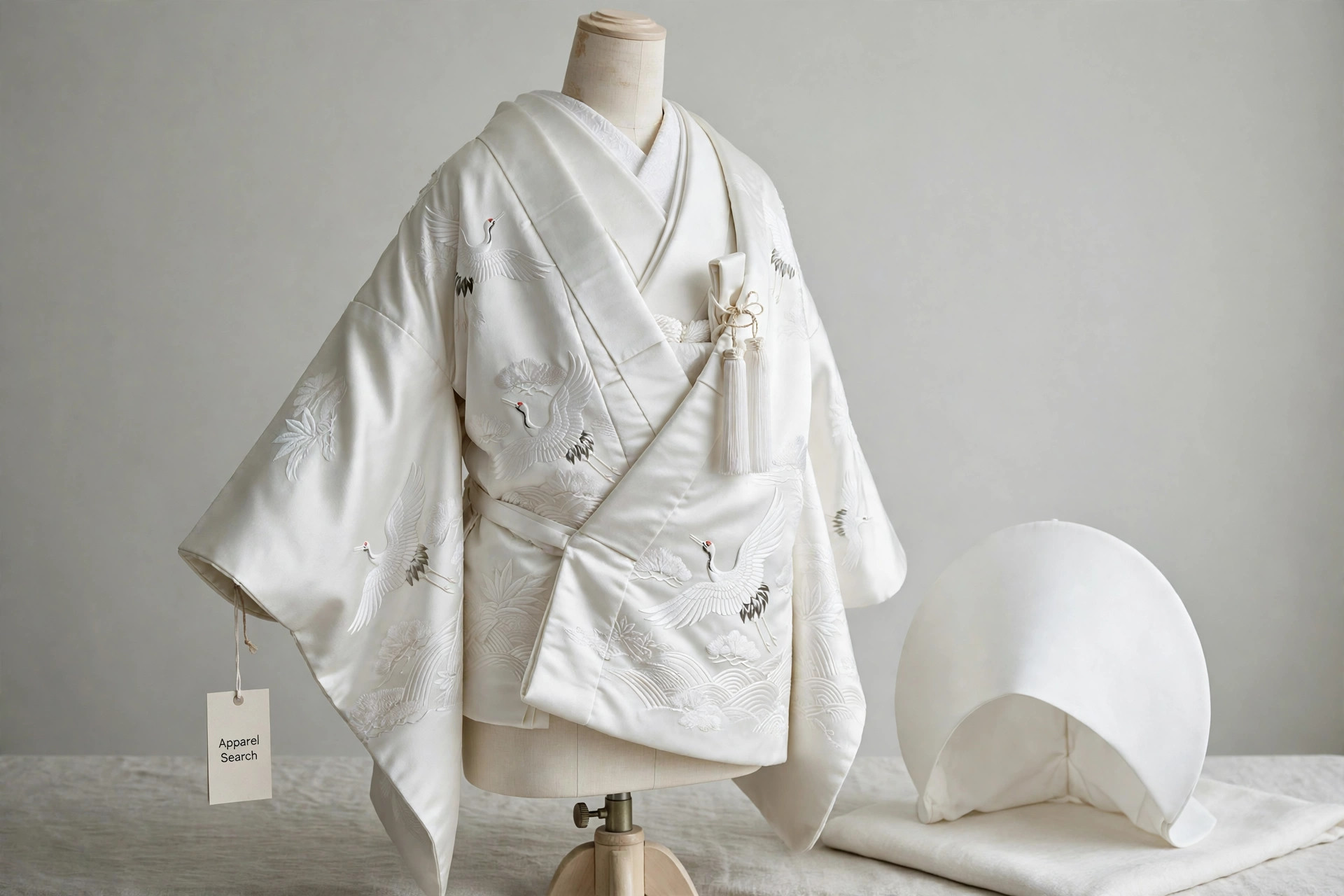
The shiromuku is the all-white wedding ensemble — its name joins shiro, white, with muku, purity or innocence — and white is total: outer robe, under-kimono, obi, accessories, even the cords and the fan, all in shades of white, its patterns woven or embroidered white-on-white so that cranes, pines and flowing water appear as texture before they appear as image. The ensemble is built in layers:
- Kakeshita — the under-kimono
- A long-sleeved furisode-style kimono worn beneath the outer robe, in white for the shiromuku, with the obi tied over it. The kakeshita carries the structure of the outfit; everything the guest sees is arranged over it.
- The white uchikake — the outer robe
- A heavily padded, trailing silk over-robe worn unbelted, draped over the kakeshita and obi so its full length and hem sweep the floor. Uchikake began as formal dress of upper-class and samurai households, and its unbelted drape is what makes bridal kimono move — slowly, and with ceremony — so differently from everyday kimono.
- Wataboshi — the hood
- A soft white hood worn over the traditional bridal hairstyle with the shiromuku, framing the face. It belongs to the ceremony and the procession; it is removed for the reception.
- Tsunokakushi — the alternative cap
- Instead of the hood, a bride may wear the tsunokakushi: a band of white silk, often lined in red, pinned over the bridal hairstyle, and wearable with coloured kimono as well as white. Its name is popularly explained as "horn-hider" — concealing the horns of jealousy so the bride enters marriage gentle — though that story is best treated as folk etymology rather than settled fact; the headpiece's documented history runs through Edo-period dress worn for temple visits.
The white itself carries the meaning. White is purity, and it is also a beginning: the traditional explanation is that the bride comes in blank white, ready to be dyed in the colours of the groom's family — to take on her new household's ways as a cloth takes dye. Whether a modern bride reads it literally or as poetry, the all-white figure processing into the shrine remains the defining image of the Japanese wedding.
The Groom
Montsuki, Haori, Hakama
The groom wears Japan's most formal menswear: montsuki haori hakama. The montsuki is a black silk kimono bearing five white family crests — mon — at the chest, sleeves and back, five crests being the highest degree of formality. Over it goes the haori, a black crested jacket, its white haori cords tied at the front; below, hakama — wide pleated trousers, usually in a fine grey or striped weave — over white tabi socks and sandals, with a white folding fan carried as the bride carries hers. The effect is deliberate understatement: black, white and grey against the bride's white or colour, the crests the only ornament. So formal is the set that guests must not wear it — a male guest in montsuki would upstage the groom, and dark suits are the guest rule. At chapel-style ceremonies and many modern receptions the groom wears a Western suit or morning dress instead, changing as the bride does; where she keeps one kimono moment in the day, he very often keeps his montsuki to answer it.
Accessories
The Small Things in the Obi
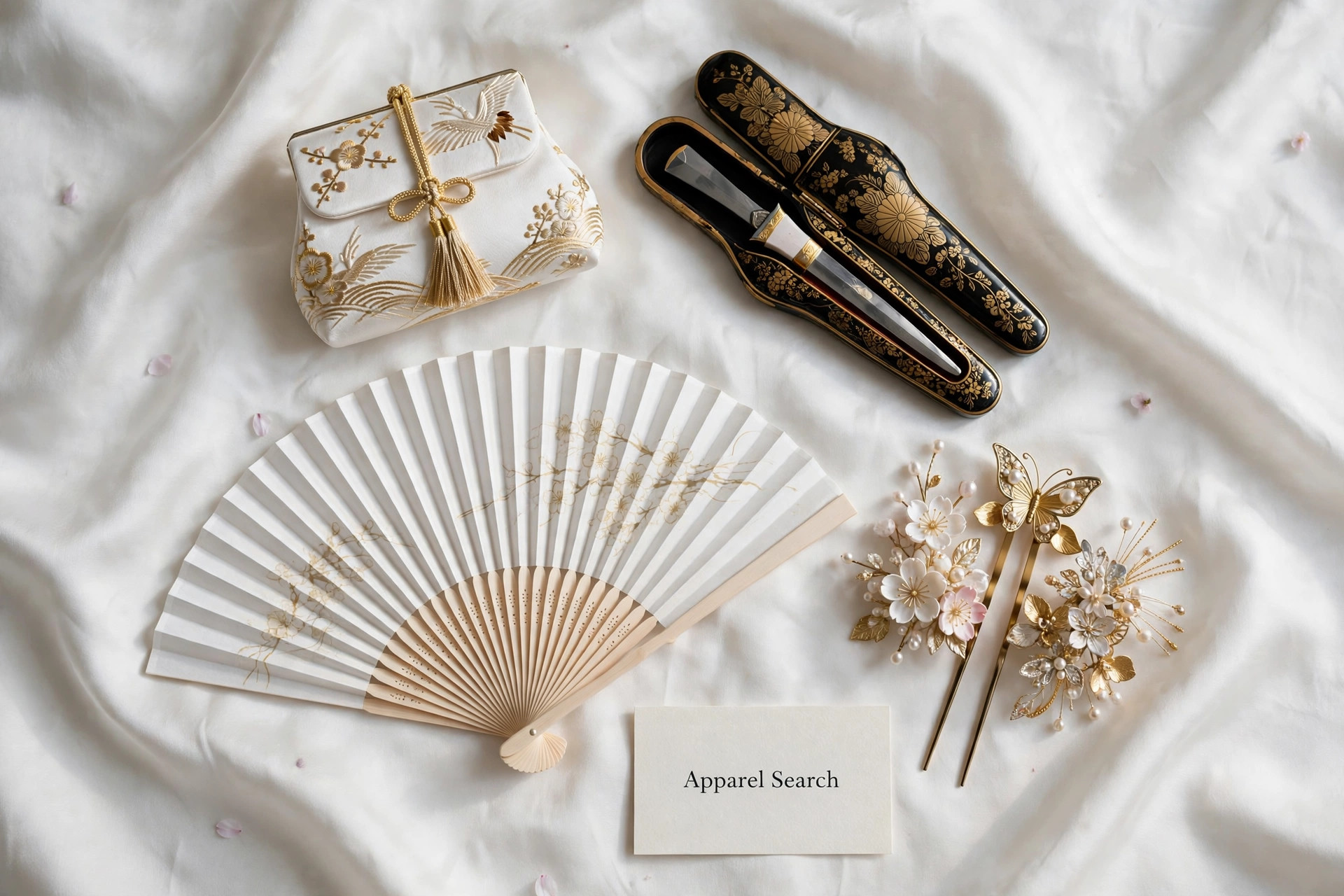
The shiromuku's accessories are prescribed, not chosen freely, and each has its place tucked into the front of the ensemble:
- Hakoseko — the purse
- A small, stiff, embroidered purse carried at the breast of the kimono, matching the set. Historically it held a bride's small necessities — powder, paper, comb; today it completes the formal silhouette.
- Kaiken — the dagger
- A short dagger in a decorative case, tucked alongside the hakoseko. It descends from the blade a samurai-class bride carried for her own protection, and it survives as a symbol of resolve within the white ensemble.
- Sensu — the fan
- A folding fan, white or gold-and-silver for a bride, held in the formal photographs and carried through the ceremony. Fans widen toward the tip, and so stand for a future that opens and prospers — suehiro, ever-widening, is the auspicious idea.
- Kanzashi — the hair ornaments
- Ornaments of tortoiseshell, lacquer, silk flowers or metalwork worn in the traditional bridal hairstyle, especially with the tsunokakushi. With the wataboshi hood the hair is covered; with the cap, the kanzashi do the decorating.
Our kimono definition page untangles the wider vocabulary — uchikake, furisode, hakama — for readers meeting these terms for the first time.
The Change
Oshiro-Naoshi: Into Colour
At the reception the bride leaves — and returns transformed. The change of costume, oshiro-naoshi (also read oiro-naoshi), replaces the white uchikake with an iro-uchikake: the same trailing outer robe in vivid colour — deep red above all, or black, gold or rich brocade tones — embroidered and couched with cranes, pines, plum and peonies in gold and silver thread. Only the outer robe need change, over the same kakeshita, which is part of the system's elegance: one layer carries the whole emotional turn of the day, from shrine white to banquet colour, and the guests applaud the entrance as a second arrival.
Some brides instead change into a hikifurisode — a long-sleeved furisode worn trailing, traditionally often black — or make the kimono their ceremony dress and the reception change a Western one. The modern two-part wedding is now a standard pattern rather than an exception: a chapel ceremony in a white Western gown and a kimono for the shrine rite or the photographs, or shiromuku first and a coloured dress to finish. Photo weddings have grown alongside — couples who hold no large reception, or who marry quietly, commissioning a formal portrait session in full bridal kimono, so that the shiromuku and montsuki appear in the family album even when the day itself was small. Through every variation the white-to-colour grammar survives; it is the sentence the wardrobe keeps speaking.
The Wider Day
Chapel Weddings, Family Dress and the Hair
Not every Japanese wedding is a shrine wedding. Chapel-style ceremonies — modelled on Christian weddings, held in the chapels built into hotels and wedding halls, and chosen by many couples with no Christian affiliation — are at least as common, and there the bride usually wears a Western white dress and the groom a suit or morning coat, with kimono reserved for the reception change or the photographs. Civil and humanist-style ceremonies fill out the modern menu. The kimono system described in this guide belongs first to the shrine rite, but it travels: a couple may hold a chapel ceremony and still process, pose and receive in shiromuku and montsuki, because the garments have become the visual language of "a Japanese wedding" itself.
That portrait impulse now has a name of its own: the photo wedding. Distinct from maedori, the pre-wedding shoot taken ahead of a ceremony, a photo wedding skips the ceremony and reception altogether and keeps only the portraits — the couple in full wedding dress, photographed in a studio or on location at a shrine, garden or other chosen setting. Recruit's bridal research found that in 2024 some 62 percent of newly married couples in Japan had wedding photographs taken, and for about one couple in eight the photographs were the whole occasion. In traditional dress the session still demands the full apparatus — shiromuku or iro-uchikake for the bride, montsuki haori hakama for the groom, and a trained dresser to put it on.
The family dresses to frame the couple. Mothers of bride and groom traditionally wear kuro-tomesode — black formal kimono with five crests and a pattern below the waist — the most formal dress for a married woman, against which the bride's white or colour is meant to shine. The bride's own hair is part of the costume: the traditional bridal hairstyle, bunkin-takashimada, is a high, sculpted arrangement built over padding, worn under the wataboshi or with the tsunokakushi and kanzashi; many modern brides choose a Western hairstyle with the hood instead, and salons plan hair, makeup and dressing as one timed operation. Even the reception has its dress choreography — speeches, the couple's rounds of the tables, the candle and cake ceremonies borrowed from Western banquets — each entrance an occasion for the room to read the bride's current layer. White, colour, perhaps a dress: the day is a sequence of appearances, carefully timed and announced, and the wardrobe — layer by layer, crest by crest — is its script from first procession to final farewell.
Acquiring
Rented, Dressed by Specialists
A bridal kimono of silk, hand-embroidered and padded to trail, is a costly object that most families will need once — and Japan has answered with rental on an industrial scale. Bridal kimono are overwhelmingly rented, through bridal salons, hotel wedding departments and specialist kimono rental houses, which keep shiromuku, iro-uchikake and montsuki sets in graded qualities and fit them as part of complete wedding packages. What is rented is never just the robe: the package brings the full layer set, the accessories, the hairstyling — and the dressing itself.
For no one simply puts on a shiromuku. Bridal dressing is the work of kitsuke specialists — professional dressers who build the ensemble layer by layer with cords, pads and the obi, shaping the silhouette so the uchikake drapes unbelted yet stays immaculate through procession, rite and photographs, and who attend the oshiro-naoshi change mid-day. Salons schedule dressing in hours, not minutes, and a shrine wedding day runs four to six hours from first layer to final photograph. Heirloom kimono exist — a family's own uchikake, re-dressed by the same specialists, its crests and embroidery carrying a grandmother's or mother's wedding into a new one — but the rental system, with its dressers included, is how the tradition stays wearable: the knowledge is rented with the silk. Rental packages also solve the knowledge problem that ownership would pose: how the layers are stored, cleaned, repaired and re-pressed between wearings is the salon's craft, and a bride renting a shiromuku is renting that whole chain of care along with the silk. Guests, meanwhile, need none of it, and our wedding guest dressing guide covers the simpler rules on their side of the room.
Common Questions
Common Questions
What is a shiromuku?
The shiromuku is the all-white Japanese bridal kimono ensemble: a white long-sleeved kakeshita under-kimono with a white uchikake outer robe draped unbelted over it, with white accessories throughout. White symbolises purity and a new beginning — traditionally, the bride comes undyed, ready to be dyed in the colours of the groom's family. It is worn for the ceremony, above all at a Shinto shrine wedding.
What is the difference between a wataboshi and a tsunokakushi?
Both are traditional bridal headpieces worn with the shiromuku. The wataboshi is a soft white hood that covers the hair and frames the face, worn for the ceremony and removed for the reception. The tsunokakushi is a band of white silk pinned over the bridal hairstyle, which can also be worn with coloured kimono. Its popular 'horn-hider' explanation is best treated as folk tradition rather than settled fact.
What is san-san-kudo?
San-san-kudo — 'three, three, nine times' — is the sake rite at the centre of a Shinto wedding. The couple share three lacquered cups of sake, small, medium and large, taking three sips from each for nine sips in total, alternating who drinks first. Traditionally it, rather than an exchange of rings, is the act that binds the marriage, and the families then share sake too, joining the two houses.
What does a Japanese groom wear?
Japan's most formal menswear: montsuki haori hakama — a black silk kimono bearing five family crests, a black crested haori jacket over it, and wide pleated hakama trousers, with white tabi socks and a folding fan. The five crests mark the highest formality, and the set is reserved to the groom; male guests wear dark suits so as not to upstage him.
Why does a Japanese bride change into a coloured kimono?
The change, called oshiro-naoshi, marks the turn from ceremony to celebration. The bride leaves the reception and returns wearing a vivid iro-uchikake — the trailing outer robe in red, black or gold brocade — in place of the white one, over the same under-kimono. Some brides change instead into a trailing hikifurisode or a Western dress; the white-to-colour progression is the pattern underneath all of them.
Keep Exploring
More to Explore
In This Series
Wedding Attire Around the World
The series hub — wedding dress country by country, from China's qun kua to Scotland's tartan, as each guide is published.
Visit the hub ↑Japan — The Kimono
The base garment behind this page: kimono form, formality and wearing, explained in the Traditional Dress series.
Read ↑Go Deeper on Japan
Japan Clothing Industry
Japan’s apparel and textile industry — the silk merchants and specialists behind the bridal kimono system.
Explore ↑Kimono Guide
Kimono as clothing to buy and wear today — the everyday end of the register whose summit is the shiromuku.
Read ↑Bridal Necklaces
Bridal necklaces at the Western counter — a contrast with a tradition whose bridal set carries no necklace at all.
Read ↑Attending a Wedding?
Search Apparel Search