Wedding Attire Around the World · India
Wedding Attire in India
An Indian wedding is not dressed once but five times or more. Across days of ceremonies, the bride moves from turmeric yellow to henna green to the deep bridal red of a Banarasi silk or a gold-worked lehenga, while the groom climbs his own ladder from a simple kurta to a turbaned sherwani. This guide walks the whole wardrobe: what is worn at each function, how the bride's dress changes from region to region, what the groom wears, and the jewelry — mangalsutra, chooda, kaleere — in which the marriage itself is carried. For the sari as a garment, begin with our sari of India guide; this page is about what happens to it, and to everything else, at a wedding.
The Shape of It
A Wedding in Several Acts
Most weddings in the West are a day. A Hindu wedding in India — and, with their own variations, Sikh, Muslim, Christian and Jain weddings too — is a small season. The date itself is chosen from the calendar of auspicious days, the muhurat, which is why Indian weddings cluster in the cooler months and why, on a favored date, a city can seem to be marrying all at once. Around the ceremony gather a ring of smaller ceremonies, each with its own mood, its own guest list and — the point for this guide — its own dress code. Nobody wears the same thing twice, and the couple least of all.
That structure turns wedding clothing into planning. Families shop for months. The bride's outfits are chosen as a set, so that five days of photographs tell one story; the groom's wardrobe is built to answer hers function by function. Jewelry is assembled from new purchases and family gold that may have been worn by a mother or grandmother at her own wedding. And underneath the celebration runs a serious textile economy — the great wedding silks of Banaras and Kanchipuram, hand embroidery that takes weeks on a single garment — which our India clothing industry page profiles from the industry side.
Day by Day
The Days, Dressed
Haldi — the yellow morning
A day or two before the ceremony, family and friends anoint the bride and groom with a paste of turmeric, sandalwood and rosewater — for glow, for blessing, and by all accounts for the joy of the mess. The dress code follows the ritual: yellow, the color of turmeric and marigolds, in clothes that can survive it. Brides wear a simple yellow sari, a light lehenga or a kurta set, often with jewelry made of fresh flowers instead of gold; grooms wear a plain kurta and pajama. Haldi outfits are frequently bought cheap or made for the day, precisely because turmeric stains do not come out.
Mehndi — green, and hands occupied
At the mehndi, artists paint the bride's hands and feet with henna in patterns that can take hours to apply and hours more to dry. The signature color is green — fertility, spring, new life — answered by bright pinks, oranges and floral prints across the room. Dress is festive but practical: the bride, whose hands are out of action, wears a lehenga, sharara or sari she can sit in for hours, often in green or a bright contrast, with short or three-quarter sleeves. The groom's mehndi is a smaller affair — a motif, sometimes the bride's initials hidden in it.
Sangeet — the night of sparkle
The sangeet is the wedding's concert: both families perform rehearsed songs and dances for the couple, and then the floor opens. It is the most fashion-forward night of the wedding and the one where dress is judged as party dress — sequinned lehengas and saris, Indo-western gowns, jewel tones and metallics under evening light. The only real rule is that the outfit must move: the bride will be dancing in it. Grooms answer with bandhgalas, Nehru jacket sets or sherwanis with a shine of their own.
The wedding day — the main event
The ceremony itself — pheras around a sacred fire in a Hindu wedding, the Anand Karaj in a gurdwara, the nikah, a church service in Kerala or Goa — calls for the heaviest, richest and most traditional dress of the whole wedding, and it is the subject of the bride and groom sections below. This is the outfit the heirloom silks are saved for, the one photographed for the family wall, and the one where regional tradition speaks loudest.
Reception — the change
After the ceremony comes the reception, traditionally hosted by the groom's family, and with it the great change of clothes. The bride leaves her ceremonial dress behind and returns in glamour: a gown, a cocktail sari, a second lehenga in a contrasting color — increasingly, the most Western or the most experimental outfit of her wedding. The groom changes too, into a bandhgala, an Indo-western jacket or a tailored suit. If the ceremony outfit says tradition, the reception outfit is allowed to say fashion.
The Bride
Red, and the Regions That Answer It
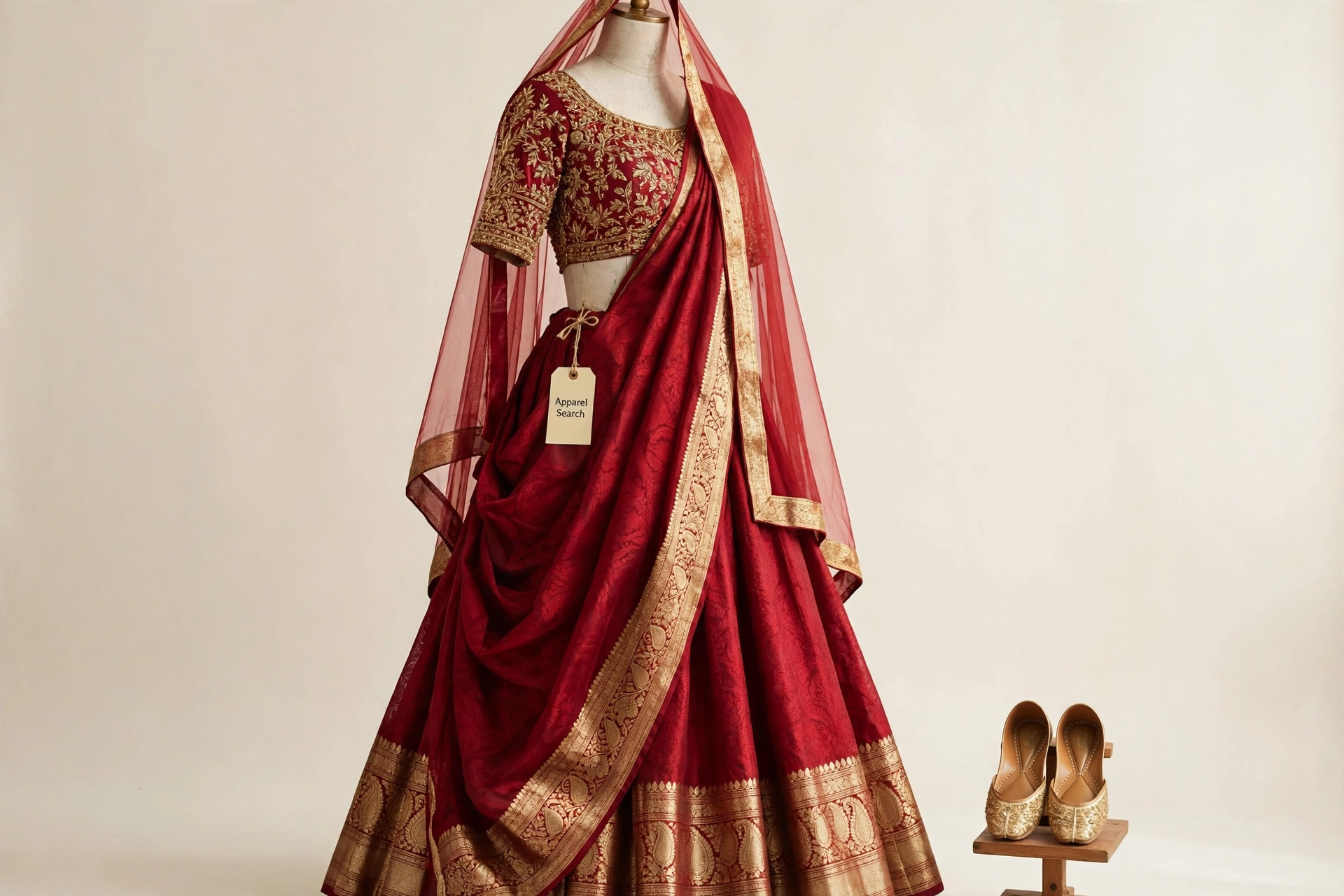
The classic Indian bridal outfit is red, and the color is a statement, not a default. Red is the most auspicious color in Hindu tradition — prosperity, fertility, strength, the color of the goddess and of the sindoor powder a married woman wears in her hair parting. To marry in red is to dress the marriage in everything it is hoped to be. Two great silhouettes carry it. Across much of the north and west, the bride wears a lehenga: a full, often heavily worked skirt, a fitted choli blouse, and a dupatta draped over the head and shoulders. Across the south and east, she wears a sari — and not any sari, but one of the great named wedding silks.
The wedding layer is where those silks reach their peak. A Banarasi sari from Varanasi, brocaded with gold and silver zari in Mughal-descended floral patterns, is the bridal cloth of the north and of Bengal. A Kanchipuram from Tamil Nadu, its borders and pallu woven separately and interlocked with the body, is the bridal cloth of the south. Onto silk like this goes the second great wedding craft: zardozi, hand embroidery in metallic gold thread — coiled dabka wire and nakshi thread worked into vines, paisleys and peacocks, a court art of the Mughal era still centered in places like Lucknow. A fully worked bridal lehenga can occupy embroiderers for weeks, and its weight is part of its ceremony: brides describe feeling the importance of the day in kilograms. The weaves themselves — how a Banarasi is brocaded, how a Kanchipuram is joined — are covered in our sari guide; here, what matters is that at a wedding they are worn at their richest.
But red is a tradition, not a law, and India's regions answer it in their own colors:
| Region | The bridal dress | Signature details |
|---|---|---|
| Kerala | The kasavu sari — off-white or cream with a woven gold border | Layered gold jewelry, jasmine in the hair; the great exception that proves red is a choice. A colored — often red — blouse answers the white |
| Maharashtra | A Paithani silk sari, often in yellow or green with a gold border, draped as the nine-yard nauvari | The mundavalya — a beaded string worn across the forehead by bride and groom — green glass bangles, a crescent-moon bindi, the Maharashtrian nath nose ring |
| Bengal | A red Banarasi sari | Shakha-pola bangles — white conch shell and red coral — alta red dye on hands and feet, and the mukut, a crown of white shola pith |
| Gujarat | The panetar — white with a red border — exchanged for the red-and-green gharchola | The panetar traditionally comes from the bride's maternal uncle, the gharchola from her new in-laws: the two families, worn in sequence |
| Tamil Nadu | A Kanchipuram silk sari; in Tamil Brahmin weddings, the nine-yard madisar drape | Temple jewelry in gold, jasmine and the koorai pudavai — the ceremony sari given by the groom's family |
| Punjab | A red lehenga or salwar suit | The chooda bangles and dangling kaleere (below), a dupatta over the head for the Anand Karaj |
Muslim brides in India often marry in a richly worked lehenga, sharara or gharara — deep red, maroon or green, with a dupatta framing the face — and Christian brides in Kerala and Goa may wear a white gown, a kasavu sari, or one at the ceremony and the other at the reception. The pattern underneath all of it is the same: the wedding outfit is the family's textile heritage, worn at full strength.
The Groom
The Groom's Answer: Sherwani, Safa, Mojari
The groom's wedding dress climbs the same ladder as the bride's, a few rungs lower. For the haldi he is in a plain kurta; for the mehndi and sangeet, kurta sets with a Nehru jacket or a bandhgala; and for the ceremony he appears in the full formal answer to the bridal lehenga — the sherwani.
- The sherwani
- A long, tailored coat that buttons up the front to a high collar, worn over a kurta with churidar or pajama trousers. Descended from the achkan of the Mughal and Awadhi courts, it took its modern tailored shape in the nineteenth century — and it remains the groom's ceremonial uniform across most of India, in ivory, cream, gold or deep colors, often embroidered to answer the bride's outfit without matching it exactly.
- The safa — the turban
- A length of cloth wound and pinned into a turban, in a color chosen against the sherwani — maroon, pink, saffron or a contrast print are classics. A jeweled ornament, the kalgi, may be pinned at the front. In parts of the north the groom also wears a sehra: a veil of flower strings hung from the turban over his face, lifted at the ceremony's key moments.
- The stole and the shoes
- A dupatta or stole over one shoulder adds the final layer of ceremony — sometimes the very cloth that will be knotted to the bride's dupatta during the rituals. On his feet, mojari: curled-toe, embroidered leather shoes, made in their most famous form in Punjab and Rajasthan. In Kerala the groom's answer is different and older: a white mundu with a gold border, worn with a shirt or bare-chested with a shawl for the temple rites.
Coordination is the modern groom's real job. His sherwani's embroidery echoes a motif from her lehenga; his safa picks up her accent color; at the reception the couple appears deliberately matched — his bandhgala or suit cut from a palette that answers her gown. The days when the groom dressed as an afterthought are over.
Jewelry
Jewelry That Carries the Marriage
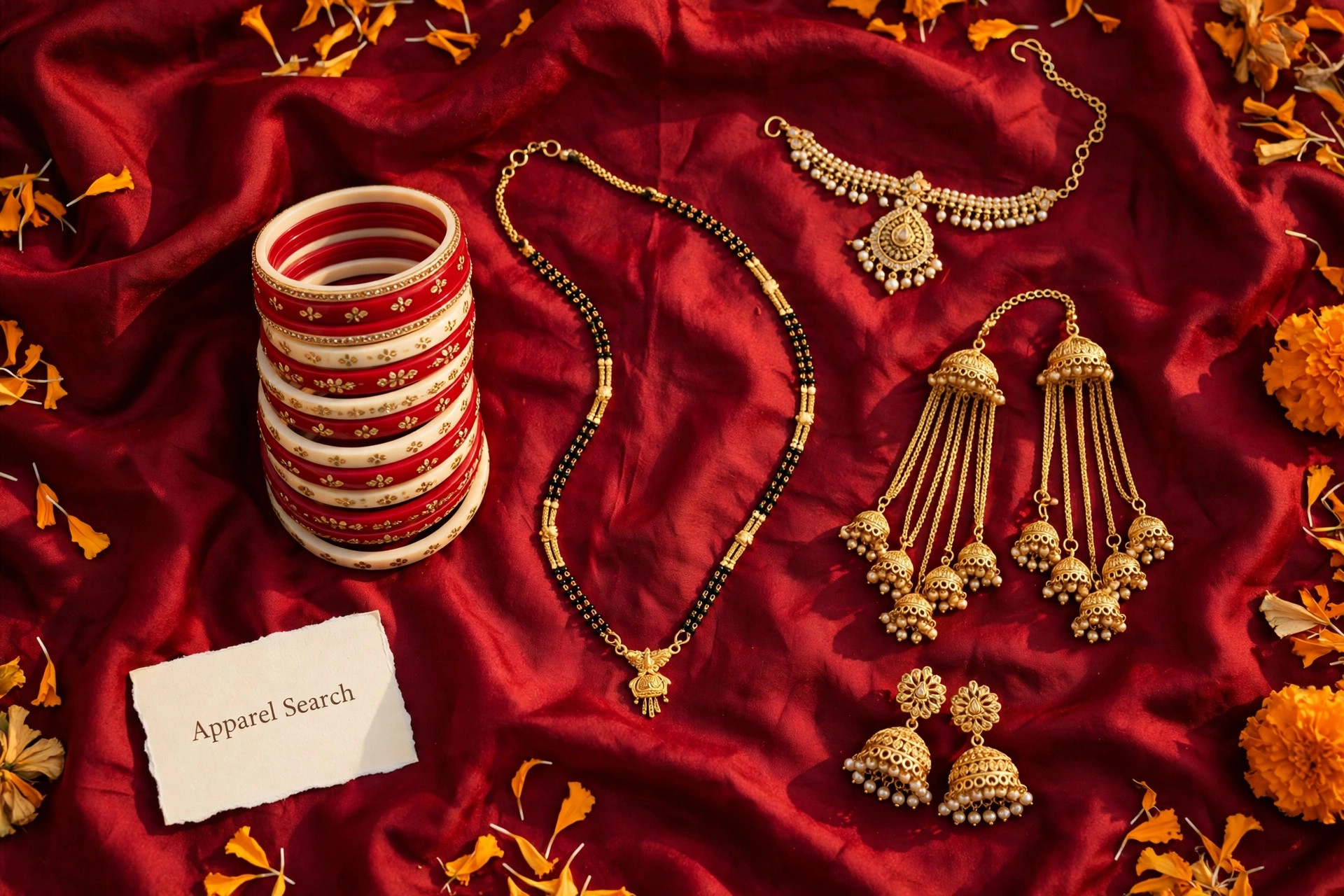
Indian bridal jewelry is not decoration added to the outfit; several of its pieces are the wedding, worn on the body. The full traditional set is counted as the solah shringar — the sixteen adornments, from the bindi and hair ornaments down to toe rings and henna. Three pieces carry the marriage itself:
- Mangalsutra — the necklace that marries
- During the ceremony the groom ties the mangalsutra around the bride's neck, and in many traditions that act — more than any garment — is the moment of marriage. It is a necklace of black beads, believed to protect the couple and ward off ill luck, with a gold pendant whose shape is a regional signature: the thali of Tamil Nadu, the paired cup-shaped vati of Maharashtra, the leaf-shaped ela thali of Kerala. It is traditionally worn every day of married life, and modern brides increasingly choose shorter, finer versions that work with daily dress.
- Chooda — the bangles of the new bride
- In Punjab, the bride's maternal uncle presents her with the chooda: a set of red and ivory bangles, put on in a ceremony of their own on the wedding morning. The chooda announces a new bride at a glance, and tradition asks her to wear it for a period after the wedding — once a year or more; today, often some weeks — before it is ceremonially removed. Bengal's shakha-pola and Maharashtra's green bangles are cousins of the same idea: marriage you can see on the wrist.
- Kaleere — prosperity, dangling
- Tied to the chooda by her sisters and friends, the kaleere are umbrella-shaped gold or silver ornaments that hang in tiers of domes and drops — traditionally worked with coconut, shells and dried fruits, all emblems of prosperity and a well-provided home. When the kaleere are tied, the bride shakes them over the heads of her unmarried friends: the girl a piece falls on, the custom says, is the next to marry.
Around these three gathers the rest of the gold: the maang tikka and matha patti on the forehead, the nath nose ring, jhumka bell earrings, layered necklaces, the kamarbandh at the waist. Much of it is not bought for the day at all — it is family gold, reset, restrung and re-polished, so that a bride may marry wearing her grandmother's necklace under her own new mangalsutra. Our bridal necklaces and wedding bands guides cover the Western jewelry counterpoints.
Acquiring
Buying the Wedding Wardrobe
An Indian wedding wardrobe is bought the way it is worn: as a campaign. Shopping begins months ahead, often timed to the announcement of the auspicious dates, and it is family work — mothers, aunts and sisters negotiating across the great bridal markets and weaving towns, from Delhi's Chandni Chowk to the silk shops of Kanchipuram itself. The ceremony outfit is chosen first and everything else is built around it. The bride's collected wardrobe for her new life, the trousseau, grows alongside the wedding outfits themselves.
The money is real, and it is spread deliberately. A handloom Banarasi sari with real zari commonly runs from about ₹25,000 to well over ₹2,00,000; a headline designer lehenga can cost several times that. Against those numbers, families balance: the heirloom sari re-worn for one function costs nothing and means the most; the haldi outfit is meant to be stained and is bought accordingly; gold jewelry is treated not as spending but as the family's wealth changing form. Rental and pre-loved outfits, once unthinkable for a bride, are quietly growing for receptions and sangeets — the functions where fashion outranks heirloom. And because the wedding dates cluster on a handful of auspicious days, tailors, embroiderers and weavers work to the same calendar the priests do: order late for a peak muhurat date and the whole market is booked.
Today
The Modern Mix
The newest chapter of Indian wedding dress was written, as so much fashion now is, in public. When actor Anushka Sharma married in 2017 in a blush-pink lehenga instead of bridal red, the photograph circled the world — and she is often credited with shifting a generation of brides toward pastels: blush, powder blue, mint, ivory. Priyanka Chopra's 2018 wedding became the emblem of the two-tradition marriage — a red lehenga for the Hindu ceremony, a white gown for the Christian one, each worn at full strength rather than blended into compromise. Alia Bhatt married in 2022 in an ivory handwoven sari rather than a lehenga, and handloom pride — marrying in a named weave, a GI-tagged silk, a mother's re-draped wedding sari — has become a statement in itself.
The fusion runs through the details now: sari-gowns and pre-draped saris that keep the drape's look without the draping; lehengas cut with pockets; grooms in ivory and pastel sherwanis matched to pastel brides; brides changing into sneakers under the lehenga when the sangeet dancing starts. None of it has displaced the structure underneath — the days, the colors, the jewelry that marries. Indian wedding dress is absorbing modern fashion the way it absorbed everything before it: by giving it a function, a day, and a color of its own. If you are attending rather than starring, our Wedding Guest Attire section covers what to wear from the other side — including to weddings exactly like this one.
Common Questions
Common Questions
How many outfits does an Indian bride wear?
Usually at least five — one for each main function: the haldi, the mehndi, the sangeet, the wedding ceremony and the reception — and many brides add an engagement or roka outfit as well. The ceremony outfit is the heaviest and most traditional; the haldi outfit is the simplest, because it is expected to be stained by turmeric. Grooms typically plan three to five outfits across the same days.
Why do Indian brides wear red?
Red is the most auspicious color in Hindu tradition — the color of prosperity, fertility, strength and the goddess, and the color of the sindoor a married woman wears. A red bridal outfit is meant to carry all of that into the marriage. It is a strong tradition rather than a rule: Kerala's brides wear off-white and gold, Maharashtra's often wear yellow or green, and pastel and ivory bridal outfits have become popular in recent years.
What is the difference between a bridal lehenga and a bridal sari?
A lehenga is a stitched three-piece outfit — a long skirt, a fitted blouse (choli) and a scarf-like dupatta — and it is the dominant bridal silhouette across much of northern and western India. A sari is a single unstitched length of cloth draped around the body, and it remains the bridal garment of the south and east, where the great silk saris — Kanchipuram, Banarasi, Paithani — are woven. Many brides wear both: a sari for the ceremony and a lehenga for the reception, or the other way round.
What does an Indian groom wear?
For the ceremony, most often a sherwani — a long, tailored, buttoned coat — worn over a kurta and churidar or pajama trousers, with a safa turban, a stole, and curled-toe mojari shoes. For the smaller functions he wears lighter kurta sets, often with a Nehru jacket, and for the reception many grooms change into a bandhgala, an Indo-western outfit or a suit.
What is a mangalsutra?
The mangalsutra is the necklace a groom ties around the bride's neck during the wedding ceremony — in many traditions the act that seals the marriage. It is strung with black beads, which are believed to protect the couple, and a gold pendant whose form is regional: a thali in Tamil Nadu, cup-shaped vati pendants in Maharashtra, an ela thali leaf in Kerala. Married women traditionally wear it daily.
Keep Exploring
More to Explore
In This Series
Wedding Attire Around the World
The series hub — wedding dress country by country, from China's qun kua to Scotland's tartan, as each guide is published.
Visit the hub ↑India — The Sari
The base garment behind so much of this page: the sari's drapes, silks and zari, explained in the Traditional Dress series.
Read ↑Go Deeper on India
Definition of Sari (Saree)
The short Apparel Search definition of the sari and its key terms.
Read ↑Silk Sari Guide
Silk saris as clothing to buy and wear — the great silk traditions and what to look for.
Read ↑India Clothing Industry
India's apparel, mill and handloom industry directory — the sector behind the wedding silks.
Explore ↑Attending a Wedding?
Search Apparel Search