Wedding Attire Around the World · Vietnam
Wedding Attire in Vietnam
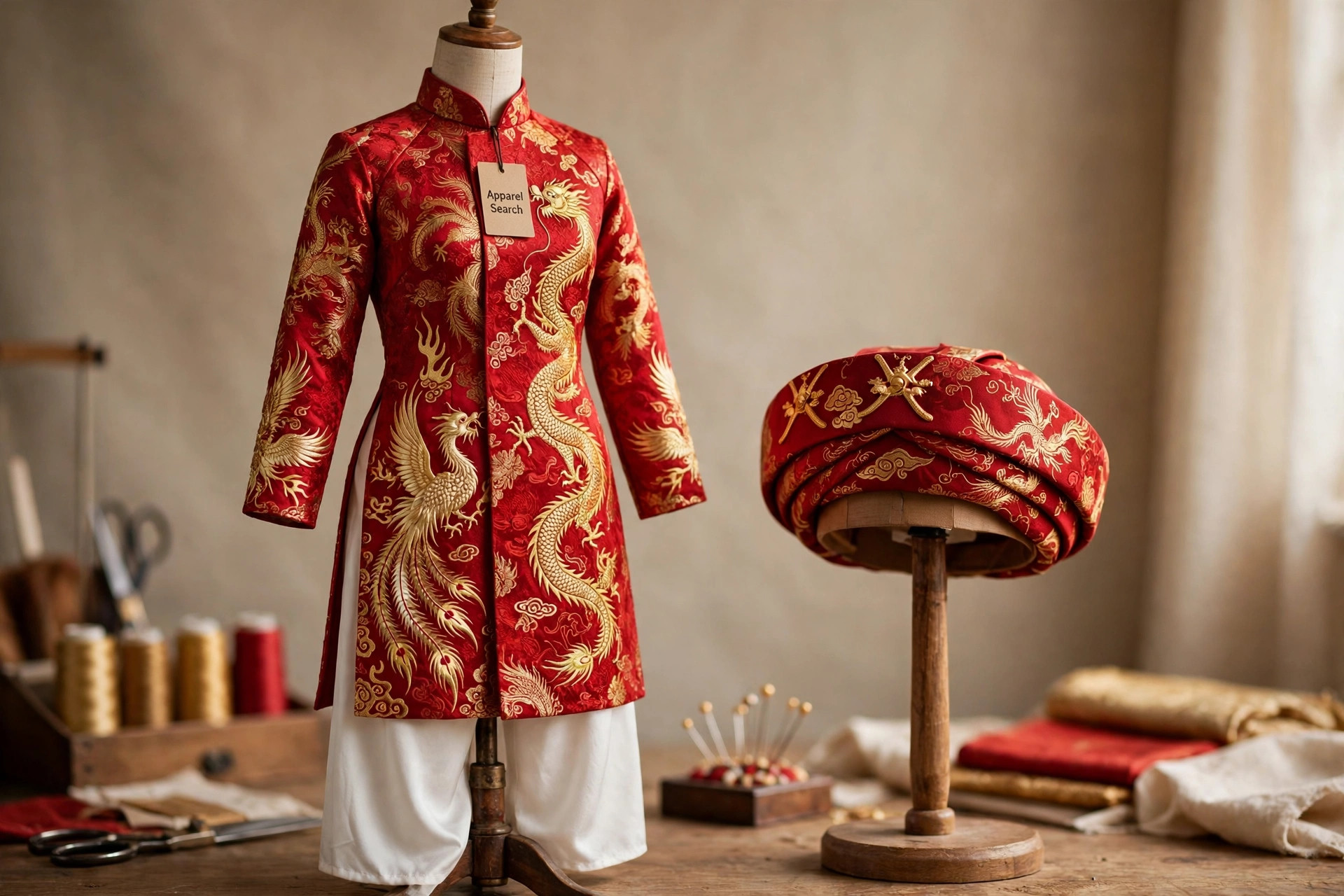
At a Vietnamese wedding, one garment does the marrying: the ao dai, the long tunic worn over silk trousers, raised for the day to its most ceremonial register — red and gold brocade for the bride, a brocade tunic for the groom, and on both heads the circular folded turban called the khan dong. The couple wear it through a wedding that is less a single ceremony than a journey between two houses and two sets of ancestors: the engagement procession of the an hoi, the bride's farewell in the vu quy, incense and tea offered before the family altars. This guide follows the clothes through all of it. For the garment itself, begin with our ao dai of Vietnam guide; this page is about what happens to it at a wedding.
The Shape of It
A Marriage Between Two Houses
A Vietnamese wedding is built on a premise the clothes keep restating: a marriage joins two families, not just two people, and it joins the living to the ancestors who watch over both houses. That is why the traditional wedding is a sequence of journeys and receptions rather than one service — the groom's family processing to the bride's house with gifts, the bride processing to the groom's house as a daughter-in-law, the couple kneeling at altars in both homes. The full traditional program once ran to six ceremonies, from the first proposal visit (le dam ngo) to the bride's return visit to her own family days after the wedding; modern couples compress and combine them, but the dressed core survives almost everywhere: engagement, procession, ancestor rites, tea.
Through every stage, the dress is the ao dai — but not the ao dai of everyday life, and the distinction matters. The wedding ao dai is a separate, ceremonial register of the garment: heavier cloth, brocade instead of plain silk, embroidery with meaning, colors restricted to the auspicious end of the spectrum, and a headdress that no one wears to the office. Vietnam's garment industry, one of the world's great clothing exporters, stands behind the modern trade in these clothes — our Vietnam clothing industry page profiles it — but the wedding ao dai still answers to the altar first and the market second.
Stage by Stage
The Processions, Dressed
An hoi — the engagement procession
The engagement, le an hoi, is a wedding in miniature and the first great dressing of the marriage. The groom's family processes to the bride's house carrying the mam qua — gifts arranged on trays and in boxes covered in red, traditionally lacquered — borne by young attendants in matching dress. The gifts speak in symbols: betel leaves and areca nuts above all, so inseparable from marriage in Vietnamese that the phrase for them is a byword for matrimony itself, plus tea and wine, sticky rice and cakes, fruit in even numbers, sometimes a roast pig — and jewelry and gold for the bride. Both families dress for the occasion in ao dai: the couple in their wedding brocade, parents and elders in their best silk, so that the street outside the bride's house fills with the garment at every level of formality at once.
Vu quy — the bride's procession
On the wedding day the procession reverses and grows. The groom's party returns to the bride's house to ask for her — the vu quy, the bride's farewell from her natal home — and, the rites there complete, escorts her to the groom's house, where his mother receives her as a daughter-in-law (the welcome is sometimes named separately, le tan hon). The bride travels in her full wedding ao dai and khan dong; it is the outfit in which she leaves one family's altar and is presented at another's, and it is photographed accordingly.
Tea, incense and the ancestors
At the heart of both houses' rites stands the altar. The couple light incense and bow before the ancestors, asking their blessing on the marriage; then, kneeling, they serve tea — green tea or chrysanthemum tea — to parents, grandparents and elders, eldest first, in thanks and respect. The elders answer with advice and blessings, and with gifts: red envelopes of money, and traditionally gold jewelry placed on the bride — necklaces, bracelets, earrings — given at the ceremony itself, in front of the family, as both blessing and foundation: gold that is hers, wearable wealth carried into the new household. Rings may be exchanged here too, unless they are saved for a church or Western-style ceremony later in the day.
The Bride
Red and Gold Brocade, and the Khan Dong
The bridal ao dai keeps the garment's famous silhouette — a long, close-fitted tunic with a high mandarin collar, slit from the waist so its two panels fall front and back over loose silk trousers — and changes everything else. The cloth is brocade (gam), silk with its pattern woven in rather than printed on, heavier and stiffer than everyday silk, holding the tunic's architectural line. The color is red, the great auspicious color of Vietnamese celebration — happiness, luck, prosperity — worked with gold: gold thread in the weave, gold embroidery over it, beads and sequins where a modern bride wants more light. The motifs are the wedding's heraldry. The phoenix is the bride's emblem, grace and virtue in bird form; the dragon answers it for the groom, and the pair together — dragon and phoenix in harmony — is the classic image of a balanced marriage, repeated on invitations, decorations and the couple's clothes. Peonies, lotus and clouds fill the ground between them.
On her head the bride wears the khan dong: a headdress built from a long strip of fabric folded and wound into a neat circular turban — flat-topped, halo-like from the front — made for a wedding in brocade matching or answering her tunic, red and gold for a bride. (The same headdress is also called khan van or khan xep in some sources and regions; most couples today wear the convenient pre-formed version rather than winding meters of cloth on the morning of the wedding.) The effect, with the high collar and the long tunic, is formal in a way the everyday ao dai never attempts: this is the ao dai as court dress, and historically that is exactly what it descends from — the elaborate formal tunics standardized under the Nguyen dynasty, whose court at Hue set the pattern Vietnamese weddings still follow. Under the tunic she wears silk trousers, traditionally white or a pale contrast, and her jewelry — the gold given at the ceremony — goes on over the brocade as the day proceeds, so the bride quite literally accumulates her family's blessings as she moves from house to house.
The register has an older, grander layer that the most traditional weddings still recall. Under the Nguyen court, the standard wedding dress was the ao tac, an ancient formal ao dai with long, wide sleeves — court dress in the full sense, worn over the trousers with the headdress — and Hue families in particular keep its memory in wide-sleeved ceremonial tunics and in the royal ao nhat binh worn for the most formal portraits. A bride may also change ao dai between the day's stages: one for the engagement, the fullest red-and-gold brocade for the wedding processions, and sometimes a lighter, more fashionable ao dai — pink, pastel, even white — worn at the reception before, or instead of, the Western gown. The garment's genius is that all of these are recognizably the same dress, pitched at different levels of ceremony.
The Groom
The Groom's Ao Dai Gam
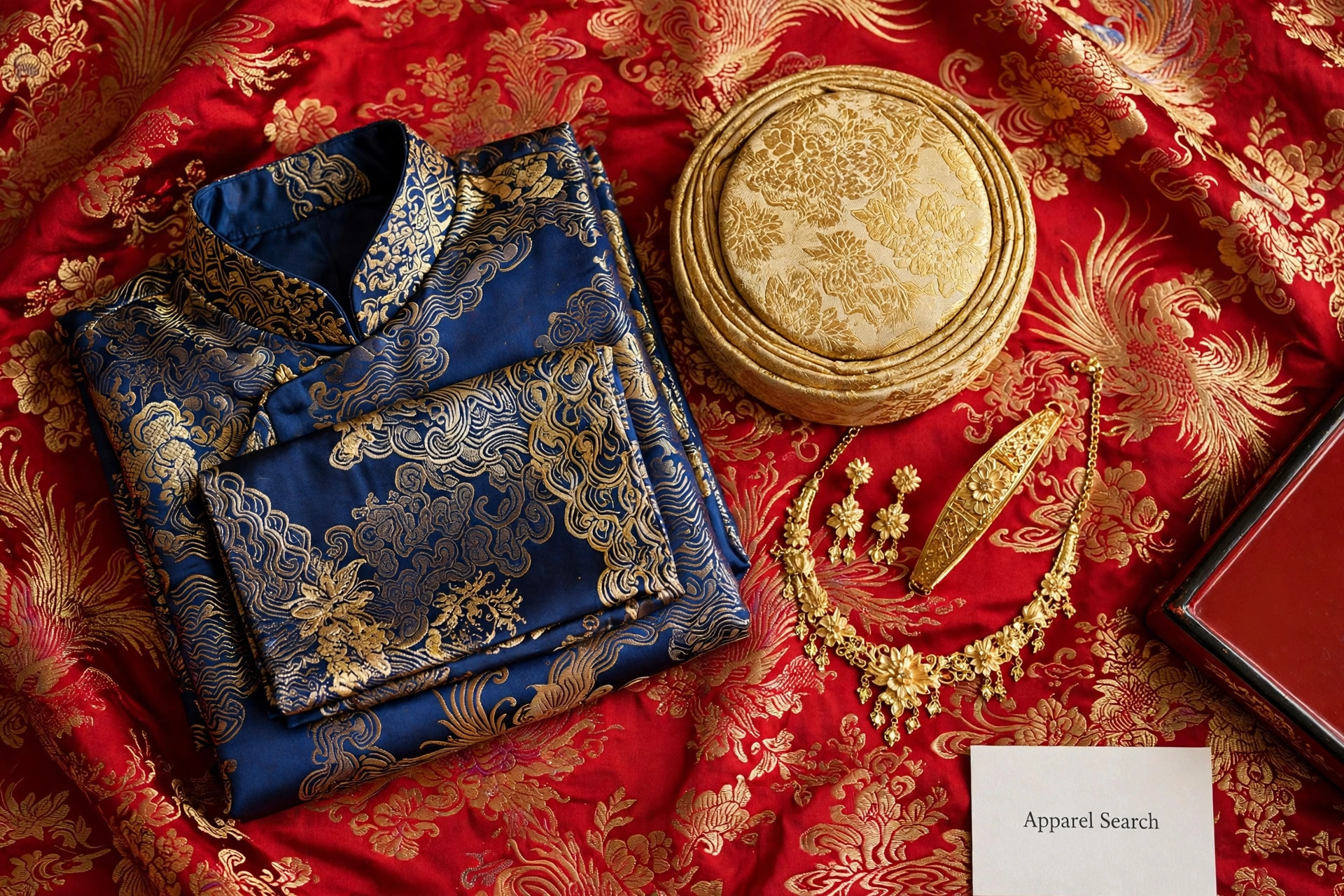
The groom wears an ao dai too — and at a traditional wedding, his is not a lesser copy of hers but the masculine form of the same garment, with its own name and rules. The men's ao dai (ao dai nam) is straighter and looser than the women's, its collar a touch lower, its sleeves fuller, falling below the knee over wide trousers. For a wedding it is made as an ao dai gam — the brocade version, reserved for grand occasions — in silk brocade with woven or embroidered dragons and stylized clouds. His traditional color is most often blue, read as strength, honesty, peace and hope against the bride's red; red and gold grooms are also common, especially where the couple chooses to match. With it he wears his own khan dong, smaller and simpler than the bride's, in brocade matching his tunic.
The pairing is deliberate heraldry: phoenix and dragon, red and blue, her house and his. For the reception, or for a church ceremony — many Vietnamese couples are Catholic, and a Mass may sit alongside the traditional rites in the same day's program — the groom commonly changes into a Western suit, just as the bride changes into a white gown, keeping the ao dai for the rites it belongs to. His family dresses to support the procession: fathers and elders in dark ao dai or suits, the attendants who carry the mam qua in matched ao dai of their own.
Regions
North, Center, South
Vietnam's three regions share the wedding ao dai but keep their own accents, and a careful eye can read a bride's home region in her clothes. The differences below are tendencies reported by designers and tradition-keepers, not rules — modern tailoring has blurred them — but they are the ones Vietnamese families themselves name.
| Region | The wedding accent | Notes |
|---|---|---|
| The North (Hanoi) | The most conservative register: classic cuts, deeper and more subdued tones under the bridal red | The north is the old home of the four-panel ao tu than, still remembered in folk dress; northern weddings are often described as the most formal in sequence and dress |
| The Center (Hue) | Imperial richness: deep colors, violet and royal purple in the wider wedding party, intricate pattern | Hue was the Nguyen dynasty's capital, and its court set the formal wedding dress the whole country inherited; the royal ao nhat binh, with its wide rectangular collar, survives in ceremonial wear |
| The South (Saigon) | The freest register: brighter color, more fashion-forward cuts, readier mixing with Western dress | Southern weddings lean into the modern pattern — ao dai for the rites, white gown and suit for a large hotel reception — with the country's deepest bench of bridal tailors and rental shops |
What does not vary is the grammar underneath: brocade for the couple, red and gold at the center, incense at the altar, tea for the elders, and gold for the bride. Region changes the accent; it does not change the sentence.
Acquiring
Tailored, Rented, Kept
The wedding ao dai is one of the more attainable great wedding garments, because Vietnam tailors it everywhere. In Ho Chi Minh City (Saigon) and Hanoi, bridal ao dai are both rented — by the day, from shops that stock the full wedding register, khan dong included — and made to measure, the route most brides who want to keep theirs take: choose the brocade, be fitted for the tunic's exact line, and collect a garment that can be re-worn at Tet, at family weddings and at the couple's own anniversaries. The groom's ao dai gam is rented and tailored the same way, and shops dress whole processions, attendants included. A mother's and grandmother's silk ao dai for the day are often already in the family wardrobe — the wedding is one of the occasions the garment is kept for.
The gold follows the opposite logic: it is not rented, borrowed or returned. The necklaces, bracelets and earrings presented to the bride at the tea ceremony are gifts outright, part of the marriage settlement in its oldest, most portable form, and Vietnamese families treat the giving as a ceremony moment in itself — an elder fastening a necklace over the bride's brocade while the family watches. Between the rented headdress and the given gold, a Vietnamese wedding dresses its bride in both halves of the wedding economy at once: what is hired for the day, and what is hers for life.
Today
The Modern Mix
The standard modern Vietnamese wedding is a two-wardrobe day, and couples plan it that way from the first fitting. The ao dai — his and hers, with khan dong — is worn for the traditional rites: the processions, the altars, the tea. Then, for the reception, and for a church ceremony where there is one, the couple change: the bride into a white Western gown, the groom into a suit. Neither wardrobe is a compromise of the other; each is worn at full strength for its own part of the day, and the photographs keep both. Modern bridal ao dai design plays inside the tradition — lighter brocades, pastel and even white ao dai for some receptions, embroidery placed by fashion rather than heraldry — while the red-and-gold ceremonial set remains the default for the rites themselves.
The rites, notably, have held. Processions still close streets, betel and areca still head the gift trays, and elders still fasten gold over brocade. If you are attending a Vietnamese wedding rather than processing in one, our advice for wedding guests covers what to wear from the seats — where a guest ao dai, respectfully worn, is often welcomed.
Common Questions
Common Questions
What does a Vietnamese bride wear?
A wedding ao dai: the long, high-collared tunic worn over silk trousers, made for the day in red brocade with gold — the pattern woven into the cloth and often embroidered over it with phoenix, dragon, peony and lotus motifs. On her head she wears the khan dong, a circular folded turban headdress in matching brocade. She wears the ao dai for the traditional rites and often changes into a white Western gown for the reception.
What is the khan dong?
The khan dong is the traditional Vietnamese ceremonial headdress: a long strip of fabric folded and wound into a neat, flat-topped circular turban. Both bride and groom wear one at a traditional wedding — the bride's larger and more elaborate, in red and gold brocade matching her ao dai; the groom's smaller, matching his tunic. Most couples today wear a pre-formed version rather than winding the cloth by hand.
What happens at the an hoi and the vu quy?
The an hoi is the engagement ceremony: the groom's family processes to the bride's house with gifts on red-covered trays called mam qua — betel leaves and areca nuts, tea, wine, cakes, fruit, and jewelry and gold — and formally asks for the bride. The vu quy is the wedding-day procession in which the groom's party fetches the bride from her home and escorts her to the groom's house, where she is received as a daughter-in-law. Both families wear ao dai, and both houses hold rites at their ancestral altars.
Why is gold given to the bride at a Vietnamese wedding?
Gold jewelry — necklaces, bracelets, earrings — is traditionally presented to the bride by the families during the ceremony itself, often fastened on her by an elder as the family watches. It is at once a blessing, a display of the families' goodwill, and portable wealth that is personally hers: a foundation for the new household that she carries into it on her own person.
What does a Vietnamese groom wear?
An ao dai of his own: the men's version is straighter and looser than the bride's, and for a wedding it is made in brocade — an ao dai gam — most often in blue, for strength, honesty and hope, or in red and gold to match the bride, with dragon and cloud motifs and his own smaller khan dong headdress. For the reception or a church ceremony he commonly changes into a Western suit.
Keep Exploring
More to Explore
In This Series
Wedding Attire Around the World
The series hub — wedding dress country by country, from China's qun kua to Scotland's tartan, as each guide is published.
Visit the hub ↑Vietnam — The Ao Dai
The base garment behind this page: the ao dai's cut, fabrics and everyday life, explained in the Traditional Dress series.
Read ↑Go Deeper on Vietnam
Vietnam Clothing Industry
Vietnam's apparel and garment industry directory — the sector behind the country's tailoring and bridal trades.
Explore ↑Ao Dai Guide
The ao dai as clothing to buy and wear — fabrics, fit and what to look for.
Read ↑Attending a Wedding?
Search Apparel Search