Wedding Attire Around the World · China
Wedding Attire in China
A Chinese bride may change outfits three or four times in a day, and each change means something: the red qun kua, dense with gold dragons and phoenixes, for the tea ceremony; white for the ceremony; a qipao for the banquet toasts. This guide explains the kwa and how it differs from the qipao, the groom’s black magua, and the gold given at the tea table. For the qipao as a garment in its own right, begin with our qipao and hanfu of China guide; this page is about the wedding wardrobe built around the kwa.
The Shape of It
A Wedding Counted in Outfits
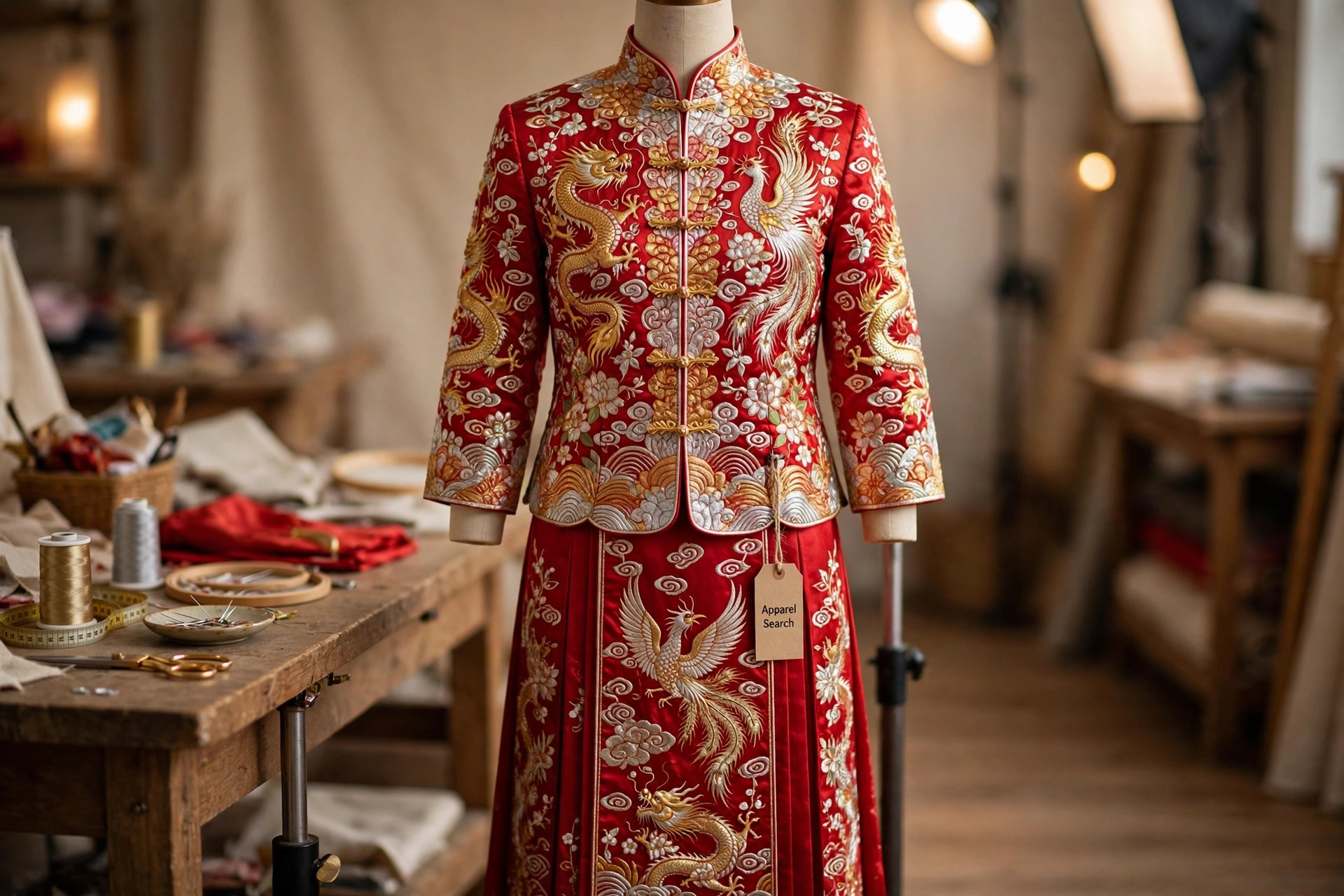
A Chinese wedding is a joining of two families before it is a party for two people, and its clothing tells that story in changes. The modern Chinese bride may wear three, four or more outfits in a single day — a white Western gown, a red traditional dress, an evening gown for the toasts — and the changes are not indecision: each garment has its ceremony, and counting the outfits is part of the celebration. At the centre of the traditional wardrobe stands one garment that belongs to the wedding alone: the qun kua, the two-piece Cantonese bridal dress in red silk covered with dragons and phoenixes in gold and silver thread.
It is worth stating plainly, because the two are constantly confused: the qun kua is not the qipao. The qipao — the cheongsam — is the one-piece, close-fitting dress with a stand collar that took its modern shape in 1920s Shanghai, and it has its own bridal life, covered in the modern section below. The kwa is older in form and different in every particular: a separate jacket and skirt, worn loose and straight, made only for brides, and embroidered so densely that on the finest examples the red silk beneath all but disappears. Our qipao and hanfu guide tells the qipao's own story; this page is about the kwa and the wedding built around it. The industry that embroiders, rents and sells these garments is profiled on our China clothing industry directory page.
The Day, in Order
Combing, Door Games, Tea
Hair-combing — the night before
The wedding begins quietly, the night before, in the couple's separate homes. In the hair-combing ceremony — shang tou, traditionally a Cantonese custom now widely practised — a woman of good fortune, happily married with children and grandchildren, combs the bride's hair four times, reciting a blessing with each pass of the comb: for a lasting union, a harmonious union, many descendants, prosperity and longevity. The bride has bathed, often with pomelo leaves to cleanse away ill luck, and changed into new red clothes and slippers. It is the threshold between girlhood and marriage, marked not with a garment bought for display but with a comb, candles, incense and red yarn with cypress leaves tucked into the hair.
Door games — the morning
On the wedding morning the groom comes to fetch his bride — and her bridesmaids bar the way. The door games, chuangmen, test his determination with challenges set by the bride's sisters and friends: songs sung, dances performed, strange concoctions eaten to stand for the sour, sweet, bitter and spicy of married life, red envelopes of money negotiated under the door. The groom dresses for comedy as much as ceremony here — many wear a Western suit for the games, some a traditional outfit, all expect to be photographed mid-ordeal. Only when the sisters are satisfied does the door open.
The tea ceremony — the heart of it
The tea ceremony is the soul of the Chinese wedding. The couple kneel before parents and elders and serve tea with both hands — an act of gratitude for their upbringing and the formal moment each is received into the other's family. The bride serves in the qun kua: the garment was made for exactly this kneeling, bending and offering, its straight jacket and skirt keeping their embroidered order through every cup. Elders sip, bless the couple, and answer with red envelopes and gold jewelry — the bangles and necklaces of the jewelry section below are very often put on the bride, piece by piece, at this table.
The Bride
The Qun Kua: Dragon and Phoenix
The qun kua — also written qun kwa, and called longfeng gua, dragon-and-phoenix kwa, when the great pair covers it — is a two-piece dress: a jacket (gua) with a stand collar and frog closures, and a straight skirt (qun), both in red silk. Its embroidery, worked in couched gold and silver thread, is graded by coverage, and Cantonese workshops have a ladder of grades for it: from lighter coverage, where the red silk breathes between the motifs, up through ever denser work to the highest grades — often called kwa queen at the top — where gold covers nearly everything and the jacket can stand stiff with thread. A bride chooses her grade as earlier generations chose the weight of a sari's zari: it is the wedding's splendour, made measurable.
The motifs are a language the older generation reads at a glance:
| Motif | Meaning | Where it appears |
|---|---|---|
| Dragon and phoenix | The groom and the bride; strength with grace; a balanced marriage | The governing pair across jacket and skirt, meeting at the front opening |
| Peony | Prosperity, honour and feminine beauty | Among the clouds and waves of the ground pattern |
| Pomegranate and bats | Many sons and descendants; bats for blessings — the word puns on good fortune | Scattered through the embroidery as smaller emblems |
| Double Happiness | Doubled joy for the couple | On the kwa, the candles, the invitations — everywhere at the wedding |
Above the kwa, the most formal brides wear the fengguan, the phoenix crown: an elaborate headdress of gilded filigree phoenixes, pearls and beads, descended from the court headdress that Ming and Qing brides were permitted — for this one day — to wear in imitation of nobility. A full crown is heavy, and modern brides often wear it for the ceremony and portraits and exchange it for a lighter phoenix hairpiece for the banquet. Embroidered red shoes, worked to match the kwa, complete the traditional dress.
Alongside the kwa stands a younger cousin often seen beside it in shop windows: the xiuhefu, a two-piece set with a straighter jacket and colourful floral embroidery rather than all-over gold. It owes much of its modern fame to period television drama, and honest shops present it as such — a garment inspired by older forms rather than a fixed ancient costume. Many brides choose it as a second traditional outfit, lighter than a high-grade kwa for the morning's photographs, and keep the true dragon-and-phoenix kwa for the tea ceremony itself. The distinction matters to the families reading the embroidery: the kwa's gold pair is a claim about lineage, and the xiuhefu makes no such claim. Knowing which is which — jacket cut, motif and thread — is the first skill of kwa shopping, and the reason the rental racks label their grades so carefully.
The Groom
Magua Over Changshan
The groom's traditional dress is the kwa's dark foil: a long robe, the changshan, in a deep, sober colour, worn under a short jacket, the magua, most classically in black. Where the bride is red and gold and covered in emblems, the groom is restraint itself — the magua's frog-buttoned front and mandarin collar carry little or no embroidery, and the colour does the ceremonial work. A red sash or a large red silk flower pinned at the chest is his one blaze of the wedding colour, matching the bride's red without competing with her gold. Many modern grooms split the day: a suit for the door games and the Western ceremony, the magua and changshan for the tea ceremony and the family photographs, where the pairing of black robe and red kwa is the portrait both families expect. At the banquet he is usually in a suit or tuxedo, answering the bride's final gown.
Jewelry
Gold, Given at the Tea Table
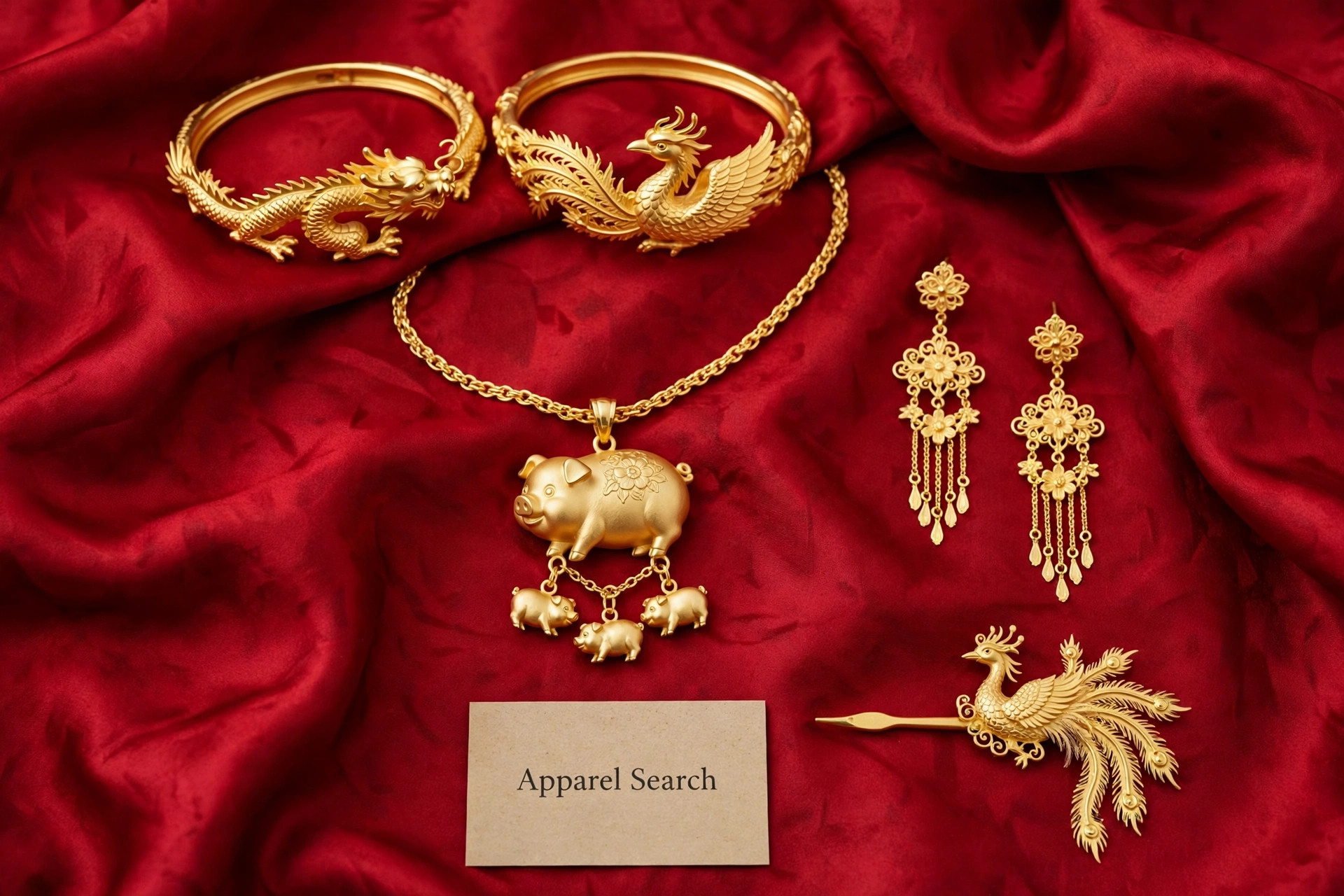
Chinese bridal gold is not chosen to match an outfit; it is given, by the groom's parents and the elders, at the betrothal and the tea ceremony, and it is worn immediately, over the kwa, as fast as it is received. Three gifts define it:
- Dragon-and-phoenix bangles
- Heavy gold bangles worked with the dragon and the phoenix, given and worn in pairs — one for each wrist, the couple's emblems divided between them. For Cantonese families this pair is the essential bridal gold; a bride may end the tea ceremony wearing several pairs, stacked, as each set of elders presents its own.
- The gold pig necklace
- The Cantonese necklace of a gold sow with piglets dangling beneath her — pigs standing for fertility and abundance, the wish for many children made cheerful and literal. It is worn over the kwa for the tea ceremony photographs, however it sits with the embroidery, because its meaning is its beauty.
- The wider gold set
- Rings, earrings and further necklaces accumulate from both families — Teochew tradition formalises a set of four gold pieces, si dian jin — together with the red envelopes given at the same table. The gold is pure, soft and yellow, valued as the family's wealth placed visibly on the bride: blessing, dowry and security in one. Weight is part of the message — the bangles are meant to be felt on the wrist and heard as the bride moves between the tea tables — and families keep presentation boxes and receipts with the same care as the pieces themselves, because bridal gold is also a reserve, held against the new household's future.
Our bridal necklaces guide covers the Western counterpoint; nothing in it is worn quite like a pig necklace over a dragon-covered jacket, to general delight.
Acquiring
Renting the Heirloom
The finest kwa are heirloom objects — months of hand embroidery in metallic thread — and the culture has organised itself around that fact: heirloom-grade kwa are rented. Bridal shops in Hong Kong and Guangzhou, the Cantonese heartlands of the garment, keep racks of kwa graded by embroidery coverage, and a bride rents her grade for the wedding days as a Western bride might rent nothing at all. Rental is no compromise here; it is how the best pieces circulate, each returning to the shop to dress another family's tea ceremony. Shops commonly price rental by the kwa's history as well as its grade.
Alongside rental runs the family kwa: a mother's or aunt's dress, kept and re-worn, its meaning outweighing any grade. New kwa are also commissioned and bought — in Guangzhou's bridal districts and Hong Kong's wedding streets, and increasingly online — at every level from printed imitation embroidery to fully hand-worked pieces that take their place in the rental racks and family boxes of the next generation. The qipao for the banquet, by contrast, is usually bought or tailored: it is a dress a woman may wear again, and Shanghai and Hong Kong tailors still cut it to measure.
Today
The Modern Order of the Day
The contemporary Chinese wedding runs its outfits like a programme, and a common order of the day now looks like this: the kwa for the morning — door games, the fetch, the tea ceremony; a Western white gown for the ceremony itself, whether in a chapel, a hotel garden or a registry; and for the banquet, a change into a qipao or cheongsam — the fitted one-piece dress, often in red — or a red evening gown, in which the bride toasts every table with the groom. Some brides add a fourth change, a light gown for the send-off. The outfit changes are counted proudly, announced by the emcee and applauded like entrances, because each one honours a different part of the inheritance: the kwa for the ancestors and the elders, the white gown for the couple's own modern story, the qipao for the feast. None of the three has displaced the others; the skill of the modern Chinese wedding is sequencing them. If you are attending one, our advice for wedding guests covers the guest's side of the dress code — beginning with leaving bright bridal red to the bride.
Common Questions
Common Questions
What is a qun kua?
The qun kua is the traditional Cantonese bridal dress: a two-piece outfit of a jacket (gua) and a skirt (qun) in red silk, densely embroidered with dragons and phoenixes in gold and silver thread. It is worn above all for the tea ceremony, and its embroidery is graded by coverage — the densest, highest grades are so covered in gold thread that the red silk barely shows.
What is the difference between a qun kua and a qipao?
They are different garments. The qun kua is a loose, straight, two-piece jacket and skirt made only for brides and covered in dragon-and-phoenix embroidery. The qipao, or cheongsam, is a one-piece, close-fitting dress with a stand collar that took its modern shape in 1920s Shanghai. Many brides wear both on the day: the kwa for the tea ceremony and a qipao for the banquet.
What happens at a Chinese tea ceremony?
The couple kneel before their parents and elders and serve them tea with both hands, as a gesture of gratitude and respect. It is the formal moment each partner is received into the other's family. The bride usually wears the qun kua, and the elders answer the tea with blessings, red envelopes and gifts of gold jewelry, such as dragon-and-phoenix bangles.
What does a Chinese groom wear?
Traditionally, a black magua jacket over a long, dark changshan robe, with a red sash or a large red silk flower as his one blaze of wedding colour. Many modern grooms split the day — a Western suit for the door games and ceremony, the magua and changshan for the tea ceremony and family photographs, and a suit or tuxedo for the banquet.
Why do Chinese brides change outfits so many times?
Each outfit belongs to a different part of the day. A common modern order is the qun kua for the tea ceremony, a Western white gown for the ceremony, and a qipao or red gown for the banquet toasts — sometimes with a fourth change for the send-off. The changes are counted proudly: each garment honours a different strand of the wedding, from the elders and ancestors to the couple's own celebration.
Keep Exploring
More to Explore
In This Series
Wedding Attire Around the World
The series hub — wedding dress country by country, from China's qun kua to Scotland's tartan, as each guide is published.
Visit the hub ↑China — Qipao & Hanfu
The base garments behind this page: the qipao’s Shanghai tailoring and the older hanfu tradition, in the Traditional Dress series.
Read ↑Go Deeper on China
China Clothing Industry
China’s apparel and textile industry directory — the sector behind the embroidery workshops of Guangdong.
Explore ↑Definition of Qipao
The short Apparel Search definition of the qipao — the one-piece dress the kwa is so often confused with.
Read ↑Wedding Bands
Wedding bands and rings — the exchange that modern Chinese ceremonies have added to the tea and gold.
Read ↑Attending a Wedding?
Search Apparel Search