Wedding Attire Around the World · Indonesia
Wedding Attire in Indonesia
Indonesia is an archipelago of thousands of islands and hundreds of ethnic groups, and it has no single bridal look — it has dozens, each governed by its own adat, its customary law of dress. A Javanese bride marries in black velvet and gold with her forehead painted in the paes pattern; her Sundanese neighbor in a white kebaya under a gold crown; a Balinese couple in the gilded splendor of payas agung; a Minangkabau bride beneath a suntiang headdress that rises like a sunrise. This guide tours the great regional wardrobes one by one — what the bride wears, what the groom wears, and how a Muslim-majority nation dresses them both today. For the base garments, begin with our kebaya of Indonesia guide; this page is about what happens to them at a wedding.
The Shape of It
One Country, Many Brides
Every Indonesian wedding answers two authorities at once: religion, which solemnizes the marriage, and adat — the inherited custom of the couple's own people — which dresses it. The religious core is often brief: for the Muslim majority, the akad nikah, the marriage contract, spoken before an officiant and witnesses. Around that core, adat builds the visible wedding: processions, ritual bathing (siraman), the eve-of-wedding vigil (midodareni in Java), the ceremonial meeting of bride and groom (panggih), kneeling for parents' blessing (sungkeman) — and at every stage, prescribed dress that can change between the contract and the reception. A couple may marry in white at the akad in the morning and receive their guests in the full regalia of their region by evening.
Three textiles recur across the archipelago's wardrobes. The kebaya, the fitted lace or embroidered blouse, is the bride's garment from Java to Bali and beyond. Batik — wax-resist cloth, its motifs carrying wishes in pattern — wraps the waist as kain or jarik in Java; our batik definition explains the technique. And songket, cloth woven with gold and silver thread, is the splendor fabric of Sumatra and Bali. Behind the clothes stands a professional world of bridal studios that supplies all of it at once — the subject of the buying section below — and a national garment industry our Indonesia clothing industry page profiles. The tour that follows takes the four wedding wardrobes the rest of the world knows best, in the order a map suggests: Java's two great styles first, then Bali, then Sumatra.
The Regional Tour
Four Wardrobes at a Glance
| Region | The bride | The signature | The groom |
|---|---|---|---|
| Javanese (Central/East Java) | Black velvet kebaya beludru with gold embroidery over batik kain | Paes — the black-and-gold forehead painting — with sanggul bun, jasmine ronce and cunduk mentul pins | Beskap jacket, blangkon headcloth, batik kain, keris at the back |
| Sundanese (West Java) | White kebaya with batik kain | The siger — a gold crown — with jasmine strands | Matching jacket and blangkon-style headcloth, keris |
| Balinese | Payas agung: songket, layered gold jewelry, structured waist | A tall gold headdress with frangipani — the gelungan crown | Matching songket and gold headpiece; the couple crowned as a pair |
| Minangkabau (West Sumatra) | Richly embroidered tunic with red-and-gold songket | The suntiang — a tall, radiant, multi-tiered gold headdress | Teluk belanga-style shirt, saluak folded headcloth, songket and ornate belt |
Each of these is a complete system — garment, headdress, jewelry, cloth — with its own specialists, and each is explored below. Dozens more exist beyond this tour: the Batak couple draped in handwoven ulos, the Bugis bride in a silk baju bodo with gold pins, the Lampung siger over gold-threaded tapis cloth. An Indonesian wedding guide could run to a book; what follows are the four wardrobes that define the country's image of a bride.
Java — The Bride
Velvet, Gold and the Painted Forehead
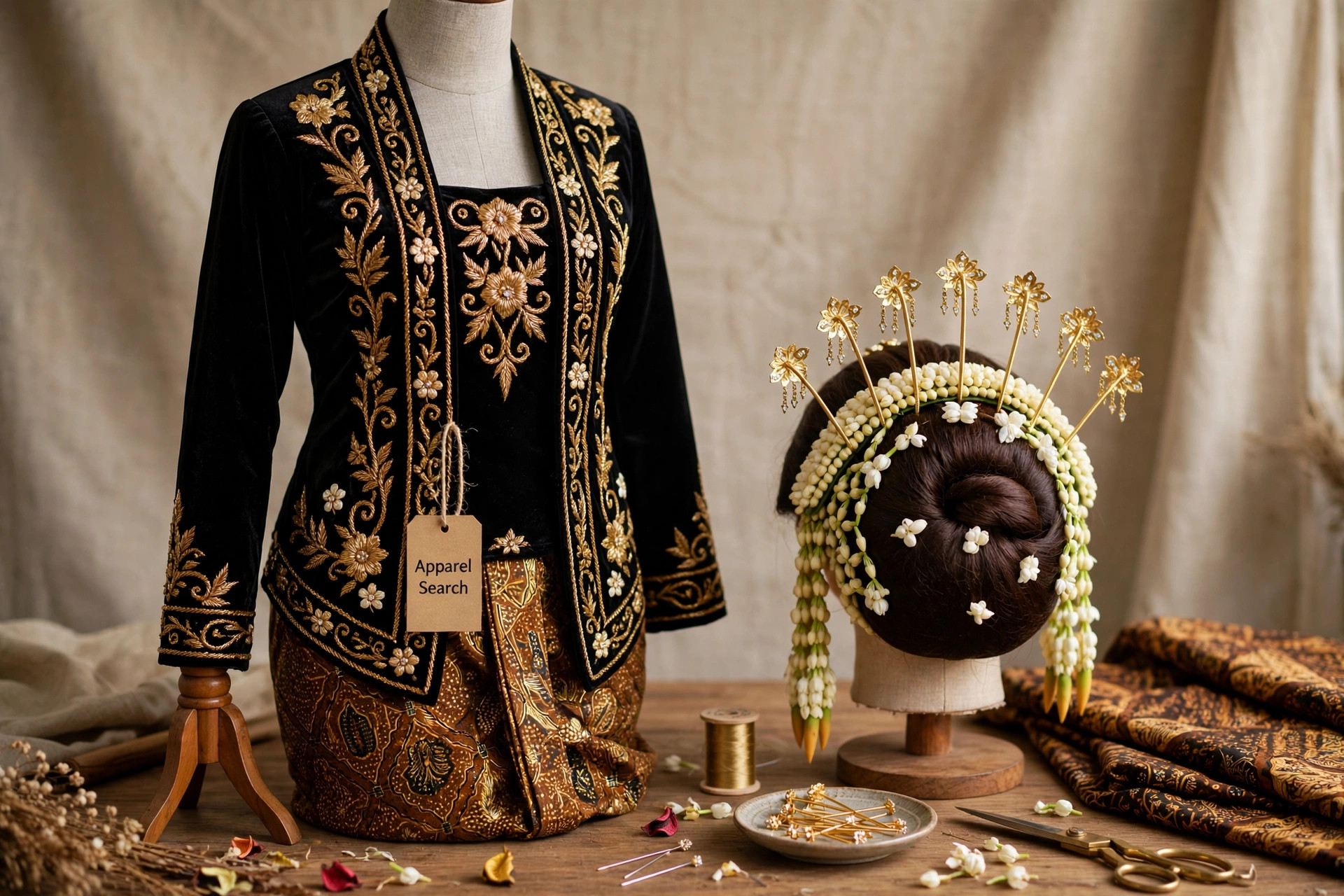
The grand Javanese bridal look comes from the royal courts of Yogyakarta and Surakarta (Solo), and its centerpiece is the kebaya beludru: a fitted kebaya of black velvet, embroidered — often heavily — in gold thread, worn over a wrapped batik kain whose motif is chosen for the day. Black and gold is the court's own pairing: darkness as depth and dignity, gold as glory. In the most traditional court form, the basahan dress, bride and groom are wrapped instead in a long ceremonial cloth, the dodot, for the panggih meeting rite — the dodot ageng of the Mangkunegaran court in Solo, in indigo bangun tulak patterning, is the famous example — but for most modern couples the velvet kebaya and beskap carry the court's look in tailored form.
What makes a Javanese bride unmistakable, though, is above the neckline. The paes is a design painted onto the forehead and hairline in black (greenish-black in Solo's basahan style), its edge shaped in a set of named curves — in the Solo Putri style, the gajahan, pengapit, penitis and godheg, each carrying a meaning: wisdom, carefulness, steadfastness, a prayer for children. The grand Yogyakarta form, paes ageng, was once reserved for palace royalty; its painted outline — the pattern template is the cengkorongan — is now the ambition of Javanese brides generally, applied by a specialist paes artist whose hand is booked as carefully as the venue. The hair is drawn into a sanggul, a formal bun (the bokor mengkurep, shaped like an upturned bowl, in Yogyakarta style), pierced with cunduk mentul — trembling gold pins, traditionally five or seven or nine, the odd numbers themselves meaningful — and hung with ronce melati, long strands of strung jasmine buds whose fragrance and whiteness stand for purity. Gold jewelry, brooches at the kebaya's front, and the jasmine together finish a look that is meant to transform: the Javanese word for the bride's hoped-for radiance is manglingi — so beautiful she is almost unrecognizable.
The groom: beskap, blangkon, keris
The Javanese groom answers in the same black-and-gold register. He wears the beskap, a tailored, high-collared jacket — velvet with gold embroidery to match his bride, or white for the akad — over a batik kain that matches or answers hers, and on his head the blangkon, a batik headcloth tied in the region's prescribed form (Yogyakarta and Solo blangkon differ at the back, and Javanese men notice). At the small of his back, thrust through the kain, goes the keris: the wavy-bladed dagger that is Java's emblem of manhood, heirloom and guardian at once, its hilt and sheath dressed for the day and a jasmine strand often hung upon it. Jasmine garlands for the groom complete the pairing — the same flower, worn by both.
Dressed more than once: siraman to panggih
A full Javanese wedding dresses the bride in sequence, like India's and Korea's. The day before, at the siraman — the ritual bathing in which elders pour flower water over her — she wears a simple batik cloth, dress deliberately humble before the transformation. That night, at midodareni, the vigil of prayer and family blessing, she is kept in modest dress, traditionally not yet seen in her glory. The glory is saved for the wedding day itself: white for the akad nikah if the couple solemnize in Javanese dress, then the velvet-and-gold regalia for the panggih, the couple's ceremonial first meeting as husband and wife — the rite for which the court's basahan dodot dress was made — and for the reception that follows. Each change is a threshold, and the paes, painted once, presides over all of them.
Sunda, Bali, Sumatra
The Crown, the Gold, the Sunrise
Sundanese — white kebaya and the siger
West Java's Sundanese bride is Java's answer in a lighter key: a white kebaya — lace or embroidered, often with crystal beading — over a batik kain, and above it the siger, a triangular gold crown that is the region's signature, read as a sign of wisdom and virtue. The siger is pinned into a prepared bun and balanced with care — it must survive bows — and is finished with trembling flower pins (kembang goyang) and the same long jasmine strands Java wears. The whole effect is deliberately serene below the crown: the siger is the statement, and everything else is its frame. (Lampung, at Sumatra's tip, wears a taller, many-pointed siger of its own over gold-embroidered tapis — the crown idea, carried further.)
Balinese — payas agung
Bali dresses its couples as royalty and divinity at once. Payas agung, the grand dress, builds the bride from songket woven with gold, a fitted upper garment and structured waist, layered gold jewelry, an ornate belt — and a tall ceremonial headdress, the gold-leaf gelungan crown, towering with frangipani flowers. The groom is crowned and dressed to match, in songket and gold of his own: in Bali the couple are presented as a pair, king and queen for the day, in a Hindu wedding world of offerings, family-temple processions and purification rites that the dress's splendor is designed to honor. The headdress is heavy and the wrapped layers formalize every movement — payas agung is worn the way ceremony is done in Bali, completely.
Minangkabau — the suntiang
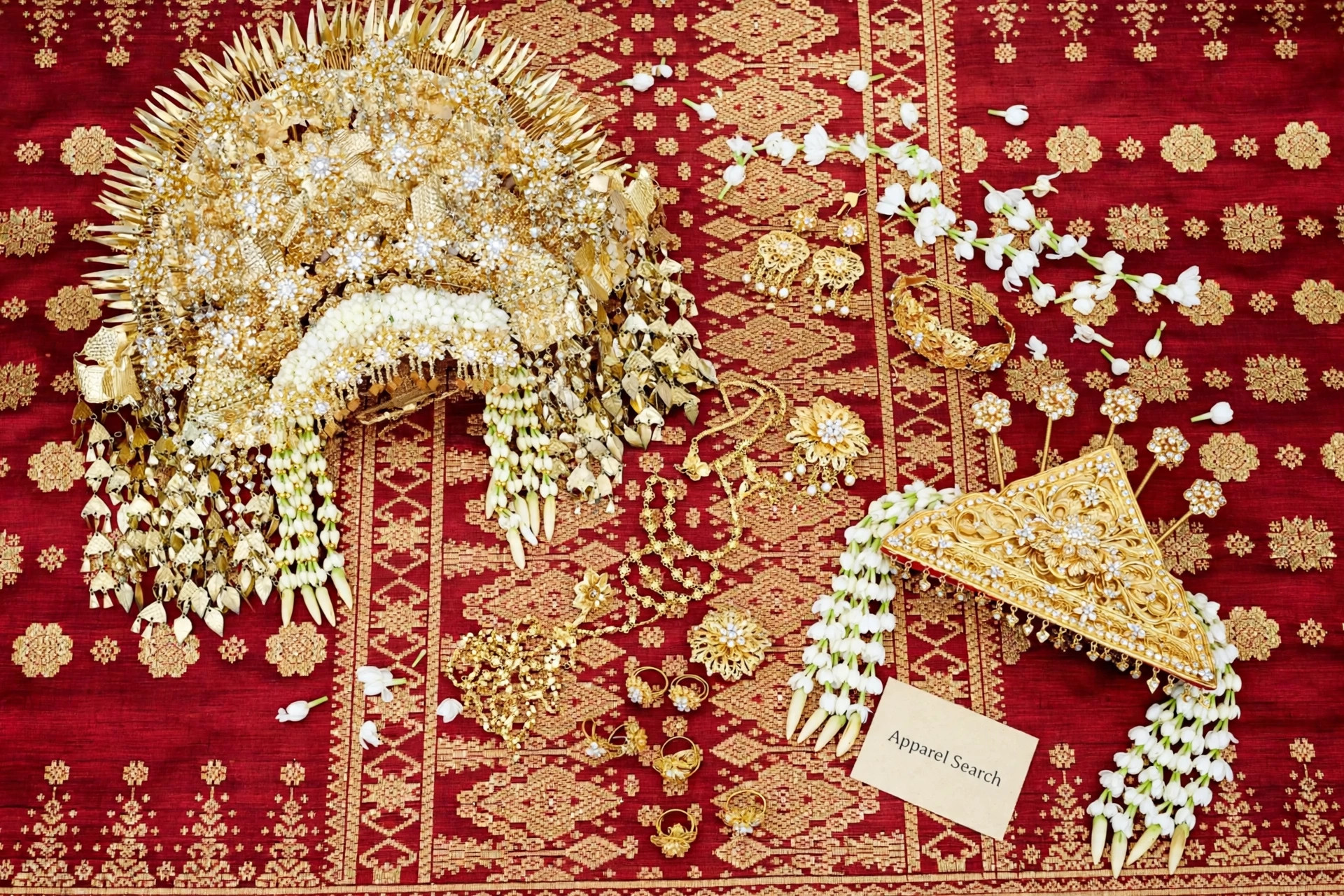
West Sumatra's Minangkabau — the world's largest matrilineal society, where lineage and property pass through women — dress the bride as the day's sovereign. Her garment is a richly embroidered tunic worn with songket in red and gold, and on her head rises the suntiang: a tall, radiant headdress of layered gold ornaments — tier upon tier of small flowers and shapes that tremble as she moves. A traditional suntiang is famously heavy, and modern versions are lightened, but even so it is fitted, balanced and worn with a stillness that becomes part of the bride's bearing; it is said to represent the glory — and the weight — of the role she takes up as a matriarch of her line. The groom wears a teluk belanga-style shirt, the folded saluak headcloth, matching songket and an ornate belt: splendid, and deliberately a step below the suntiang's blaze.
Today
Akad White, Reception Splendor — and the Hijab
Indonesia is the world's largest Muslim-majority country, and the modern Indonesian wedding day is usually built in two movements. The first is the akad nikah, the solemnization itself, and its dress code is white: the bride in a white kebaya — lace, embroidered, often with a train borrowed from Western gowns — the groom in a white beskap or suit, white reading as purity and new beginning. The second movement is the reception, and it belongs to adat: the couple change into the full regional wardrobe of the tour above, velvet and gold, crowns and songket, and receive hundreds of guests as their people's royalty.
Hijab styling has become one of Indonesian bridal dress's great crafts, not an afterthought to it. Bridal studios style the hijab to carry the regional regalia: a siger pinned over a structured hijab base, a Javanese paes painted at the hairline above it, cunduk mentul and jasmine arranged around it, even a lightened suntiang balanced on it — each region's specialists have worked out how their crown sits on covered hair, so that a bride need not choose between her faith's dress and her people's. Christian, Hindu and other couples follow their own solemnizations — a church service, Bali's temple rites — with the same pattern: the religious dress first, the adat splendor after. If you are attending an Indonesian wedding, expect batik to be the guests' uniform and regional dress on the couple; our wedding guest dressing guide covers the guest's side of the etiquette.
Acquiring
The Sanggar: One Studio, the Whole Wardrobe
Almost nobody in Indonesia assembles a regional wedding wardrobe piece by piece, because a specialist trade exists to supply it whole: the sanggar rias pengantin, the bridal studio. A sanggar is at once a makeup house, a wardrobe rental and a ritual staff. From one studio a couple hires the couple's complete regional set — her kebaya or regional dress, his beskap and blangkon, the keris, the crowns and pins, often the parents' and attendants' outfits to match — together with the artists who apply them: the makeup artist, the hijab stylist, and, for a Javanese wedding, the paes artist whose painted forehead design is a booked skill of its own. Established sanggar keep wardrobes for several regions at once — a Jakarta studio may dress a bride as Javanese, Sundanese or Minangkabau on successive weekends — and the best are booked as early as venues.
Against the rental system stands the tailored kebaya. Because a kebaya fits the body closely, many brides have theirs made — white for the akad, or the reception kebaya itself — keeping the rented regalia (crowns, suntiang, the groom's set) from the sanggar. The heirloom layer persists underneath both: a mother's batik kain, a family's keris, songket woven in the bride's own region. An Indonesian wedding wardrobe is thus typically three wardrobes in one — rented splendor, tailored keepsake and inherited cloth — which is exactly the structure of the day it dresses.
Common Questions
Common Questions
What does an Indonesian bride wear?
It depends on her region — Indonesia has no single bridal look. A Javanese bride wears a black velvet kebaya beludru with gold embroidery over batik, with paes forehead painting, a sanggul bun, jasmine strands and gold pins. A Sundanese bride wears a white kebaya under the gold siger crown. A Balinese bride wears payas agung — songket, layered gold jewelry and a tall gold headdress. A Minangkabau bride wears red-and-gold songket under the towering suntiang headdress.
What is paes?
Paes is the design painted onto a Javanese bride's forehead and hairline, in black or greenish-black, shaped in named curves — in the Solo style the gajahan, pengapit, penitis and godheg, each with its own meaning. The grand court form, paes ageng, was once reserved for royalty in Yogyakarta and Solo. It is applied by a specialist paes artist, usually booked through the bridal studio, and it is the single most recognizable element of the Javanese bridal look.
What is a suntiang?
The suntiang is the bridal headdress of the Minangkabau people of West Sumatra: a tall, radiant crown of layered gold ornaments and small trembling flowers, worn with a richly embroidered tunic and red-and-gold songket. It represents the bride's glory and her standing in a matrilineal society. Traditional suntiang are famously heavy; modern versions are made lighter, but it is still carefully fitted and balanced by the bridal studio.
What does an Indonesian groom wear?
His region's answer to the bride. A Javanese groom wears a beskap jacket — black velvet with gold embroidery to match the bride, or white for the akad nikah — with a batik kain, a blangkon headcloth and a keris dagger at his back. A Minangkabau groom wears a teluk belanga-style shirt with a saluak folded headcloth, songket and an ornate belt; a Balinese groom wears matching songket and a gold headpiece, crowned as the bride's pair.
What is a sanggar?
A sanggar rias pengantin is an Indonesian bridal studio: a single business that supplies a wedding's whole regional wardrobe and the artists to apply it. From a sanggar, couples rent the complete set — kebaya or regional dress, groom's outfit, crowns and headdresses, keris — together with makeup, hijab styling and, for Javanese weddings, the paes artist. Many brides still have their own kebaya tailored to keep, renting only the regalia.
Keep Exploring
More to Explore
In This Series
Wedding Attire Around the World
The series hub — wedding dress country by country, from China's qun kua to Scotland's tartan, as each guide is published.
Visit the hub ↑Indonesia — Kebaya and Batik
The base garments behind this page: the kebaya, batik and songket explained in the Traditional Dress series.
Read ↑Go Deeper on Indonesia
Indonesia Clothing Industry
Indonesia's garment and textile industry directory — the sector behind the kebaya, batik and songket trades.
Explore ↑Kebaya Guide
The kebaya as clothing to buy and wear — cuts, lace and what to look for.
Read ↑Definition of Batik
The short Apparel Search definition of batik and its wax-resist technique.
Read ↑Attending a Wedding?
Search Apparel Search