Traditional Dress by Country · Bangladesh
The Jamdani Sari of Bangladesh
Bangladesh's gift to world dress is a cloth so fine it was called woven air. The jamdani sari is patterned at the loom itself, its flowers and paisleys laid in thread by thread by weavers working from memory, and it stands at the head of a whole wardrobe — tangail saris, the men's panjabi and lungi, and the story-telling kantha quilts. This guide explains how jamdani is made, how to tell the real weave from imitations, and how Bangladesh wears, keeps and buys its dress today.
The Garment
What the Jamdani Sari Is
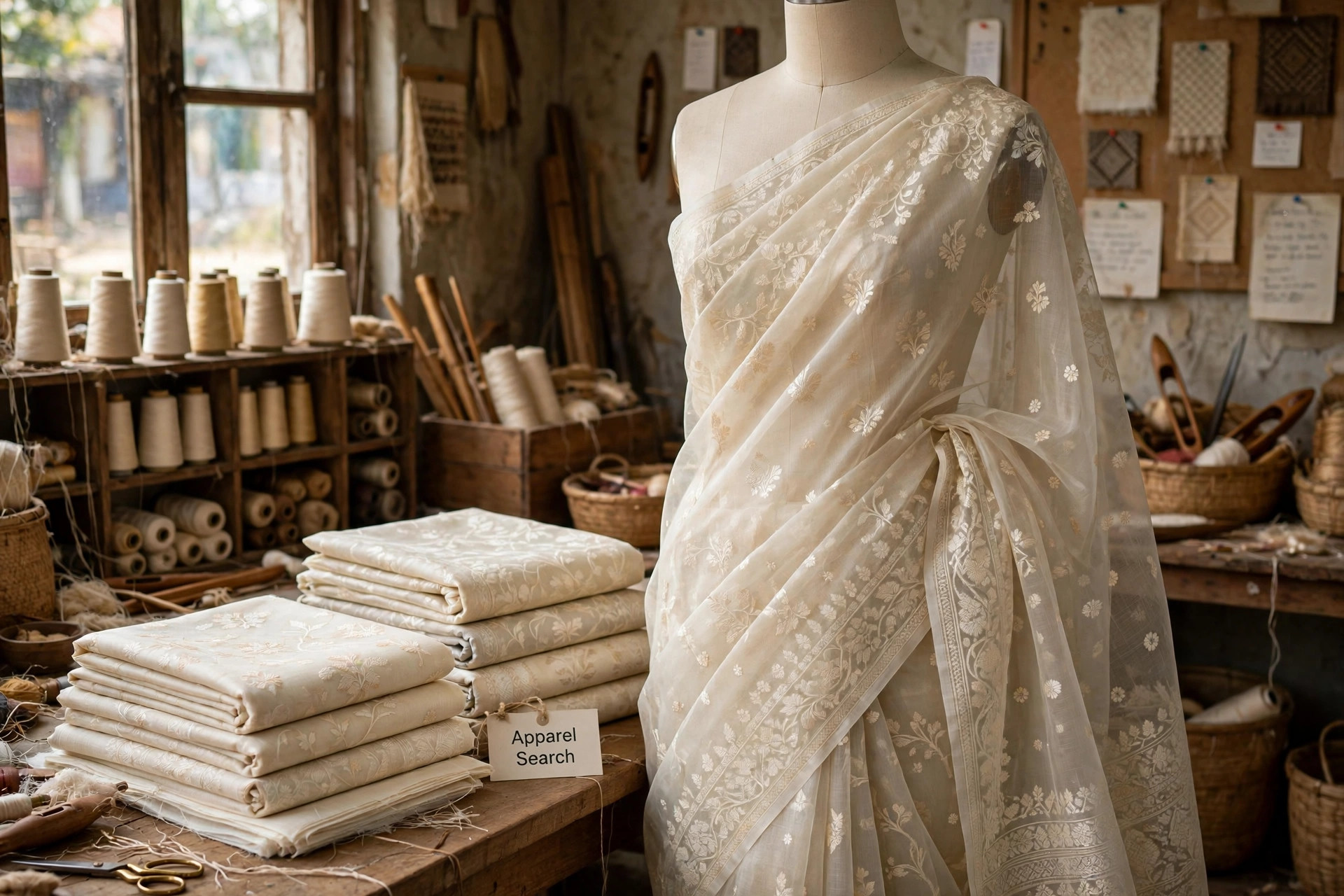
Bangladesh dresses in the sari, as does its great neighbour — but Bangladesh's own sari, the one the country claims with pride, is the jamdani: a handwoven sari of the finest cotton muslin, patterned not by print or embroidery but by threads laid into the weave itself, motif by motif, as the cloth is made. A true Dhakai jamdani is so fine it was once described as woven air, and its floral and geometric motifs seem to float on a translucent ground. For festive and formal wear it is the Bengali woman's supreme garment — the sari chosen for Eid, for weddings, for Pohela Boishakh, the Bengali New Year, and for every occasion at which a Bangladeshi woman wishes to appear in the dress of her own land at its best.
The jamdani's home is the old weaving country around Dhaka — Narayanganj and the villages along the Shitalakshya river, where weavers have worked for centuries. Dhaka's muslins were legendary in the ancient and Mughal worlds, exported to emperors and, later, to Europe, and jamdani — its name from the Persian for flower and vase, a nod to its floral motifs — was the figured crown of that trade. Under Mughal patronage the Dhaka weavers produced muslins of almost unbelievable fineness for the imperial court. The industry was then nearly destroyed in the colonial period, when machine-made British cloth flooded Bengal and the fine handloom trade collapsed; jamdani survived in the villages at a humbler level, and the twentieth century slowly rebuilt it as the emblem of Bengali, then Bangladeshi, identity.
Since independence in 1971 the jamdani has been carried as a national symbol — presented to state guests, worn by Bangladeshi women representing their country abroad, and recognised by UNESCO, which inscribed traditional jamdani weaving on its Representative List of the Intangible Cultural Heritage of Humanity. Yet it is not kept behind glass: jamdani saris are bought, worn, gifted and inherited by ordinary families, and the weekly jamdani market at Demra, where weavers sell directly, is one of the great cloth sights of Asia.
Around the jamdani stands the rest of the Bangladeshi wardrobe: the everyday cotton sari, the tangail sari woven in the Tangail district for daily and festive wear, men's lungi and panjabi, and the embroidered quilts called nakshi kantha. This guide covers them together, because in Bangladesh cloth is not a backdrop to the culture — to a remarkable degree, it is the culture.
Anatomy
The Parts of Bangladeshi Dress
The sari is a single unstitched cloth, but the outfit built around it, and the men's dress beside it, have their own named parts:
- The sari
- A length of cloth — traditionally about five to six yards — wrapped around the waist, pleated at the front, and carried over the shoulder as the anchal or pallu, the decorated end that carries the jamdani's richest motifs. Bengali draping has its own classic style, with broad pleats and the anchal arranged across the torso, distinct in detail from drapes elsewhere in India.
- Blouse and petticoat
- The sari is worn over a tied underskirt (the petticoat or shaya) into which its pleats are tucked, and with a fitted blouse. Festive blouses may be embroidered or of contrasting silk; the blouse is a modern tailoring layer on an ancient unstitched garment.
- Panjabi — the men's tunic
- The long, collarless or band-collared tunic worn by Bengali men for festivals, Fridays and formal occasions, in white cotton for prayer and in embroidered or silk versions for Eid and weddings — the Bengali counterpart of the kurta, worn with pyjama trousers or, informally, a lungi.
- Lungi
- The men's wrap skirt of the delta: a sewn tube of checked or striped cotton, wrapped and folded at the waist, worn by farmers, rickshaw-pullers, fishermen and, at home, by men of every class. In Bangladesh's heat and flood-prone fields it is the most practical garment ever devised, and it is worn with unembarrassed universality.
- Gamchha
- The thin cotton towel-scarf every working man carries — for sweat, sun, bathing and a hundred other uses — woven in bright checks, and as much a part of delta dress as the lungi itself.
Variations
Jamdani, Tangail and the Everyday Sari
Bangladeshi saris are read by their weave and their district:
| Sari | Character | Worn for |
|---|---|---|
| Dhakai jamdani | Finest cotton muslin with motifs inlaid by hand in the weave — flowers, vines, paisleys and geometric buti scattered over a translucent ground; the border and anchal carry the densest work | Eid, weddings, New Year, formal and state occasions — the prestige sari |
| Tangail sari | Handwoven cotton (and cotton-silk) from Tangail district, with woven borders and anchal designs, softer and more affordable than jamdani | Everyday and festive wear across the country |
| Half-silk and silk saris | Jamdani and other weaves in silk or cotton-silk, including the silk of Rajshahi | Weddings and the grandest occasions |
| Everyday cotton sari | Mill and handloom cottons in prints and checks | Daily dress for millions of women, at home and at work |
| Nakshi kantha (as dress and wrap) | Layers of old cloth embroidered with running-stitch pictures — the kantha stitch covered below | Wraps, shawls and heirloom textiles rather than a draped sari |
Colour speaks in Bangladesh as it does across Bengal: white with a red border is the classic festive combination for Hindu women and for Pohela Boishakh, when Dhaka's streets fill with red-and-white saris; brides traditionally wear red; and the green of the delta's rice fields is the colour the whole culture returns to.
Motifs carry meaning as well as beauty. The fish — above all the hilsa, the delta's beloved fish — stands for the rivers and for abundance; the lotus and the water lily, Bangladesh's national flower, speak of the flooded fields; rice sheaves, boats and monsoon clouds recur in both jamdani patterns and kantha pictures. A weaver choosing motifs is drawing the landscape she lives in, which is why Bengali textiles, for all their technical refinement, feel so rooted: the pattern book of the jamdani loom is the delta itself, translated into thread.
Cloth and Pattern
Jamdani Weaving and Kantha Stitch
Jamdani is a supplementary-weft technique: as the plain muslin ground is woven on the loom, the weaver inserts extra pattern threads by hand, without any mechanical aid, building each motif from a pattern remembered or read from a graph, using small bobbins and a needle-like tool. Two weavers work a fine sari together for weeks or months. The motifs — the kalka paisley, jasmine and marigold forms, diagonal floral sprigs, peacocks, fish and geometric stars — sit slightly raised on the sheer ground, and a genuine jamdani shows the pattern clearly on the reverse, with the fine hand-finishing that machine copies cannot imitate. Our World Textiles guide to jamdani weaving follows the technique at the loom in detail.
Bangladesh's second great textile art works with the needle instead. Kantha is the running stitch of Bengal, used for centuries by village women to embroider layers of worn saris and dhotis into new quilts — nakshi kantha — covered with stitch-drawn pictures of daily life: fish, birds, boats, weddings, gods and fields. The stitch is the simplest in embroidery, and the results are among the most expressive textiles in Asia. Kantha stitch now also decorates saris, scarves and jackets made for the modern market. Our companion guide to kantha stitch tells its story from the recycled quilt to the fashion runway.
The cloth beneath both arts is cotton — the delta's own crop historically, spun and woven in a land of rivers where muslin's fineness was possible because of the humid air itself, weavers say, which kept the fine threads from snapping. Silk from Rajshahi in the north completes the national palette.
Living Dress
When It Is Worn Today
The sari remains the normal formal and festive dress of Bangladeshi women and the daily dress of a great many, particularly outside the youngest urban generation: Eid mornings, weddings, university convocations, office wear for many professionals, and the red-and-white flood of Pohela Boishakh all belong to the sari. The jamdani specifically is the choice when the occasion is also a statement — worn by women in public life, presented by the state to honoured guests, and carried abroad by the diaspora as the portable form of home. For men, the panjabi is the dress of Fridays, Eid and celebration, and the lungi remains, at home and at work across the delta, simply what men wear.
The weaving itself is a living industry under real pressure — handloom weavers compete with power-loom imitations sold as jamdani — which is why the Demra jamdani haat, the weavers' own market, and the GI (geographical indication) recognition of Dhakai jamdani matter to Bangladeshis beyond nostalgia. The wider garment economy, one of the largest clothing exporters on earth, is profiled in our Bangladesh clothing industry page — a striking contrast: the same country dresses the world in factory T-shirts and dresses itself, on its best days, in handwoven muslin.
Wearing
Wearing Basics
The Bengali sari drape begins with the cloth tucked into the petticoat at the waist and wrapped once around, then pleated at the front — the pleats fanned and tucked so they fall in a panel — and the remaining length brought across the back and over the left shoulder as the anchal. In the classic Bengali style the anchal is arranged broadly across the torso and its decorated end displayed; keys and small purses were traditionally knotted into its corner. A jamdani, being sheer and fine, is usually worn over a blouse of matching or contrasting colour chosen to set off the motifs, and the whole effect depends on the pleats falling cleanly — a skill Bangladeshi girls traditionally learn from their mothers long before they own a jamdani of their own.
The panjabi is worn loose and long, over pyjama or, at home, a lungi; the lungi itself is stepped into as a tube, folded and rolled down at the waist to the right length and tightness — a two-second operation its wearers perform without thought. Festive panjabis carry embroidery at the collar and placket, and for Eid a new panjabi, like a new sari, is the expected and budgeted-for pleasure of the season.
Keeping
Care and Storage
A fine jamdani is the most delicate garment in this series, and it is cared for accordingly. It should be washed rarely, and then only by a specialist or by gentle hand washing without wringing; many owners simply air a jamdani after wearing and store it folded in soft cotton cloth, refolding it periodically so the fine threads do not break along a permanent crease. Starch, which gives everyday cottons their body, is used sparingly or not at all on the finest pieces. Sun and damp are the enemies: Bangladesh's monsoon humidity mildews stored cloth quickly, so saris are aired on dry days and kept with natural repellents in the wardrobe.
Everyday cotton saris and tangails are washed, starched and ironed as a matter of routine — the crisp cotton sari is a point of household pride. Nakshi kantha quilts, being layers of old cloth, are washed gently and mended as they age; their value is in their stitching and their stories, and families keep them for generations. A treasured jamdani is inherited the same way, from mother to daughter, and a bride may wear her grandmother's — the muslin, properly kept, outlives its weaver by a century.
Acquiring
Buying and Collecting
Dhaka is the place to buy, and the Demra jamdani haat — the weavers' market held on Fridays outside the capital — is the connoisseur's source, where saris come straight from the loom families at weavers' prices. In the city, the shops of Dhanmondi, Banani and the craft outlets such as Aarong (the BRAC craft organisation's stores, found across the country) sell certified handloom jamdani and kantha work with fair-trade assurance. Prices tell the truth about jamdani: a fine handwoven sari represents weeks of two weavers' work and costs accordingly, while a suspiciously cheap 'jamdani' is a power-loom imitation — check the reverse of the motifs, where hand inlay shows its character, and feel the ground: real jamdani muslin is feather-light and slightly crisp.
Collectors seek older Dhakai jamdanis with dense, fine motifs, antique nakshi kantha with narrative stitching, and Rajshahi silk. Buy from reputable craft organisations or known weavers, ask where a piece was woven, and expect to pay for handwork at handwork prices — that payment is precisely what keeps the looms of Narayanganj alive. As a visitor's wear, a jamdani bought for a festival or a Bengali wedding, draped with local help, is received with genuine pleasure: in Bangladesh the sari is not a costume but the country's best dress, and a guest who wears it well honours the hosts.
Common Questions
Common Questions
What is a jamdani sari?
A jamdani sari is Bangladesh's finest traditional sari: a handwoven cotton muslin in which the floral and geometric patterns are inlaid by hand into the weave itself, using supplementary weft threads, rather than printed or embroidered afterwards. The best, called Dhakai jamdani, come from the weaving villages around Dhaka and Narayanganj.
How long does it take to weave a jamdani sari?
A fine jamdani takes two weavers working together weeks to months to complete, depending on the density of the pattern. Each motif is inserted by hand with small bobbins as the cloth is woven, from patterns held in memory or read from a graph — which is why genuine handwoven jamdani costs what it does, and why power-loom imitations are a different product entirely.
What is a lungi, and who wears it?
A lungi is a tube of checked or striped cotton cloth worn by men as a wrap skirt, folded and rolled at the waist. In Bangladesh it is worn by men of all classes — by farmers, fishermen and rickshaw-pullers at work, and by nearly everyone at home — because in the delta's heat it is cooler and more practical than trousers.
What is nakshi kantha?
Nakshi kantha is the embroidered quilt tradition of Bengal: layers of worn saris and cloth stitched together with running stitch (kantha) and covered with stitch-drawn pictures of daily life — fish, birds, boats, people and gods. Made for centuries by village women in what is now Bangladesh and West Bengal, kantha quilts are family heirlooms, and the same stitch now decorates scarves, jackets and saris.
What do Bangladeshi men wear for festivals?
For Fridays, Eid, weddings and formal occasions Bangladeshi men wear the panjabi — a long tunic, white cotton for prayer and embroidered or silk versions for celebrations — with pyjama trousers. The lungi serves for home and work. A new panjabi for Eid, like a new sari for women, is a cherished seasonal tradition.
Keep Exploring
More to Explore
In This Series
Traditional Dress by Country
The series hub — every country guide, from the hanbok of Korea to the kilt of Scotland, as each is published.
Visit the hub ↑Bangladesh Clothing Industry
Bangladesh's apparel and textile industry directory — a handloom heritage inside one of the world's largest garment exporters.
Explore ↑Go Deeper
Search Apparel Search