Traditional Dress by Country · Sri Lanka
The Osariya of Sri Lanka
Sri Lanka takes the sari — the most widespread garment in Asia — and drapes it in a way no one else does: pleats at the side, waist wrapped smooth, and the cloth over the shoulder fluted into a frill called the potaya. The result, the osariya, is a national dress still worn daily by teachers, officials and brides. This guide explains the Kandyan drape and its everyday sister, the redda hatte, the men's sarama, and the handloom, batik and lace that make the island's cloth its own.
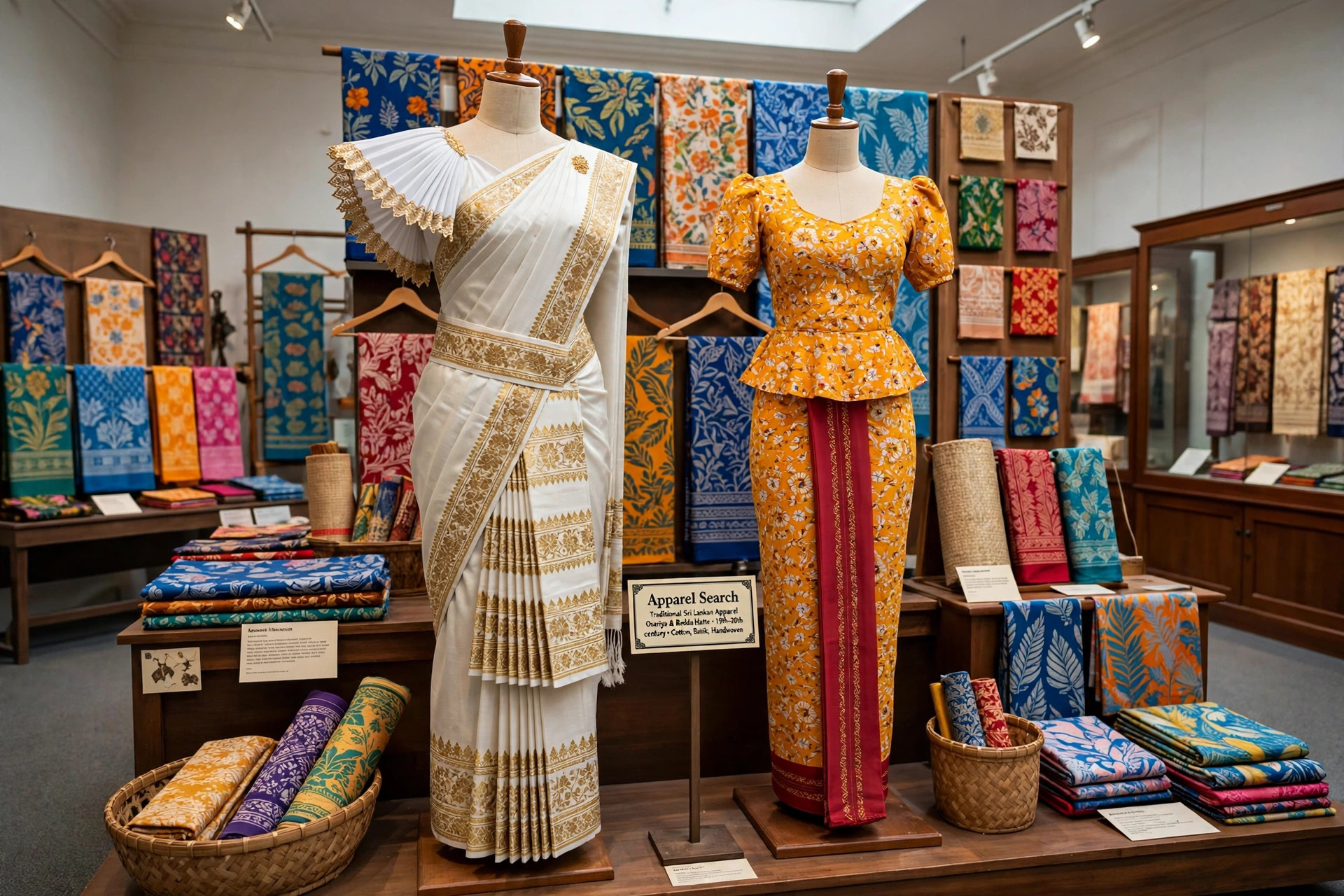
The Garment
What the Osariya Is
Sri Lanka wears the sari in a style found nowhere else on earth. The osariya — the Kandyan sari — takes the same six yards of cloth worn across South Asia and drapes it in a way that is unmistakably Sri Lankan: the pleats are arranged at the side rather than the centre front, the cloth is wrapped around the waist in a distinctive band, and the fall of fabric over the shoulder ends in a frilled, fan-like flourish, the potaya, that gives the Kandyan silhouette its unmistakable profile. Worn with a fitted jacket-style blouse, the osariya is the national dress of Sinhalese women — the dress of teachers, officials, brides and grandmothers, and the garment a Sri Lankan woman abroad puts on to say where she is from.
Its name and its form both point to Kandy, the hill capital of the last Sri Lankan kingdom, which held out against European powers until 1815. The Kandyan court developed its own court dress from the sari cloth traded across the straits from India, and the draping that emerged there — structured, almost architectural, with its wrapped waist and frilled shoulder — became the dress of Kandyan aristocratic women and then, in the national revival of the late nineteenth and twentieth centuries, the dress of Sinhalese womanhood itself. When Sri Lanka (then Ceylon) gained independence in 1948, the osariya took its place as the new nation's female dress, worn by its women politicians, its air hostesses and its brides.
The osariya has a plainer sister. The redda hatte — literally 'cloth and jacket' — is the everyday traditional dress: a length of cotton cloth (the redda) wrapped as a skirt around the waist, worn with a short fitted jacket (the hatte), often of white lace-trimmed cotton. It was the daily dress of village and working women for generations, is still worn by older women and for traditional occasions, and its white hatte is one of the most recognisable sights of the Sri Lankan countryside. Between the festive osariya and the everyday redda hatte stands the ordinary Indian-style sari, also widely worn in Sri Lanka — but it is the Kandyan drape that the country claims as its own.
Men's dress completes the picture: the sarama, the Sinhalese form of the lungi-like wrap skirt, worn at home and in the fields, and for formal occasions a national dress of a long shirt or jacket with the sarama or trousers, crowned in Kandyan aristocratic tradition by elaborate dress that survives today in the costume of Kandyan dancers and grooms. This guide covers the whole wardrobe — and the batik and handloom cloths that Sri Lanka makes for it.
Anatomy
The Parts of Sri Lankan Dress
The osariya is one cloth, but its drape has named parts, and the outfits around it have their own pieces:
- The osariya cloth
- Six yards of sari cloth — handloom cotton, silk, or modern fabrics — with a border and a decorated end. The cloth is the same as any sari; everything distinctive about the osariya is in the draping.
- The waist wrap and side pleats
- The defining construction: the cloth is wrapped around the waist and secured, and the pleats are formed and tucked at the left side rather than the centre front, giving the Kandyan drape its smooth front and its characteristic line.
- Potaya — the frill
- The fall of cloth over the shoulder is arranged into a frilled, fluted fan at the shoulder and back — the potaya — the single most recognisable detail of the Kandyan style, somewhere between a ruffle and a peacock's crest.
- The jacket blouse
- A fitted, tailored blouse, traditionally with sleeves to the elbow or wrist and a modest neckline, often trimmed with lace or beeralu bobbin-lace edging — a Kandyan craft in itself. Festive blouses use brocade, velvet or the same cloth as the sari.
- Redda and hatte
- The everyday pair: the redda, a wrap skirt of printed or plain cotton, and the hatte, a short, fitted jacket, classically of white cotton with lace at the neck and sleeves. Worn together they are Sri Lanka's traditional working dress for women.
- Sarama — the men's wrap
- A sewn tube or length of checked cotton wrapped and rolled at the waist, the Sinhalese working and home dress for men, worn with a shirt or bare-chested in the fields; for formal wear it pairs with a long shirt or national-dress jacket.
- Jewellery
- Kandyan brides wear a celebrated suite of jewellery — the moon-and-sun pendants, forehead ornament and layered necklaces of the Kandyan bridal set — and everyday osariya dress is finished with gold chains, bangles and the traditional hair arrangement drawn back into a bun (konde).
Variations
Kandyan, Everyday and Bridal Dress
Sri Lankan women's dress arranges itself by occasion:
| Dress | Character | Worn for |
|---|---|---|
| Osariya (Kandyan sari) | The Kandyan drape: side pleats, wrapped waist, frilled potaya over the shoulder, fitted jacket blouse | Formal and festive wear, office and official dress, weddings, national occasions — the national dress |
| Indian-style sari | The centre-pleated drape common across India, also long worn in Sri Lanka | Everyday and festive wear, especially in the north and east and among Tamil Sri Lankans, for whom it is the traditional drape |
| Redda hatte | Wrap skirt and short fitted jacket, classically white lace-trimmed hatte | Everyday traditional dress, older women, cultural performance, home and village wear |
| Kandyan bridal dress | The osariya in ivory, cream or gold silk with the full Kandyan jewellery suite and an elaborate coiffure | Sinhalese weddings — one of Asia's most ornate bridal traditions |
| Men's national dress | Long shirt or tailored jacket with sarama or trousers; the historic Kandyan chief's dress survives in dance costume and groom's wear | Official occasions, ceremonies, weddings |
Sri Lanka is a multi-ethnic island, and its dress map is layered: Tamil women wear the sari in the Indian drape with their own jewellery traditions, Muslim women wear their own modest dress and headscarves, and Burgher and Malay communities add further threads. The osariya is specifically the Sinhalese — and by adoption, the national — form.
One more figure belongs in this table, though he wears a costume rather than daily dress: the Kandyan dancer, whose elaborate silver-chested, skirted and crowned outfit preserves the splendour of the old Kandyan court's male dress more completely than any other survival. Visitors meet this dress at the cultural shows of Kandy and at the great Esala Perahera procession each summer — and grooms borrow from the same tradition, wearing ornate Kandyan-style dress that echoes the chiefs of the hill kingdom.
Cloth and Pattern
Handloom, Batik and Lace
Sri Lanka weaves and decorates much of its own dress cloth. Handloom weaving — cotton and cotton-silk saris and sarama cloth woven in the island's weaving villages and by its well-known handloom houses — supplies the osariya's classic cloth: firm, slightly crisp cotton with woven borders, in the strong, clear colours Kandyan dress favours. The industry, supported for generations as a rural women's craft, produces the checks of the sarama and the bordered cloth of the redda as well as festive saris, and 'handloom' on a Sri Lankan label is a claim the country takes seriously.
Batik is the island's second signature. Sri Lanka developed its own batik industry in the twentieth century — wax-resist dyeing learned from Indonesia and made local with island motifs of peacocks, elephants, temple flowers and ocean waves — and batik saris, sarongs and dress lengths became a Sri Lankan speciality, worn festively and exported worldwide. A batik osariya, with its crackled wax-veined colours, is a modern Sri Lankan classic. The third craft is beeralu, the bobbin lace of the southern coast, introduced in the Portuguese period and worked by women around Galle for four centuries: it edges the white hatte jacket, trims blouses and table linen, and its presence on a Kandyan blouse quietly signals the island's layered colonial history in a single trim.
Silk for bridal and grand osariyas is largely imported, as it long has been — the Kandyan court itself dressed in traded cloth — but the draping, the lace and the batik that finish it are the island's own.
Living Dress
When It Is Worn Today
The osariya is working national dress, not a relic. It is the uniform, in effect, of Sri Lanka's women teachers, a standard dress for women in government offices and banks, the dress of air hostesses on the national airline, and the automatic choice for official functions, school ceremonies, religious observances at the temple, and weddings. Sinhala and Tamil New Year in April fills the island with new osariyas and redda hatte; a bride in the full Kandyan suite — ivory or gold osariya, layered necklaces, the sun-and-moon ornaments — is the centrepiece of the Sinhalese wedding, and her attendants wear osariyas to match.
The redda hatte has retreated to older generations, cultural shows and deliberate tradition, but it is kept with affection, and the sarama remains the unchallenged home and working dress of Sri Lankan men, paired for formal wear with the national-dress shirt and jacket worn by politicians and officials. Behind the wearing stands the cloth economy — the handloom weavers, batik workshops and garment factories profiled in our Sri Lanka clothing industry page, where the island's famous export garment industry and its small traditional crafts sit, unusually, side by side.
Wearing
Wearing Basics
Draping an osariya is a learned skill, and Sri Lankan women are frank that it takes practice. The cloth is first wrapped and secured firmly around the waist over an underskirt; the pleats are then formed and tucked at the left side; the remaining cloth is carried around and over the shoulder, and its fall is arranged into the potaya frill — the step that distinguishes a merely worn sari from a properly dressed osariya. The jacket blouse must fit closely, since the Kandyan silhouette is structured, almost tailored, in contrast to the softer line of the Indian drape. A first osariya is traditionally put on with a mother's, aunt's or dressmaker's help, and bridal dressing is a professional art.
The redda hatte is simpler: the redda wraps and tucks at the waist to the ankle, and the hatte buttons or ties over it. The sarama is stepped into, folded and rolled at the waist like the lungis worn across the region. In all three, neatness is the aesthetic — Sri Lankan traditional dress, even at its most everyday, prizes a pressed cloth, a straight pleat and a clean line, and an osariya worn for office or ceremony is expected to look immaculate from morning to evening, a standard its wearers maintain with discreet pins, firm tucking and long practice.
Keeping
Care and Storage
Handloom cotton osariyas and reddas are washed gently and pressed carefully — the crispness of the cloth is part of the dress — while silk and bridal osariyas are dry-cleaned and stored folded in soft cloth, away from light, with the jewellery suite kept separately in its boxes. Batik needs cool, gentle washing, separately at first, since its dyes can bleed; its wax-crackle pattern is in the cloth itself and does not wash out. Beeralu lace is washed by hand and pressed flat under a cloth so its fine bobbins are not torn.
The island's tropical humidity governs storage as it does everywhere in this series: garments go away dry, are aired on fine days, and are checked for mildew through the monsoon. Kandyan bridal sets and heirloom osariyas are kept as family treasures and brought out across generations — a grandmother's bridal osariya cloth, re-draped for a granddaughter, is a normal and treasured piece of Sri Lankan family continuity. Everyday handloom, treated decently, gives years of wear; the weaving is sturdy, and the sarama and redda in particular are among the hardest-wearing garments in this series.
Acquiring
Buying and Collecting
Colombo is the place to buy: the great handloom houses and department stores of the capital sell osariya-ready handloom saris with their borders woven in, batik workshops and galleries sell the island's batik by the length and ready-draped, and shops around Kandy and Galle add beeralu lace and regional craft. A handloom osariya sari is priced by its weave and fibre — cotton for daily and office wear, silk and silk-blends for weddings — and a genuine handloom cloth can be recognised by its firm hand, its woven (not printed) border and the small irregularities of the loom. Batik should be checked on the reverse: true batik's pattern and crackle show through the cloth; printed imitations sit on the surface.
Collectors look for older handloom saris in the classic Kandyan colours, fine beeralu lace, antique Kandyan jewellery, and characterful older batik from the island's best workshops. Buy lace and batik from the makers or reputable craft shops where possible — both crafts support coastal and village women directly, and the price difference over tourist-market copies is the craft's survival. For a visitor invited to a Sri Lankan wedding or ceremony, an osariya bought in Colombo and draped with the help of the shop's staff or a local friend is a compliment hosts genuinely appreciate: it is the island's best dress, and wearing it well is understood as respect.
Common Questions
Common Questions
What is an osariya?
An osariya is the Kandyan sari of Sri Lanka: a sari draped in the distinctive Kandyan style, with the pleats tucked at the side, the cloth wrapped firmly at the waist, and the fall over the shoulder arranged into a frilled flourish called the potaya. Worn with a fitted jacket blouse, it is the national dress of Sinhalese women.
How is the osariya different from an Indian sari?
The cloth is the same six yards, but the drape differs. The Indian sari is pleated at the centre front and its end falls plainly over the shoulder; the Kandyan osariya tucks its pleats at the left side, wraps the waist in a structured band, and arranges the shoulder fall into a distinctive frill, the potaya, giving a more tailored, architectural silhouette.
What is redda hatte?
Redda hatte — 'cloth and jacket' — is Sri Lanka's traditional everyday dress for women: a length of cotton cloth (redda) wrapped around the waist as a skirt, worn with a short, fitted jacket (hatte), classically of white cotton trimmed with beeralu bobbin lace. It was the daily dress of village women for generations and is still worn by older women and for traditional occasions.
What is a sarama?
A sarama is the traditional Sri Lankan men's wrap: a length or tube of checked cotton cloth wrapped and rolled at the waist and worn as a skirt, similar to the lungi worn elsewhere in South Asia. It is the everyday home and working dress of Sri Lankan men, and with a long shirt or national-dress jacket it also serves for formal occasions.
What is Sri Lankan batik?
Sri Lankan batik is the island's own tradition of wax-resist dyeing, developed in the twentieth century from Indonesian technique and worked with Sri Lankan motifs — peacocks, elephants, temple flowers and waves — in crackled, wax-veined colours. Batik saris, sarongs and dress lengths are a Sri Lankan speciality, worn festively and exported around the world.
Keep Exploring
More to Explore
In This Series
Search Apparel Search