Carton Strapping for Securing Shipping Cartons
The strap that keeps a carton closed, square and unitised — from a hand tool to a strapping machine.
Carton strapping is a band of plastic or steel, tensioned around a carton or a pallet load and sealed to itself, that does the holding tape cannot. Tape closes a carton's flaps; strapping keeps the carton closed under load, keeps a stack of cartons acting as one unit, and keeps a pallet load together through forklift handling and a truck journey. In a clothing warehouse, strapping finishes the heaviest cartons, bundles cartons for consolidation, and unitises the pallet loads the shipping dock sends out.
Carton Topics
Plastic Strap, Steel Strap and How Each Is Applied
Plastic strapping — polypropylene for light and medium duty, polyester for heavier and more demanding loads — is the apparel warehouse's everyday strap: light, safe to handle, resistant to rust and moisture, and tensioned with hand tools or machines. Steel strapping remains the strongest band of all, reserved for the heaviest, sharpest and most unyielding loads, where its lack of stretch is the point.
Application runs on a scale. At the bench, a kit — strap, seals and a tensioner-cutter tool, of the kind listed below — straps cartons one at a time wherever they are packed. At the dock, semi-automatic and automatic strapping machines arch over the carton or pallet, feed, tension, seal and cut the strap in seconds, at a pace and consistency no hand tool matches; the machinery pages linked from here cover those machines in full.
The seal is the strap's weak point by design of physics: a friction weld on machine-applied plastic strap, a crimped metal seal on hand work. Either must be made fully — a half-crimped seal holds exactly until the load needs it. Strap quality is checked at the seal, every time a tool, a strap coil or an operator changes.
Strapping Cartons and Pallet Loads of Clothing
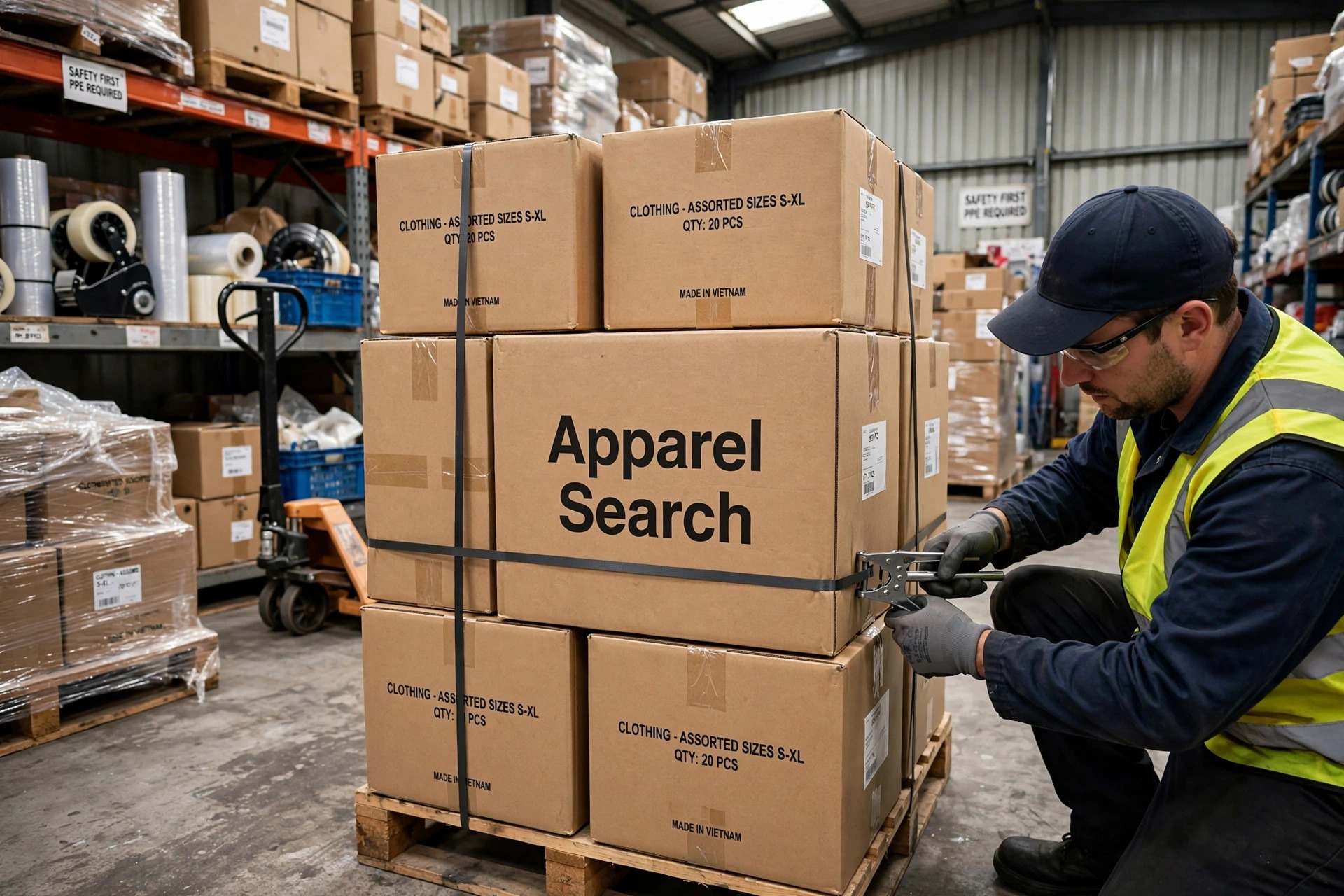
A single heavy carton takes strap around its strongest dimension, over the taped closure, so strap and tape share the work: tape seals, strap secures. Edge protection — a folded corner board or a strap protector — belongs wherever strap under tension meets a carton edge it could cut, which on a full, soft apparel carton is most edges; a strap that cheats into the board loses tension as it cuts, and the load loosens by the mile.
Pallet loads take strapping in a pattern: vertical straps through or around the pallet unitise the load to its base, and the pattern multiplies with load height and journey severity. Strapping works with, not instead of, stretch wrap — wrap contains and protects the load's faces; strap binds the load to the pallet and holds its unit shape when wrap alone would let it walk.
The supplier listed here, founded in 1982, is a full-service manufacturer of plastic strapping, strapping machines and systems, steel strapping, and the tools and accessories for both — the whole strapping station from one source, supplying quality products with on-time delivery, competitive pricing and innovative solutions, as it has for over twenty years.
Carton Strapping — Suppliers & Manufacturers
PAC Strapping Products Inc.
PAC Strapping Products, founded in 1982, is a full service manufacturer and supplier of plastic strapping, plastic strapping machines and systems, steel strapping, along with tools and accessories for both plastic and steel strapping. For over 20 years PAC has focused on providing the best value in its industry by supplying customers with a full line of quality products, on-time delivery, competitive pricing and innovative solutions.
Supplies: Plastic strapping, steel strapping, strapping kits, strapping machinery, tools and accessories
Safe, Consistent Strapping Practice
Tension to the load, not to the tool's maximum: an over-tensioned strap crushes a soft apparel carton and then loosens as the board gives; an under-tensioned one never held anything. Set tension by load family, mark it at the station, and audit finished cartons by hand — a strap should twang, not sing or sag.
Cut strap is a hazard with a spring in it: operators cut under control, eye protection on machine work, and spent strap coiled for disposal rather than left as loops on a dock floor. The strap that secured the load deserves the same discipline on its way out as on its way on.
Common Questions
What is the difference between carton tape and carton strapping?
Tape seals a carton's flaps closed. Strapping — a tensioned band of plastic or steel sealed to itself — secures the carton under load, bundles cartons together, and unitises pallet loads so they survive forklift handling and transport. Heavy cartons commonly use both: tape to seal, strapping to secure.
Should I use plastic or steel strapping?
Plastic strapping (polypropylene for light and medium duty, polyester for heavier loads) covers most apparel warehouse work: it is light, safe, and rust- and moisture-resistant. Steel strapping is the strongest band and does not stretch, so it is reserved for the heaviest, sharpest and most unyielding loads.
How is strapping applied in a clothing warehouse?
By hand kit — strap, seals and a tensioner-cutter — for cartons at the bench, or by semi-automatic and automatic strapping machines at the dock, which feed, tension, seal and cut the strap in seconds. Corner protection belongs wherever tensioned strap meets a carton edge, and the seal — friction weld or crimped metal — is checked whenever tools, strap or operators change.