Apparel Search · Factory Operations Guide
Production Planning & Control
Capacity, line loading and the time-and-action calendar — the planning work that decides whether an order ships on time.
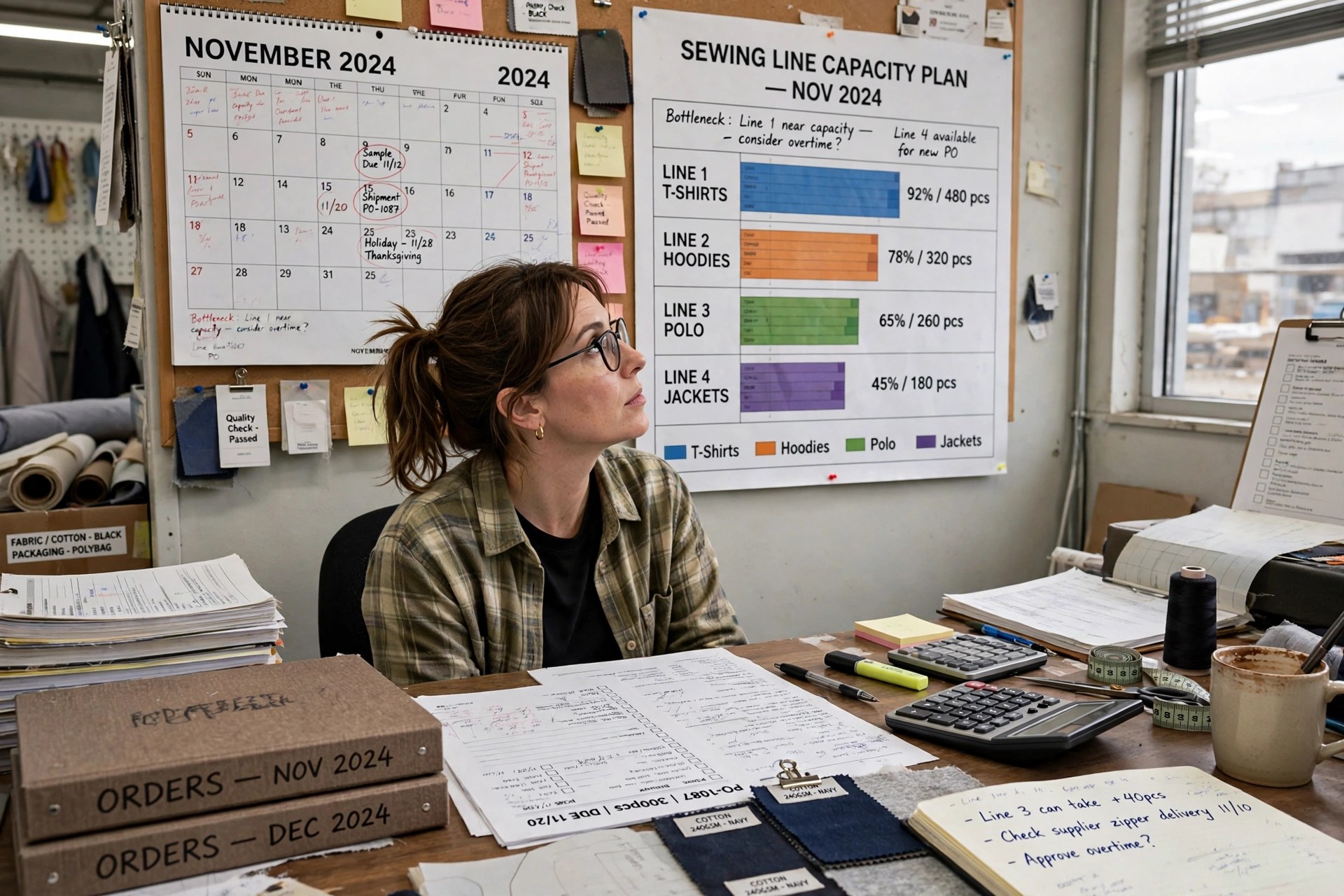
A garment factory sells something invisible: future capacity. Months before a shirt is sewn, its delivery date has been promised, and whether that promise holds is decided less at the sewing machine than in the planning office. Production planning and control (PPC) is the discipline covered in this guide — part of the Apparel Manufacturing & Factory Operations Guide — that matches orders to lines, dates to capacity, and then chases reality when it drifts from the plan.
Capacity: What the Factory Can Actually Make
Planning starts with honest capacity. A line's daily output depends on how many operators it has, how long the style takes per garment (its standard minutes — see the Costing cluster's SMV guide), and the line's realistic efficiency. Multiply across lines and working days and the factory has a capacity in pieces, or more usefully in standard minutes, per week. Styles differ enormously — a basic tee and a lined jacket may differ tenfold in minutes — which is why serious factories plan in minutes, not pieces, and why overloading a month with complex styles breaks schedules that looked fine on a piece count.
Loading: Putting Orders on Lines
Confirmed orders are placed on lines by delivery date, style similarity and line capability — a knit line cannot take a tailored woven order. Grouping similar styles together reduces changeover losses as lines re-learn operations.
Every style change costs ramp-up time while operators learn new operations and the line re-balances. The loading plan spaces changeovers deliberately instead of letting them bunch.
Experienced planners do not load lines to theoretical maximum: inspection time, rework, machine maintenance and the simply-inevitable late delivery all need room. A plan at one hundred percent is a plan to be late.
The Time-and-Action Calendar
For each order, the plan is expressed as a time-and-action calendar: the milestones from the product development stages — approvals and materials — through cutting, sewing, inspection and shipment, each with a date and an owner. The buyer's merchandiser and the factory's merchandiser work from the same calendar; Apparel Search's pre-production checklist covers the confirmations that should be complete before the calendar reaches cutting. The calendar's value is not the document but the discipline: a milestone missed on Tuesday is a conversation on Wednesday, not a surprise at shipment.

Control: Tracking and Replanning
Once production starts, control takes over: daily output by line against target, work-in-progress levels, cutting and finishing status, and material arrivals for the next orders. When a line falls behind — a hard operation, absent operators, a machine down — planners respond by re-balancing, adding hours, splitting the order across lines, or renegotiating dates early, while the buyer still has options. The plan is a living document; the factories that ship on time are not the ones whose plans never change, but the ones that notice change first.
The Daily Rhythm: Meetings and Reports
Planning becomes real in a short daily cycle. Line output is counted hourly or by the half day; the production meeting — manager, supervisors, quality lead, merchandisers — reviews yesterday's numbers against the plan, names the lines in trouble, and agrees the fixes: re-balance this line, move that order, chase this fabric. Written production reports carry the same numbers to the buyer. It sounds bureaucratic until you see the alternative, which is discovering at the final inspection that an order is three days behind.
More in This Guide
Back to the Apparel Manufacturing & Factory Operations Guide
This page is one department of the Apparel Manufacturing & Factory Operations Guide, Apparel Search's walk through the production floor. The guide connects every department — cutting, sewing, planning, quality, finishing — into one flow.
Common Questions
What is production planning and control in a garment factory?
Production planning decides, before work starts, which orders will run on which lines, in what sequence, starting and finishing when. Production control is the follow-through: tracking daily output, work in progress and material status against that plan, and replanning when reality disagrees — which it regularly does.
What is line loading?
Line loading is assigning orders to specific production lines over time: this line runs the polo order in the first week of the month, then the woven shirts. A loading plan makes the factory's commitments visible, so sales staff can see whether a requested delivery date is actually possible before promising it.
What is a time-and-action (T&A) calendar?
A T&A calendar lists every milestone an order must hit — approvals, fabric in-house, cutting start, sewing start, inspection, shipment — with a planned date and an owner for each. Buyers and factories share it, and both sides chase the next milestone rather than discovering a delay at the end.
Why do production plans slip?
The common causes are upstream: fabric or trims arriving late or failing inspection, approvals (samples, lab dips, strike-offs) coming back slowly, a style proving harder to sew than estimated, or earlier orders overrunning the line. Good planning cannot prevent every slip, but it makes slips visible early, when there are still options.