Children's Belts Guide
A children's belt holds trousers at the waist, finishes a school uniform and gives a child one of the first dressing skills that is entirely their own. Belts are functional accessories first: for most children a belt's first job is mechanical, keeping an adjustable waist where it belongs through a day of sitting, running and climbing, and its second job is looking neat doing it.
Shop Children's Belts Now
Shop Children's Belts on Amazon Shop Children's Belts on eBayThe Amazon and eBay links on this page are affiliate links. If you make a purchase through them, Apparel Search may earn a commission.
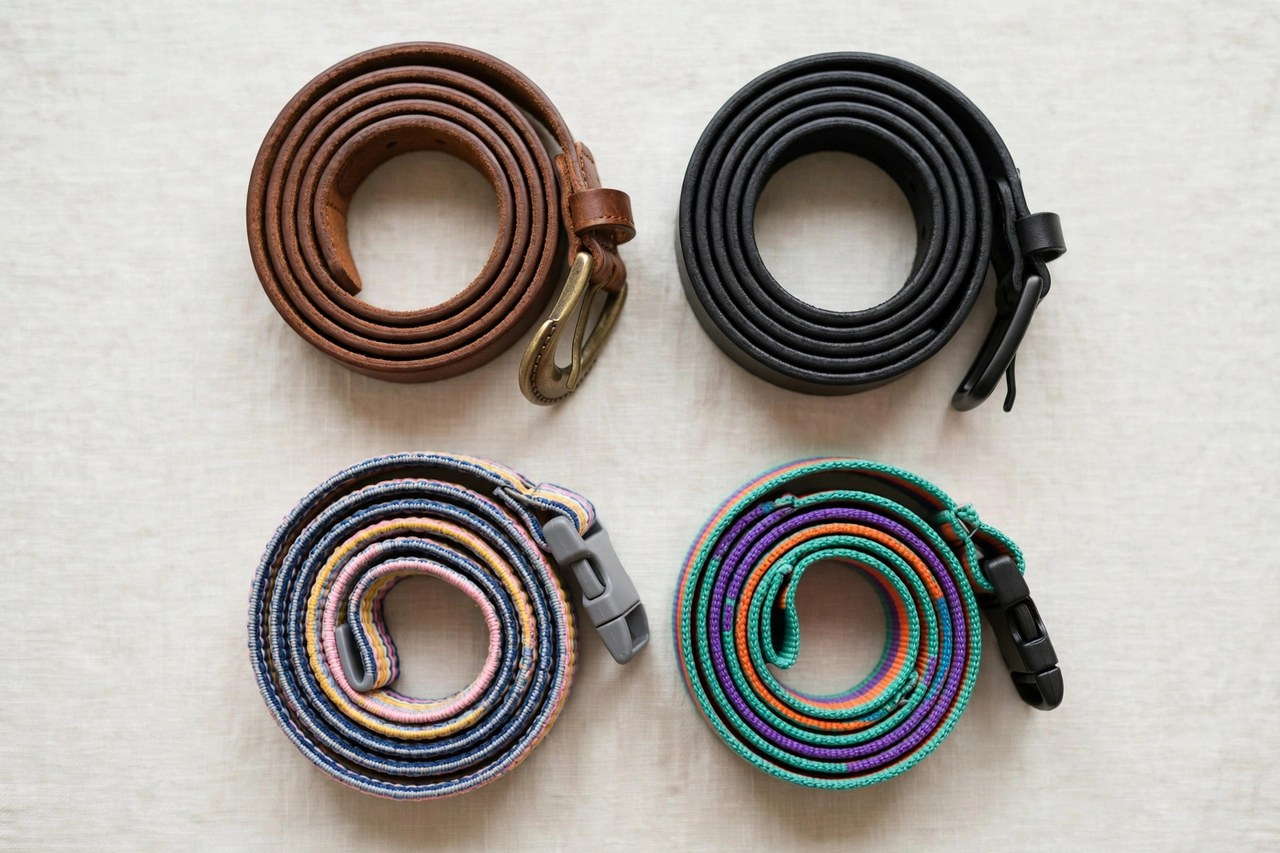
A children's belt holds trousers at the waist, finishes a school uniform and gives a child one of the first dressing skills that is entirely their own. Belts are functional accessories first: for most children a belt's first job is mechanical, keeping an adjustable waist where it belongs through a day of sitting, running and climbing, and its second job is looking neat doing it. This guide walks through the choices that matter - style, fit, fabric and finish - with the practical detail a product listing rarely gives, and closes with the care habits that keep the garment in service.
Styles and Construction
The families are leather, woven elastic, webbing and braided. Leather - even a simple corrected-grain strap - is the uniform and occasion belt: it slides through loops cleanly, takes a buckle well and polishes up for photographs. Woven elastic and webbing belts with slide or D-ring closures are the everyday heroes for younger children: infinitely adjustable, washable-ish and operable without help. Braided belts adjust at any point along their length, which suits the child between sizes, though the braid frays at the tip first. Reversible belts double the wardrobe value in one strap.
Children's accessories succeed on safety and simplicity: no small detachable parts for the youngest children, no long cords or ties that can catch on playground equipment, and closures a child can work alone. Materials should tolerate the child's real life - washable, chew-resistant for toddlers, and free of rough edges against skin. An accessory that needs adult help every time it is worn will simply stop being worn, however handsome it looks in the shop.
Fit and Sizing
Most children's trousers now carry adjustable waists, which raises the honest question of when a belt is needed at all: when the adjusters are at their limit, when a uniform code requires one, and when the child simply wants the finished look. Teach the buckle early and practice at home - a belt mastered in August is independence in September, while a belt first met on the first school morning is a queue for the teacher's help.
Accessories fit by measurement, not by age label: head circumference for hats, waist for belts measured over the trousers the belt will hold up, and hand length for gloves. Makers' charts vary more for accessories than for clothing, so measure and read the chart every time. Anything worn at the neck or head must fit close enough to stay put in play and loose enough to pull off easily - if a child cannot remove it alone, it does not fit yet.
Wearing and Care
Belts store rolled or hung by the buckle, never folded at the same crease. Wipe leather clean and condition it when it stiffens; the hole a child uses daily elongates over time, which is the sign to move a hole or size up, not to punch a new one at the strap's weakened end. Keep one spare school belt: belts join gloves and hats in the reliably-lost category, and the spare turns a lost belt into a laundry-day problem instead of a uniform violation.
Store children's accessories where the child can reach them - a low basket for hats and gloves, a hook for the belt - because an accessory with a home is an accessory that gets worn and does not get lost. Wash hats and soft accessories on the gentle cycle inside a mesh bag, reshape while damp, and check straps, buckles and fasteners monthly for cracks or looseness. Keep a spare pair of gloves and a spare hat from the start; winter loses them on schedule.
Common Questions
How do you size a child's belt?
Measure the child's waist over the trousers the belt will be worn with and choose a belt whose middle hole meets that measurement, leaving holes either side for growth and different trouser weights. As a shortcut, belts are often sold two inches or five centimeters above the trouser waist size. The strap should pass through all the loops without forcing, and the tip should reach just past the first loop when fastened.
Leather or elastic belt for a school uniform?
Leather for the finished look and where the code specifies it; elastic or webbing for younger children who must manage alone. Many families keep both: the leather belt for photographs, assemblies and occasions, the elastic for ordinary days. Either way, the buckle mechanism the child can operate beats the material the parent prefers.
When do children start wearing belts?
Usually when trousers stop staying up by elastic alone and when school dressing becomes independent - commonly between four and seven, but the trousers decide, not the birthday. Start with an easy closure, practice at home, and expect the first belt to be as much a dressing lesson as a garment.
More in Children's Clothes Guide B
The B letter hub and the guides closest to this one:
More to Explore on Apparel Search
Looking for Children's Clothing Stores?
This guide helps you choose children's belts. To browse where to buy, visit our children's clothing store directory, where you can find retailers that carry them.