Children's First Walkers Guide
From crib shoes to first walkers: why barefoot is best indoors, what a soft sole does, and the thumb-width fit checks for a baby's first real shoes.
Shop Baby First Walker & Crib Shoes Now
Shop Baby First Walker & Crib Shoes on Amazon Shop Baby First Walker & Crib Shoes on eBayThe Amazon and eBay links on this page are affiliate links. If you make a purchase through them, Apparel Search may earn a commission.
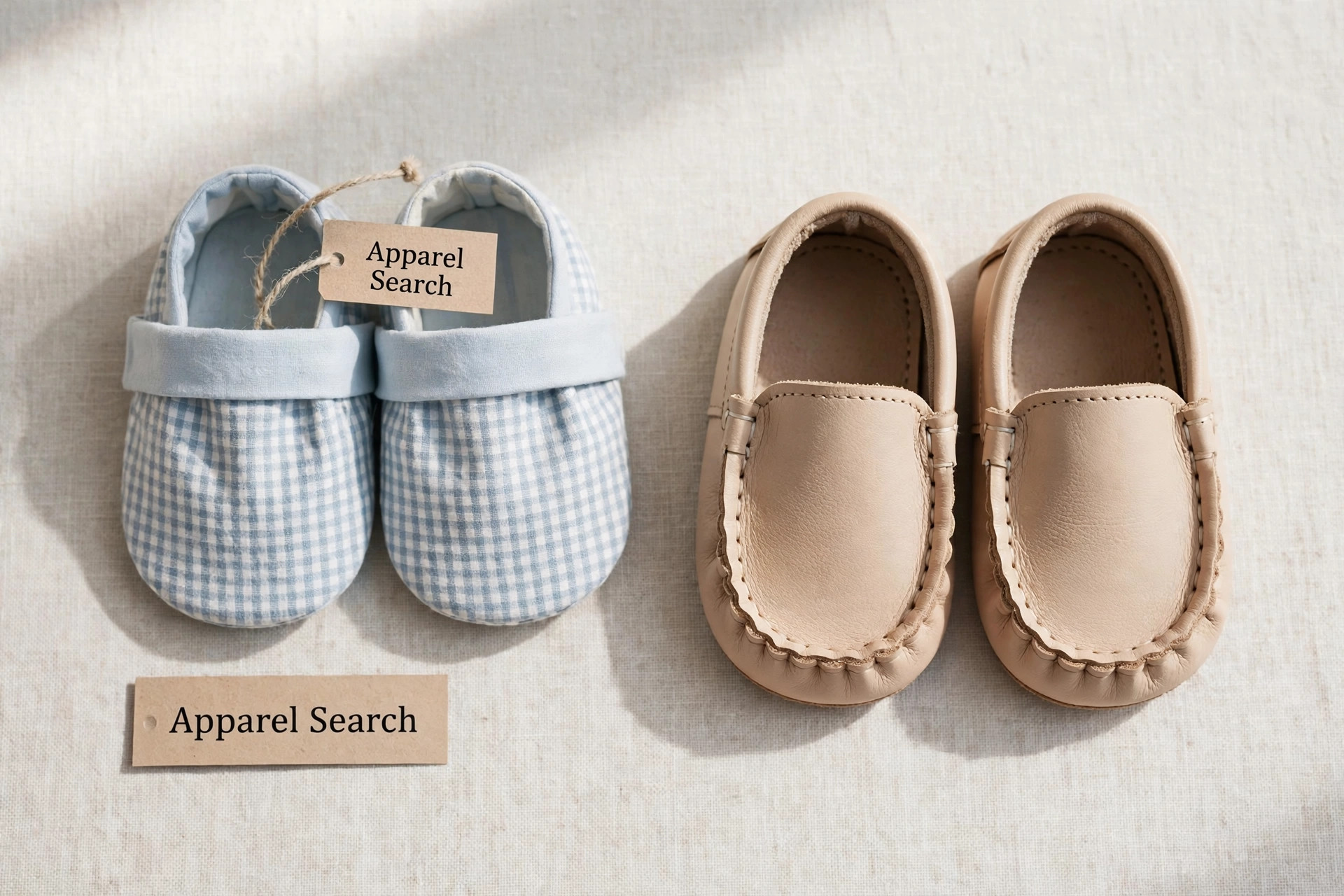
A baby's first footwear divides into two products that are often confused. Crib shoes are soft, decorative shoe-shaped covers — fabric or very soft leather, with no structured sole — worn for warmth, photographs and outings before a baby walks. First walkers are real shoes designed for the cruising and first-steps stage: still soft and flexible, but with a protective, grippy sole, a shaped heel and a fastening that keeps the shoe on a moving foot. Our infant and toddler shoes guide covers the wider children's shoe range that follows this stage.
The buying rule that governs both is simple: feet develop best unrestricted, so shoes are for protection — from cold, rough ground and outdoor surfaces — not for support or for teaching walking. Indoors, bare feet or grip socks give the traction and floor feedback a learning walker needs. This guide explains the stages, the features that matter, and the fit checks to repeat as fast-growing feet change size — the final piece of the baby basics set that begins with the layette.
Crib Shoes, Pre-Walkers and First Walkers: The Three Stages
Crib shoes (0–6 months, roughly) are the softest category: cloth uppers, elastic or tie fastenings, soles that are simply a second layer of fabric or suede. Their jobs are warmth and finish — they complete an outfit and keep socks on — and they should never be stiff or tight, since a pre-walking foot needs nothing but room. Pre-walkers or crawlers (about 6–12 months) add a full soft leather or suede sole: the baby is crawling, pulling up and cruising furniture, so the shoe protects against floors and splinters while still bending completely with the foot.
First walkers (from first independent steps) keep that flexibility but add structure where it earns its place: a thin rubber or rubber-compound outsole with grip patterning for outdoor ground, a slightly firmer heel counter so the shoe holds the heel in place, a padded collar, and a secure hook-and-loop strap or lace fastening. The test in hand is the bend: a proper first walker flexes easily at the ball of the foot and twists gently. Shoes that cannot be bent by hand are too stiff for this stage. Babies not yet walking outside do not need this category at all.
When Babies Need Shoes, and Measuring for the First Pair
Babies need shoes when they walk outdoors: pavement, gravel, cold or hot ground and public floors are what soles protect against. Before that point — and indoors afterwards — barefoot or non-slip socks are the standard recommendation of pediatric foot guidance, because toes grip, balance and strengthen without a shoe in the way. The trigger for buying is regular outdoor walking, not a birthday: sizing should follow the foot, not the calendar.
Measure both feet, in the afternoon, with the baby standing if possible, from heel to the longest toe — not always the big toe. Buy for the larger foot. Baby shoe sizes in the US run from about size 1 (roughly 3.5 inches) through size 5 or 6 (about 5.25 inches) across the first-walker stage, but every brand charts differently, so convert the measured length with the maker's chart each time rather than carrying a size between brands. Re-measure every two to three months: first-year feet can outgrow a shoe within a season.
Fit Checks and Care for First Shoes
Use three checks at every fitting. Length: there should be about a thumb's width — roughly half an inch (1–1.5 cm) — of growing room between the longest toe and the shoe's end, checked with the baby standing and weight on the foot. Width and instep: the shoe should fasten comfortably without bulging at the sides or gaping at the ankle, and the toes should lie flat, never curled to fit. Heel and walk: the heel should sit held, not slipping out with each step, and let the baby walk in them in the shop — refusing to walk often reports a fit problem. Shoes have no break-in period at this stage: a correct pair is comfortable immediately.
Wipe leather with a damp cloth and air-dry away from heat; brush suede soles to restore grip; machine-wash fabric crib shoes gently if the label allows. Check the fit monthly once walking begins — when toes reach the end or marks ring the foot after removal, the next size is due. For the sizes that follow, see our infant and toddler shoes guide.
Common Questions
When do babies actually need shoes?
When they walk outdoors. Shoes protect against rough, hot, cold or dirty ground; indoors, bare feet or grip socks are better for balance and foot development. Before independent walking, soft crib shoes or pre-walkers are enough for warmth and floor protection.
How much growing room should first walker shoes have?
About a thumb's width — roughly half an inch (1–1.5 cm) — between the longest toe and the end of the shoe, measured with the baby standing on the foot. Less room is outgrown almost immediately; much more makes the shoe trip a new walker. Re-check the fit every two to three months, because first-year feet grow quickly.
Should first walker shoes have stiff soles for support?
No. A first walker should bend easily at the ball of the foot and twist gently, with a thin, grippy outsole, a light heel counter and a secure fastening. Stiff, heavy shoes work against a new walker's balance and foot development; the shoe's job is protection and grip, not support.
More Children's Baby & Infant Basics Guides
The other guides in this cluster — bodysuits, sleep sacks, swaddles, the layette checklist, and first walker shoes:
More to Explore on Apparel Search
Complete the baby basics circle where it begins: back to the bodysuit guide, the foundation layer under everything in this cluster.
Next: Children's Onesie & Baby Bodysuit Guide: Styles, Snaps & Sizing by Weight »Looking for Children's Clothing Stores?
This guide helps you choose the right first shoes — soft-soled, correctly sized and bought at the right stage. To browse where to buy, visit our childrens clothing store directory, where you can find retailers that carry them.