Children's Printed Tees Guide
Printed tees are the everyday version of the printed top: soft short-sleeved tee shirts with a print - often smaller, softer and more repeatable than the big chest graphic of a statement t-shirt - bought not for one occasion but for the weekly rotation. This guide deliberately takes a different angle from its two sister pages in this letter: where printed shirts covers pattern judgment and printed t-shirts covers graphic print methods, this page covers the printed tee as a wardrobe staple - comfort, layering, school-day practicality and buying in sensible multiples.
Shop Children's Printed Tees Now
Shop Children's Printed Tees on Amazon Shop Children's Printed Tees on eBayThe Amazon and eBay links on this page are affiliate links. If you make a purchase through them, Apparel Search may earn a commission.
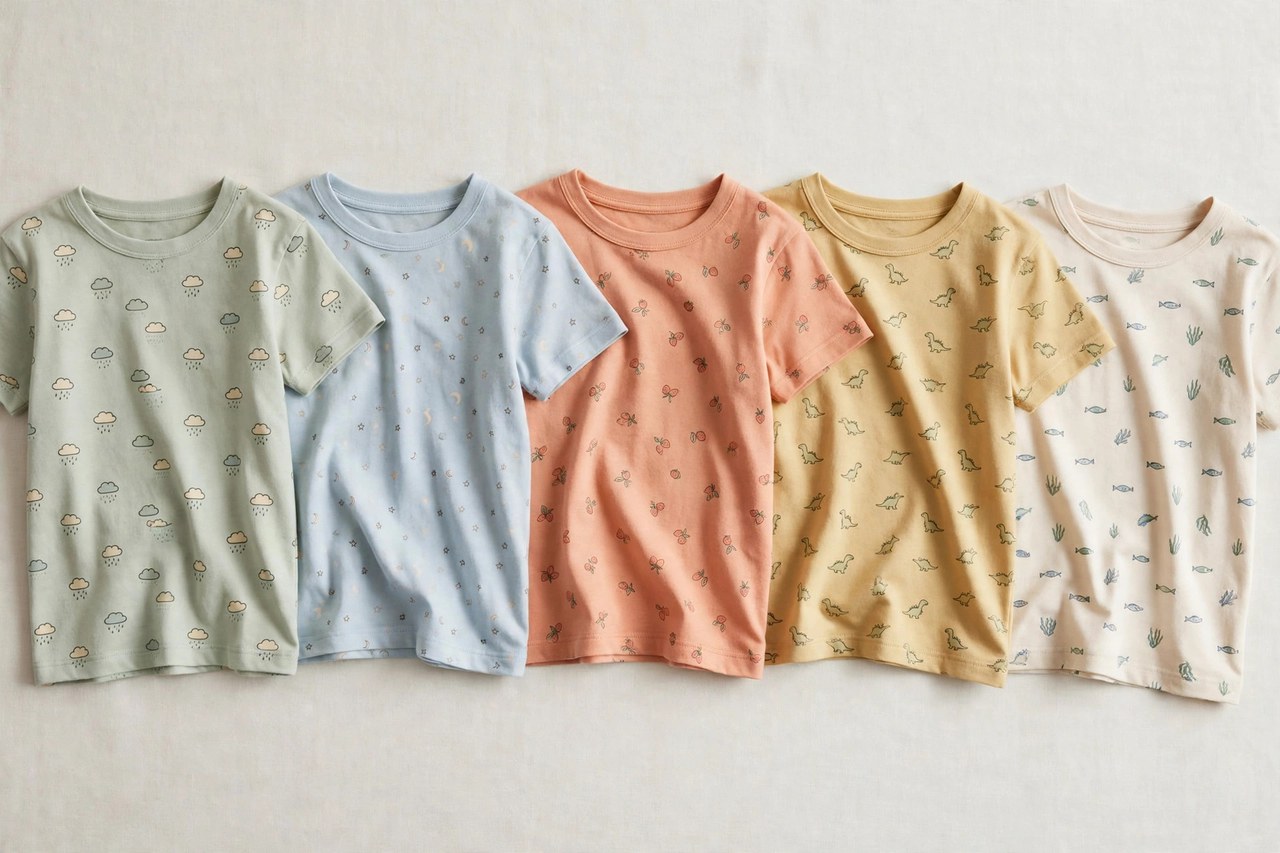
Printed tees are the everyday version of the printed top: soft short-sleeved tee shirts with a print - often smaller, softer and more repeatable than the big chest graphic of a statement t-shirt - bought not for one occasion but for the weekly rotation. This guide deliberately takes a different angle from its two sister pages in this letter: where printed shirts covers pattern judgment and printed t-shirts covers graphic print methods, this page covers the printed tee as a wardrobe staple - comfort, layering, school-day practicality and buying in sensible multiples.
The distinction is how the garment is lived in. A statement graphic tee is an event; a printed tee is Tuesday. Its print might be a small chest motif, a soft all-over pattern, a faded-look design or a gentle stripe-and-motif combination, and its success is measured in how often it comes out of the drawer clean, comfortable and uncomplicated - the shirt a child reaches for without thinking.
Comfort First: Softness, Weight and Easy Dressing
Everyday tees live or die on next-to-skin comfort. Soft, mid-weight cotton or cotton-blend jersey with a smooth print surface is the target: prints on everyday tees should be soft-hand - worked into the fabric feel rather than sitting on it like armour - because a stiff print on a shirt worn six hours a day will be complained about by hour two. Check the inside of the print area with your palm; if it feels rough or plasticky against skin, keep looking. Tagless necklines, flat seams and a collar rib that neither strangles nor sags complete the comfort picture.
Easy dressing is the second everyday test, especially for younger children: a neck opening that passes the head without a battle, sleeves that pull on without twisting, and no fastenings at all. A printed tee passes the school-morning test when a child can dress fully, unaided, in the dark, half asleep - because on school mornings, that is precisely the conditions under which it will be used.
Building the Rotation: Multiples, Colours and Layering
Printed tees are the one category where buying multiples is strategy, not excess. Three to five in rotation - a mix of the child's favourite prints and plain-adjacent quiet ones - covers the school week, absorbs the inevitable paint, food and playground incidents, and spreads washing wear so no single shirt is laundered to death. Choose a loose colour family across the set and every tee pairs with every bottom the child owns; that palette discipline, not any single shirt, is what makes mornings fast.
Layering is the tee's second job. Under dungarees, cardigans, hoodies and open shirts, a printed tee shows a slice of its design at the neck and hem and does quiet outfit work all year; in summer it stands alone with shorts or leggings. Long-sleeved printed tees extend the same rotation into cooler months. When a print is small or all-over, it layers without fighting the garment over it; save the one big statement graphic for the days it will be seen in full - its own page in this letter covers that shirt.
Value, Sizing and Knowing When a Tee Is Done
Size everyday tees for now-plus-a-little: enough ease to move and layer, not so much that sleeves cover hands and hems become tunics, because tees are cheap enough to replace on growth and miserable when swamped. Children's growth makes cost-per-wear the honest value measure - a modestly priced tee worn forty times beats a premium tee outgrown in ten wears, and the rotation system above is what guarantees the forty wears happen.
A printed tee is done when the jersey has thinned, the neck has waved beyond reshaping, the print has cracked across its centre, or growth has turned ease into stretch - at which point it retires to painting clothes, then to the rag bag, with honours. Keep the rotation stocked one size ahead during growth-spurt ages, buy soft-hand prints in a family of colours, and the humblest garment in the wardrobe becomes the one the whole week quietly runs on.
Common Questions
How is a printed tee different from a printed t-shirt?
In practice, emphasis. This guide uses printed tees for the everyday rotation shirt - softer, often smaller or all-over prints, bought in multiples for school and play - while the printed t-shirts page covers the statement shirt built around one bold chest graphic and its print methods. The garments overlap; the buying job differs.
How many printed tees should a child have?
Three to five in rotation covers a school week, spreads washing wear so no single shirt is laundered to death, and leaves a spare for paint, food and playground incidents. Choose them in a loose colour family so every tee pairs with every bottom the child owns.
What should I check for comfort on an everyday printed tee?
Soft-hand print that does not feel rough or plasticky on the inside, mid-weight jersey, a tagless or smooth neckline, and a neck opening a child can pull on unaided. A stiff print on a shirt worn all day will be complained about within hours, however good it looks on the rail.
More in Children's Clothes Guide P
The P letter hub and related P guides:
Looking for Children's Clothing Stores?
This guide helps you choose children's printed tees. To browse where to buy, visit our children's clothing store directory, where you can find retailers that carry them.