Children's Printed T-Shirts Guide
A printed t-shirt is the classic children's tee - a short-sleeved, collarless jersey shirt - carrying a printed design, usually one bold graphic placed on the chest. Where the printed shirts guide in this letter covers every shirt shape, this page is about the tee itself: the jersey it is cut from, the three print methods that put the picture on it, and the placement and care rules that decide whether a favourite graphic survives the season or cracks by half-term.
Shop Children's Printed T-Shirts Now
Shop Children's Printed T-Shirts on Amazon Shop Children's Printed T-Shirts on eBayThe Amazon and eBay links on this page are affiliate links. If you make a purchase through them, Apparel Search may earn a commission.
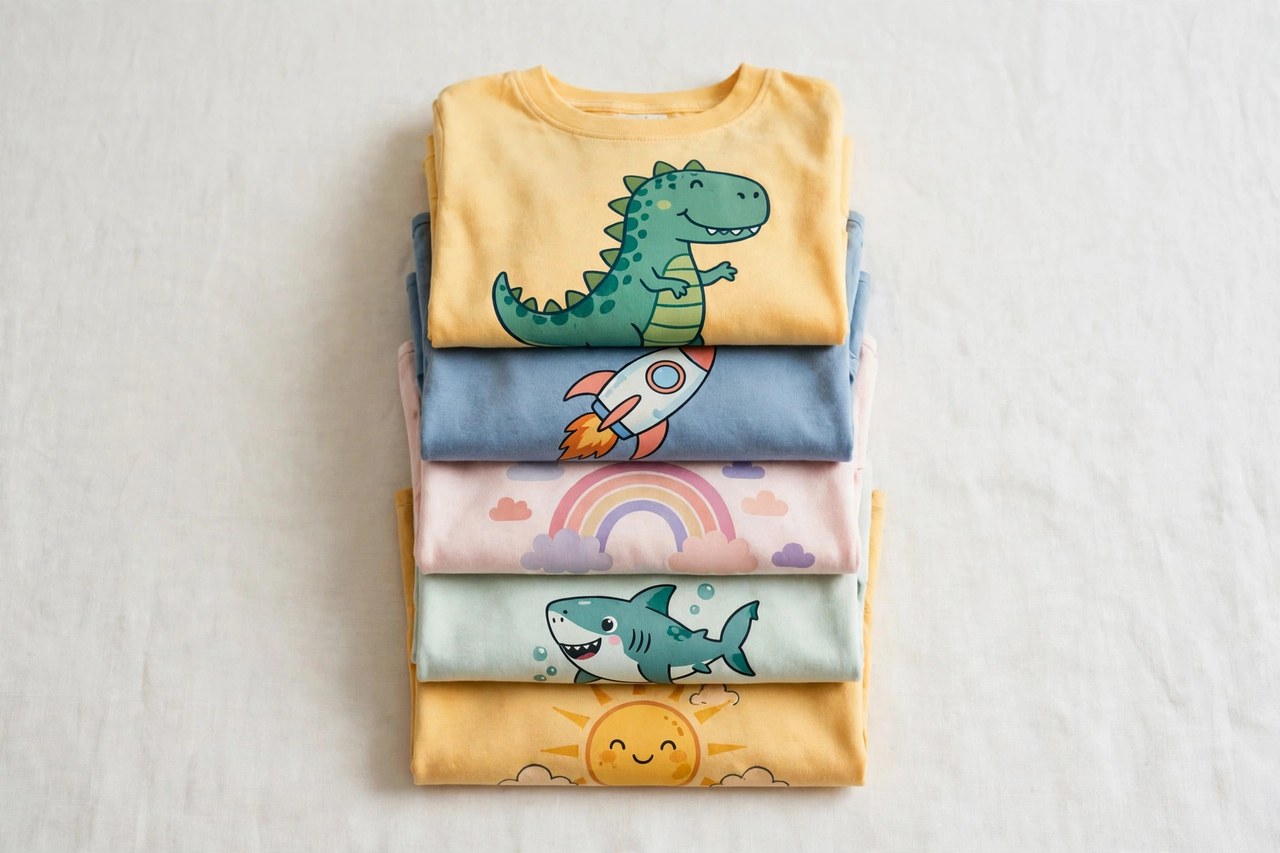
A printed t-shirt is the classic children's tee - a short-sleeved, collarless jersey shirt - carrying a printed design, usually one bold graphic placed on the chest. Where the printed shirts guide in this letter covers every shirt shape, this page is about the tee itself: the jersey it is cut from, the three print methods that put the picture on it, and the placement and care rules that decide whether a favourite graphic survives the season or cracks by half-term.
The graphic is the purchase. Children choose printed t-shirts the way adults choose posters - the picture is the point, and the shirt is its frame. Wearing funny t-shirts or novelty t-shirts that are printed is common for kids, and that appetite is the category: jokes, animals, space, sport, favourite colours and characters rendered as a wearable picture. The parent's job is not to overrule the picture; it is to make sure the frame - fabric, print quality, fit - deserves it.
The Tee Itself: Jersey, Neck and Fit
Most children's printed t-shirts are cotton or cotton-polyester jersey in a light to mid weight. Cotton is softest and breathes best; a blend resists shrinking, holds colour and shape a little longer, and dries faster - a fair trade for a shirt washed weekly. The crew neck is standard, its ribbing should lie flat and recover when stretched, and the shoulder seams and hems should be stitched evenly, because a tee's construction is simple enough that any sloppiness shows. A slightly heavier jersey carries a chest print better than a flimsy one: thin fabric lets a big print feel stiff and board-like against the chest.
Fit a printed tee by chest and length, and test the print area specifically: the design should sit flat across the chest, not stretched drum-tight, because a print stretched on the body is a print being pulled apart fibre by fibre. A little ease everywhere is the right buy for a growing child - the graphic keeps its proportions, the child keeps full arm movement, and the shirt survives being lived in rather than posed in.
Print Methods: Screen Print, Direct-to-Garment and Transfer
Screen printing pushes ink through a stencil onto the shirt and remains the durability benchmark for bold, simple graphics: a good screen print feels smooth and flexible, becomes part of the fabric's surface, and survives years of washing. Direct-to-garment printing sprays the design on like an inkjet, carrying photographs and fine gradients no stencil could, with a softer feel and slightly less wash toughness. Heat transfers apply a pre-printed film with heat and pressure; they reproduce anything, but they are the first to crack and peel, especially under hot tumble drying.
Judge any method the same way in the shop: the design's edges should be clean, its colours even, and its position centred and straight - measure from each armpit seam if your eye doubts it, because a crooked graphic cannot be un-crooked. Flex the printed area gently: it should bend with the jersey, not resist like a plastic badge. Thick, rubbery prints are not automatically bad, but on a child's everyday shirt, flexible beats thick every time.
Care: Keeping the Graphic Alive
Three habits protect every print method: wash the tee inside out, wash it cool with similar colours, and keep it out of high heat - low tumble or line dry. Inside-out washing stops the graphic abrading against other garments and the drum; cool water slows fading, especially in the saturated reds, blacks and neons novelty designs love; and heat is the direct enemy, softening transfer films and cracking ink films wash by wash. Never iron on the print itself - iron inside out, or around the design.
Bought and kept that way, a printed t-shirt does its double job all season: an easy, comfortable everyday top, and a small piece of self-expression a child picked personally - which is why the funny and novelty designs endure. Choose the picture together, check the jersey and the print like a frame deserves, and wash it like the picture matters, because to the child wearing it, it does.
Common Questions
Which print method lasts longest on a children's t-shirt?
Screen printing is the durability benchmark for bold, simple graphics - a good screen print feels smooth and flexible and survives years of washing. Direct-to-garment printing carries photographs and fine detail with a softer feel. Heat transfers reproduce anything but crack and peel first, especially in hot tumble dryers.
How can I tell if a printed t-shirt is good quality before buying?
Check that the design is centred and straight with clean edges and even colour, flex the printed area - it should bend with the jersey, not feel like a stiff plastic badge - and choose a mid-weight jersey, since thin fabric makes a big chest print feel board-like.
How should printed t-shirts be washed so the design does not crack?
Inside out, in cool water, with similar colours, then dried on low heat or on a line. Heat cracks ink films and softens transfers, and washing inside out stops the graphic abrading against the drum and other clothes. Never iron directly on the print.
More in Children's Clothes Guide P
The P letter hub and related P guides:
Looking for Children's Clothing Stores?
This guide helps you choose children's printed t-shirts. To browse where to buy, visit our children's clothing store directory, where you can find retailers that carry them.