Men's Health Care Uniforms Guide
A men's health care uniform is the clothing worn by health professionals - physicians, nurses, surgeons, dentists, technicians and the allied health professions - whose work is the diagnosis, treatment and prevention of disease and injury. What a provider wears depends on the field and on the activity: a doctor may dress one way for patient consultations and quite differently when ready for surgery. One thread connects every version: dressing in a safe and sanitary way, with good hygiene monitored at all times and uniforms kept clean at all times. The uniform is not a costume for the role - it is part of the care.
Shop Men's Health Care Uniforms Now
Shop Men's Health Care Uniforms on Amazon Shop Men's Health Care Uniforms on eBayThe Amazon and eBay links on this page are affiliate links. If you make a purchase through them, Apparel Search may earn a commission.
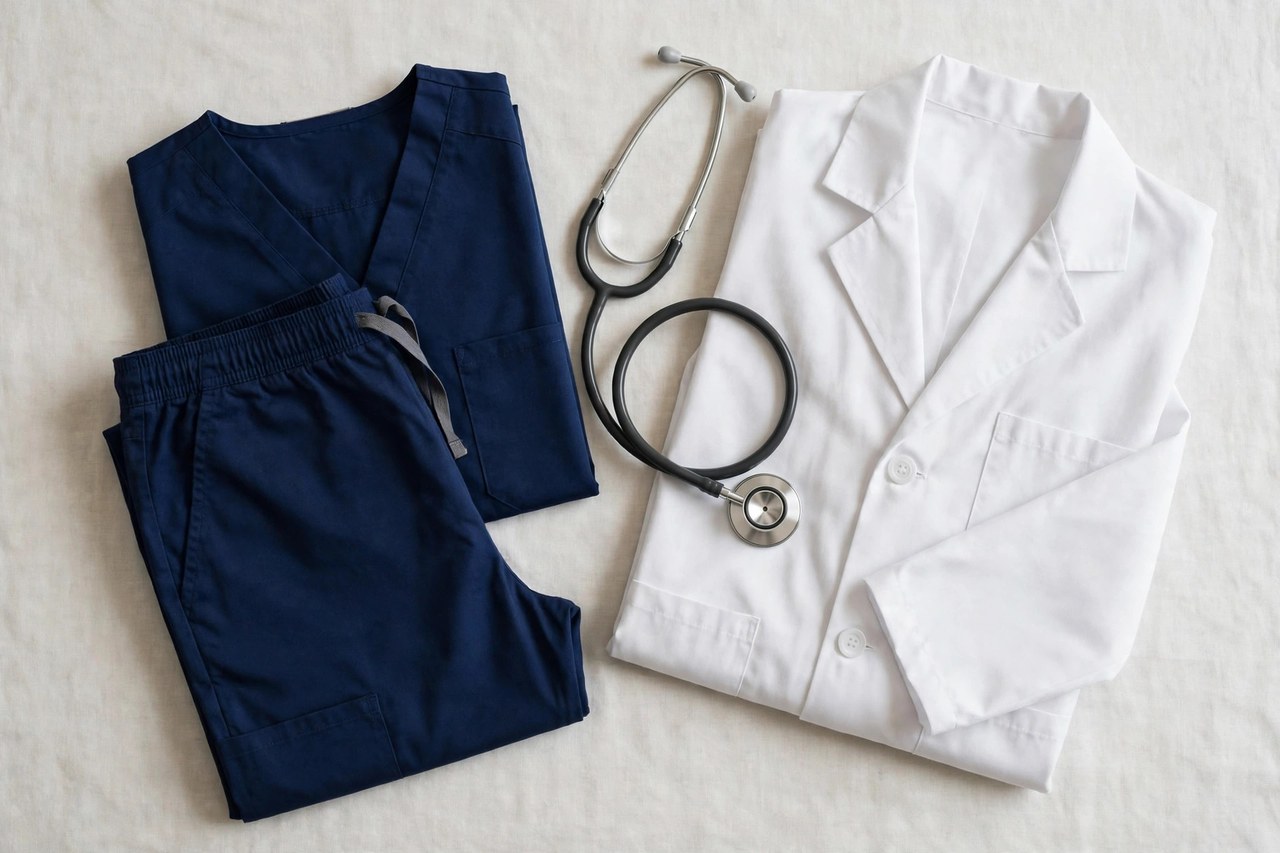
A men's health care uniform is the clothing worn by health professionals - physicians, nurses, surgeons, dentists, technicians and the allied health professions - whose work is the diagnosis, treatment and prevention of disease and injury. What a provider wears depends on the field and on the activity: a doctor may dress one way for patient consultations and quite differently when ready for surgery. One thread connects every version: dressing in a safe and sanitary way, with good hygiene monitored at all times and uniforms kept clean at all times. The uniform is not a costume for the role - it is part of the care. This guide is built around the questions buyers actually ask: which style, which size, which fabric, and what will it look like after a year of real use - answered in order, with the trade-offs stated plainly.
Styles and Construction
The working wardrobe divides by setting. Scrubs - the V-neck top and drawstring or elastic trousers born in the operating room - are now the general uniform of clinical work, in colors that often code department or role. The lab coat covers street clothes or scrubs for consultation and laboratory work, its length and pocketing varying by profession. Doctor's uniforms add the consultation dress of shirts and ties under a coat in some practices, while surgical work strips down to scrubs, cap, mask and gown - the surgical caps guide linked below covers the headwear. Fabrics are specified like equipment: cotton-polyester blends that survive industrial hot washing, fluid-resistant finishes where exposure demands them, and increasingly antimicrobial treatments whose claims should be read as carefully as their prices.
The durable buying order is job, specification, budget - in that sequence. Decide what the garment must do, translate that into fiber, weight, construction and size numbers, and only then shop price. Read labels as specifications, inspect the garment inside out where finishing is unposed, and prefer the maker who publishes measurements to the one who publishes adjectives. A garment that matches your measurements, climate and laundry will be worn; one that misses any of the three becomes expensive storage.
Fit and Sizing
Uniform fit is working fit inside a professional frame. Scrubs should allow a full range of motion - reaching, bending, lifting - without excess cloth that catches on equipment or brushes sterile fields: drawstring waists adjusted to sit at the natural waist, trouser lengths that clear the floor and the shoe, top lengths that stay decent when arms are raised. The lab coat fits over what is beneath it, closing without strain, its sleeves ending where glove and hand-washing begin. Many employers issue uniforms by size run; where you buy your own, buy the size that fits the longest shift, not the mirror, and buy enough sets that a clean uniform is never the reason a shift starts in yesterday's - hygiene is a rotation, and rotation is a quantity.
Measure yourself once a year and keep the numbers - chest, waist, inseam, foot, head - because bodies drift gradually while size habits never do. Shop from measurements, try garments under real conditions (over layers, in your own shoes, late in the day for footwear), and be honest about alterations: lengths and small waist changes tailor beautifully; shoulders, rises and patterns are the garment you bought forever.
Wearing and Care
Laundering is where this category parts company with ordinary clothing care: uniforms are washed hot, washed often, and washed separately. Follow the employer's and the garment's rules together - healthcare laundry is an infection-control step, so uniforms that have been in clinical settings are not lounged in, not worn to the shops on the way home, and not mixed casually with household wash where rules forbid it. Inspect for fluid-resistant finishes failing, elastic dying and seams opening; a uniform is protective equipment and retires like it. Keep a spare set accessible for the mid-shift change that contamination sometimes requires. Clean at all times - that is the whole care program in four words.
Five minutes when a garment comes off - shake it out, hang or fold it correctly, note the stain and the loose button - prevents most of the damage later blamed on quality. Keep a small kit where the clothes live: brush, lint roller, conditioner suited to your leathers, black, navy and grey thread. Clothing rarely dies at once; it fades by small neglects, and small attentions reverse the process at the same pace.
Common Questions
What do male health care workers wear as a uniform?
It depends on the field and the activity. The common base is scrubs - a V-neck top with drawstring or elastic-waist trousers - often color-coded by department or role. Consultations and laboratory work add a lab coat over scrubs or dress clothes; surgery reduces to scrubs with surgical cap, mask and gown; some physicians consult in shirt and tie under the coat. The constants are not the garments but the rules: safe, sanitary dressing and scrupulous hygiene, with uniforms kept clean at all times.
Why do health care uniforms put hygiene before appearance?
Because the uniform is part of infection control. Health care is delivered in environments where clothing can carry contamination between patients, so the fabric must survive hot, frequent laundering, the fit must keep cloth clear of sterile fields and equipment, and the rotation must guarantee a genuinely clean set every shift. Appearance matters - patients read professionalism from a uniform - but it ranks second, and any feature that fights the laundry or the work loses to both.
How many sets of scrubs or uniforms should you own?
Enough that cleanliness never depends on laundry luck: for full-time clinical work, a common working rule is a set per shift plus spares - five to seven sets - so each is washed after one wear and the rotation absorbs mid-shift changes and laundry delays. Part-time and student needs scale down proportionally. Whatever the number, the test is simple: the uniform you put on is clean, every time, without exception or improvisation.
More in Men's Clothes Guide H
Safe, Sanitary Dressing
Health care is the maintenance or improvement of health via the diagnosis, treatment and prevention of disease, illness, injury and other physical and mental impairments, delivered by health professionals across the allied health professions, chiropractic, physicians, physician associates, dentistry, midwifery, nursing, medicine, optometry, pharmacy, psychology and other fields, in primary, secondary and tertiary care and public health. The clothing follows the work: the clothing that a health care provider wears may depend on the particular field in which they work, and on the activities taking place — a doctor may dress one way for patient consultations and differently when ready for surgery. The primary connecting factor is dressing in a safe and sanitary way; monitoring good hygiene is important; keep your uniforms clean at all times.
Looking for Men's Clothing Stores?
This guide explains men's health care uniforms. To browse where to buy, visit our men's clothing store directory, where you can find retailers that carry them.