Men's Hunting Gloves Guide
Men's hunting gloves are gloves - garments covering the whole hand, with separate sheaths or openings for each finger and the thumb - specified for the field, where they are worn for warmth, camouflage and grip. If there is an opening but no, or only a short, covering sheath for each finger, they are fingerless gloves, and the hunting family uses every point on that spectrum: insulated full gloves for the stand, convertible mittens that free the fingers for the shot, lightweight camouflage gloves for concealment and mosquitoes, and the archer's specialized shooting gear. The hunter's hands must disappear, stay warm and still work - in that order of difficulty.
Shop Men's Hunting Gloves Now
Shop Men's Hunting Gloves on Amazon Shop Men's Hunting Gloves on eBayThe Amazon and eBay links on this page are affiliate links. If you make a purchase through them, Apparel Search may earn a commission.
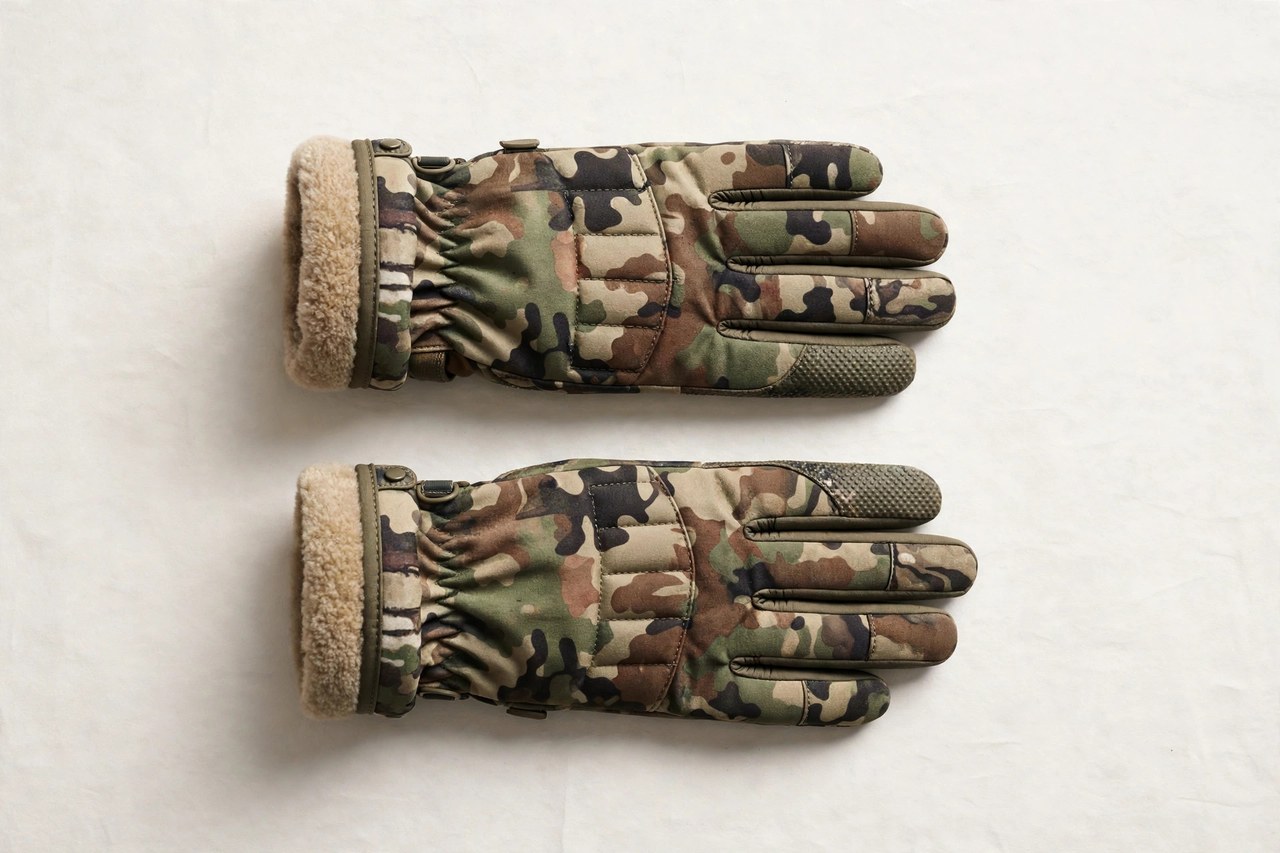
Men's hunting gloves are gloves - garments covering the whole hand, with separate sheaths or openings for each finger and the thumb - specified for the field, where they are worn for warmth, camouflage and grip. If there is an opening but no, or only a short, covering sheath for each finger, they are fingerless gloves, and the hunting family uses every point on that spectrum: insulated full gloves for the stand, convertible mittens that free the fingers for the shot, lightweight camouflage gloves for concealment and mosquitoes, and the archer's specialized shooting gear. The hunter's hands must disappear, stay warm and still work - in that order of difficulty. This guide covers the styles worth knowing, the fit points that decide comfort, the fabrics and construction that separate a good buy from a regret, and the simple care that makes the garment last.
Styles and Construction
Archery writes the family's oldest specialist chapter: for bow hunting, the drawing digits are normally protected by a leather tab, glove or thumb ring; a simple tab of leather is commonly used, as is a skeleton glove; medieval Europeans probably used a complete leather glove; and in traditional Japanese archery a special glove is used that has a ridge to assist in drawing the string. Around that heritage the modern range arranges itself: trigger-finger designs with thinned or removable index sheaths for rifle and shotgun, bow-release-compatible wrist openings, touchscreen fingertips for the modern hunt's maps and messages, and grip palms in silicone or leather where a stock or a bow must not slip in cold rain.
Accessories reward material honesty: solid metal over plated base metal, full-grain leather over bonded scraps, stitching over glue wherever fabric or hide is joined. Work every moving part through its full travel before paying - clasps, hinges, springs, adjusters - because small hardware fails before large materials do. And budget the care with the purchase: conditioner, the right cloth, a dry drawer; an accessory you can maintain will outlast a finer one you cannot.
Fit and Sizing
Fit a hunting glove for the coldest, stillest hour and the finest task together. Insulated gloves want the air margin warmth requires, but a trigger or a release punishes bulk exactly at the index finger - which is why convertible and fingerless designs exist, and why a stand glove and a shooting glove are often two pairs, not one compromise. Measure by knuckle circumference as with all gloves, then rehearse in them: work the action, the safety, the release, the call. Camouflage should match the wardrobe's pattern family, and the cuff must meet the jacket sleeve with no wrist gap - the pale flash of a wrist has ended more hunts than any glove's color. Buy the fit that passes the rehearsal, not the pair that merely matches the jacket.
Accessories have exact fits and exact measures: belt length to the middle hole of a belt you own, hat size as head circumference, a watch case within the wrist's width. Makers' accessory charts vary more than apparel charts, so measure and use the chart rather than ordering a habitual letter - ninety seconds with a tape prevents the most avoidable returns in menswear.
Wearing and Care
Glove care in this category is warmth preservation: dry insulated gloves slowly and fully after every hunt - a glove put away damp is a cold glove next time - and store them with the hunting wardrobe, sealed from household scent, washed only in scent-free detergent when they need it. Leather shooting tabs and gloves are conditioned lightly so the release surface stays smooth; a tab is replaced when its groove deepens into inconsistency, because archery accuracy lives in that leather. Check convertible mitten flaps and their magnets or buttons each season. Hands are the hunter's instruments, and their gloves are maintained like instruments: cleaned, dried, tested and ready before the season asks.
Store accessories deliberately: leather away from sun and plastic, metal dry, belts rolled or hung by the buckle rather than folded at the same crease forever. Condition leather a few times a year, polish metal with the cloth meant for its finish, and repair hardware early - a loose screw today is a lost cufflink or a failed clasp next month. Rotate daily pieces in pairs and both will outlast a single workhorse.
Common Questions
Why do hunters wear gloves besides warmth?
For camouflage and grip as much as warmth. Bare hands are among the most visible parts of a hunter - pale, moving, and catching light against a camouflaged wardrobe - so even warm-weather hunters wear lightweight gloves to disappear. Grip matters on wet stocks, cold metal and bow handles. And the family's specialists serve tasks directly: archery's tabs, shooting gloves and thumb rings protect the drawing digits, a lineage that runs from medieval leather gloves to the ridged glove of traditional Japanese archery.
What are convertible hunting gloves and mittens?
A glove-mitten hybrid: fingerless or short-sheathed glove fingers for dexterity, with a mitten flap that folds over them for warmth while sitting. They solve the stand hunter's dilemma - hours of motionless cold, seconds of fine work - by making the transformation one-handed and silent. Look for flaps that secure without noisy fasteners (magnets or quiet buttons), and rehearse the conversion with the glove on: a flap you cannot flip in the dark, quietly, is a feature that exists only in the catalog.
How should hunting gloves fit for shooting?
Warmth wants air; shooting wants contact. Reconcile them by task: a shooting glove or the shooting hand's glove should fit close, with the trigger finger thin enough to feel the safety and the trigger cleanly - many designs thin, split or remove that sheath. The non-shooting hand can wear the warmer, bulkier glove. Measure by knuckle circumference, then rehearse the actual motions - safety, trigger, bow release, calls - before deciding, because a glove is fitted by what the hand must do in it, not by the hand alone.
More in Men's Clothes Guide H
Gloves and the Archer’s Hand
A glove is a garment covering the whole hand, with separate sheaths or openings for each finger and the thumb; if there is an opening but no (or a short) covering sheath for each finger, they are called fingerless gloves. When going hunting, gloves can be worn for various reasons; they can be worn for warmth, camouflage, grip, etc., and certain types of hunting methods such as archery utilize specialized gloves. The archery account: for bow hunting, the drawing digits are normally protected by a leather tab, glove, or thumb ring; a simple tab of leather is commonly used, as is a skeleton glove; medieval Europeans probably used a complete leather glove; and in traditional Japanese archery a special glove is used that has a ridge to assist in drawing the string.
Looking for Men's Clothing Stores?
This guide explains men's hunting gloves. To browse where to buy, visit our men's clothing store directory, where you can find retailers that carry them.