Start Here
One Chain, Chosen Well
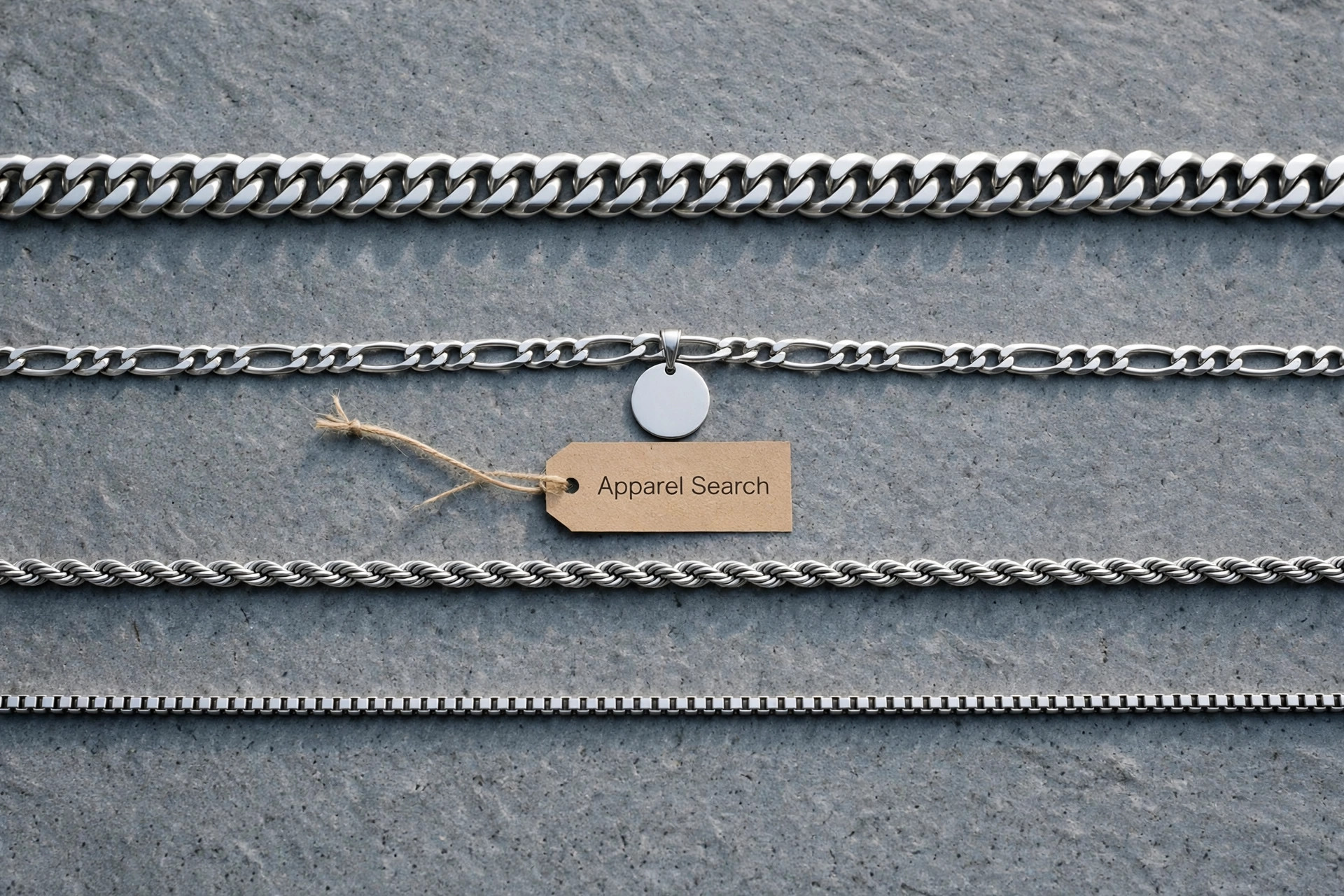
A man’s necklace is almost always a chain, and a chain is defined by three decisions: the pattern of its links, its length, and its thickness. Of the three, length is the one men most often get wrong — a well-made chain at the wrong length sits awkwardly against the collar and never quite settles, while a modest chain at the right length disappears into the outfit in the best way.
This guide works through the five chain styles that account for nearly every men’s necklace sold, the length range that suits most men, when a pendant earns its place, and the layering rules that keep two or three chains looking arranged rather than tangled. It sits inside the wider men’s jewelry guide, which covers how a chain should coordinate with bracelets, rings and a watch.
Chain Styles
Cuban, Figaro, Rope, Box and Franco Chains
Cuban link chains are built from thick, interlocking rounded links that lie flat against the chest. They are the boldest of the common styles and the most sensitive to thickness: slim versions read as a clean outline, heavy versions become the whole outfit. Figaro chains alternate a pattern of short links with one longer link, a traditional design that catches light unevenly and suits men who want a chain with visible character at a modest weight. Rope chains twist their links into a spiral that reflects light from every angle, which makes them look substantial at smaller thicknesses — a useful quality for a first chain.
Box chains use square links joined into a smooth, geometric line; they are strong for their size and are the standard carrier for pendants, because the flat profile keeps a pendant facing forward. Franco chains weave V-shaped links into a dense, flexible strand with a slightly rounded profile — durable, smooth against skin, and equally at home plain or holding a pendant. Whichever pattern appeals, the construction checks are the same: links should move freely without kinking, the clasp should close with a positive click, and the finish should be even along the whole length. The jewelry section’s chain necklaces page and its men’s necklaces page cover the category from the directory side.
Lengths
Length: The 20 to 24 Inch Working Range
Men’s chains are sold by length, and where the chain ends on the chest decides how it reads. An 18-inch chain sits at the base of the neck like a choker — a deliberate, fashion-forward choice that suits very few. A 20-inch chain ends at the collarbone and is the standard recommendation for a first chain: visible above an open collar, hidden under a closed one. A 22-inch chain falls a little below the collarbone and is the natural home for a pendant, giving it room to hang flat. A 24-inch chain reaches mid-chest, reads more relaxed, and layers well over a plain crew neck.
Two adjustments matter. Build matters: a broad neck and chest carry a 22 better than a slim frame carries a 24, and the only reliable test is measuring a string or cord to the length in question and looking in a mirror. Neckline matters too — chains sit best when their fall echoes the opening of the shirt rather than fighting it, disappearing under buttoned shirts except at an open top button, and lying cleanly over the plain surface of a crew-neck tee or fine knit. Thickness follows length: longer chains can carry a little more width before they look heavy, while a short chain should stay slim.
Pendants and Layering
Pendants, and the Rules for Layering Chains
A pendant turns a chain from an outline into a statement, so it should mean something or at least look like it does. The enduring men’s choices are simple forms — a dog tag, a small cross or other faith symbol, a coin, a minimal bar or disc — in the same metal as the chain. Proportion is the rule: the pendant should be narrower than the chain is bold, hang from a chain of 22 inches or so, and sit flat rather than spinning; box and Franco chains help with that last point. One pendant per chain, and usually one pendant per outfit.
Layering two or three chains works when three rules hold. Separate the lengths by at least two inches — 20 and 22, or 20, 22 and 24 — so each chain has its own line instead of bunching into one knot. Vary the link or the weight slightly so the layers read as distinct strands, keeping them in the same metal family, as the gold vs silver jewelry comparison explains. Limit the pendants to one across the whole stack. Layered chains belong with open collars, plain tees and knitwear; with tailoring, a single chain under the shirt is the office-safe version, and a dressed-up evening is where the fuller stack belongs — the same office-versus-evening balance the jewelry hub sets out, alongside finishing pieces like men’s sunglasses in the daytime.
Questions
Common Questions
What chain length is best for most men?
A 20-inch chain, which ends at the collarbone, suits most men and most necklines: visible above an open collar and hidden under a closed one. Choose 22 inches if you plan to wear a pendant or have a broader neck and chest, and 24 inches for a relaxed mid-chest fall or for layering over a crew neck.
Can you wear a chain necklace with a suit?
Yes, worn under the shirt. A slim chain at 20 or 22 inches sits beneath a dress shirt and tie without showing, or shows only slightly at an open collar without a tie. Bold chains, visible pendants and layered stacks sit badly with tailoring — save them for open collars and casual dress, and keep the chain’s metal in line with the watch and cufflinks.
How many necklaces can a man layer at once?
Two or three is the workable range. Keep at least two inches between each length so the chains fall in separate lines, vary the link style or weight slightly so the strands read as distinct, keep every layer in the same metal family, and wear only one pendant across the whole stack.
More to Explore
Search Apparel Search