Start Here
The Ring Is the Fixture Piece
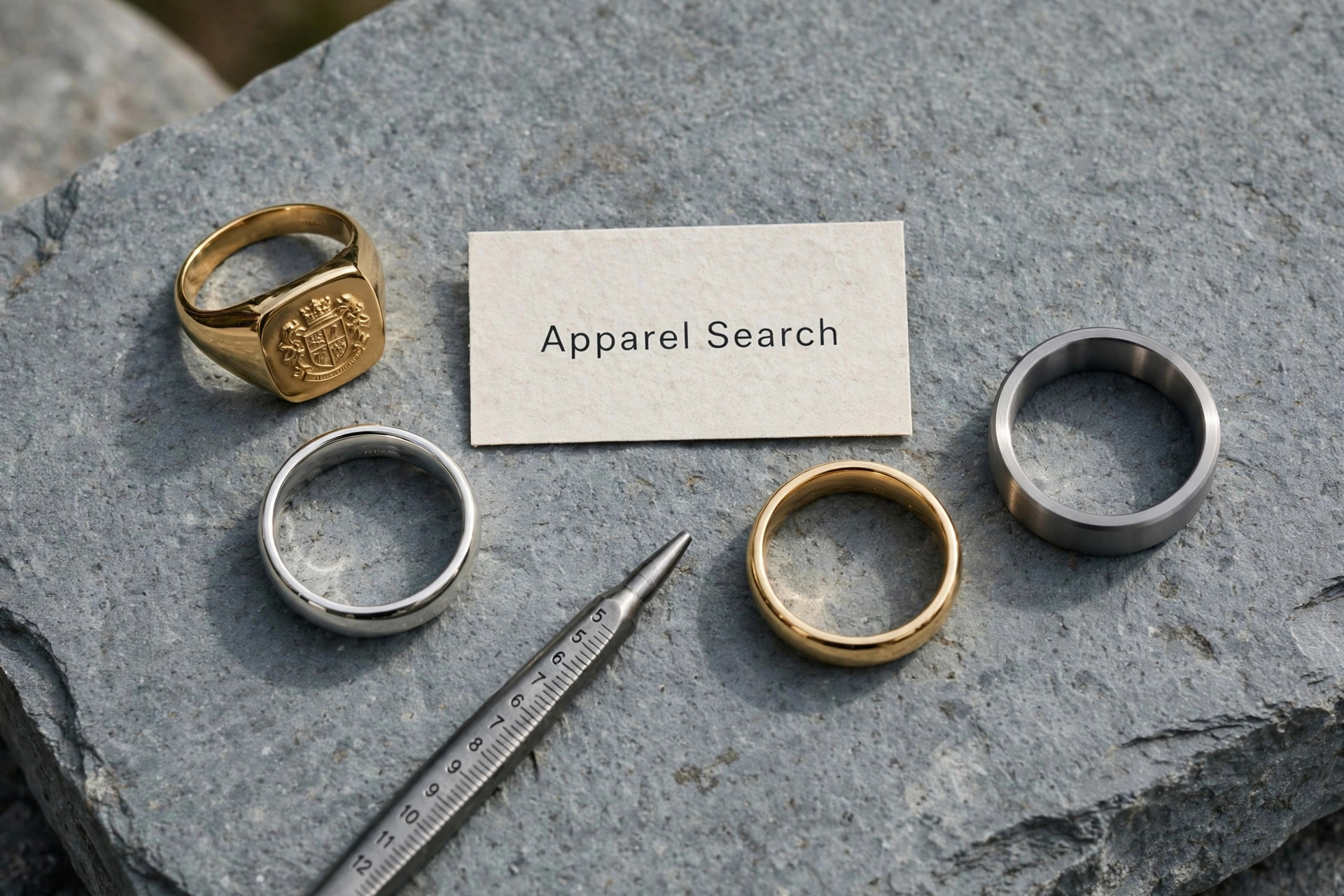
Chains come off at night and bracelets change with the outfit, but a man’s ring is usually worn every day, through handshakes, handwashing and work. That makes the ring the fixture piece of the men’s jewelry system: the one whose metal the other pieces tend to follow, and the one where a small mistake — a half size too tight, a profile that catches on everything — is felt daily rather than occasionally.
Three ring types account for nearly all men’s rings: the wedding band, the signet and the plain fashion band. This guide covers what each one is, the surprisingly specific question of which finger each belongs on, how sizing actually works, and which metals survive daily wear with the least fuss.
The Types
Wedding Bands, Signets and Plain Bands
The wedding band is the ring most men wear: a plain or lightly finished band, traditionally in gold and now just as often in platinum, palladium, titanium or tungsten. Its decisions are width — most men settle between about 4 and 7 millimetres — profile, since a rounded comfort-fit interior is kinder for all-day wear, and finish, polished, brushed or matte. The jewelry section’s wedding bands page covers the category, and the men’s wedding guest guide covers the clothing side of the day itself.
The signet ring carries a flat face, historically engraved with a crest, initials or a seal and pressed into wax; today the engraving is decorative rather than functional, and plain polished faces are as common as engraved ones. It is the most traditional statement ring a man can wear, with its own page in the jewelry section’s signet rings guide. The plain band, worn purely as jewelry, borrows the wedding band’s shape without its meaning: brushed steel, blackened finishes, wood or stone inlays and engraved exteriors all live here, and it is the easiest ring to start with because it asks nothing of the wearer but the choice of finger.
Which Finger
Which Finger: What Each Position Says
Finger choice is partly convention and partly comfort, and the conventions are worth knowing even when you intend to ignore them. The ring finger of the left hand is reserved in most Western convention for the wedding band — and in some countries the right hand does that job — so a fashion ring worn there will be read as a wedding ring whether it is one or not. The pinky is the signet’s traditional home: it keeps the ring visible, out of the grip, and historically clear of the wedding finger’s meaning, and it remains the classic position for family and club rings. The index finger suits a bolder ring that is meant to be seen — it was the finger of authority in older convention — while the middle finger takes the largest rings comfortably but sits close enough to the ring finger to blur meanings. The thumb is the modern, casual position, usually for a wide plain band.
Two practical rules sit under the conventions. One statement ring per hand is the comfortable ceiling for most men, and rings should stay clear of the grip side of working hands if the metal is soft. Whatever the finger, coordinate the metal with the rest of the system — the watch case, the belt buckle and any chain — as the jewelry hub recommends, and match the formality to the day: a signet sits as naturally with the formalwear end of the wardrobe as a plain steel band does with denim.
Sizing, Metals and Care
Sizing, and the Metals That Survive Daily Wear
Ring sizes are numbers, and the only reliable way to learn yours is to be measured — by a jeweler’s ring sizer, or with a printable gauge used carefully. Measure at the end of the day, when fingers are at their largest, and more than once: fingers change size with temperature, salt and season, and the right size slides on with slight resistance and comes off with a small tug past the knuckle. Width matters as well — a wide band fits tighter than a narrow one in the same size, so size up slightly for broad bands. Resizing is straightforward for gold and silver bands, difficult for steel, and generally impossible for tungsten and most alternative-metal rings, which is worth knowing before choosing one.
For daily wear the metal ranking is a trade between character and hardness. Gold and platinum are the traditional choices: durable across decades, resizable, and repairable, with higher-karat gold marking more easily. Sterling silver is soft enough to scratch and will tarnish, but it is inexpensive to restore and carries engraving beautifully — the signet’s classic metal. Stainless steel and titanium are light, hard and nearly carefree, at the cost of the resizing limits above. Care itself is undemanding: wash rings in warm water with a drop of mild soap, keep them away from harsh chemicals and abrasive cleaners, take soft-metal rings off for heavy manual work, and follow the fuller routine in how to clean jewelry at home. The jewelry section’s men’s rings page maps the wider category.
Questions
Common Questions
Which finger should a man wear a signet ring on?
Traditionally the pinky finger of the non-dominant hand. The pinky keeps a signet visible, clear of the grip and separate from the wedding ring finger’s meaning, and it has been the conventional position for family, school and club signets for generations. Wearing one on the ring or index finger is a modern variation, not an error.
How do I find my ring size?
Have a jeweler measure you with a ring sizer, or use a printable sizing gauge carefully at home. Measure at the end of the day, when fingers are at their largest, and check more than once, since fingers change with temperature and season. A correct size slides on with slight resistance and comes off with a small tug over the knuckle; size up slightly for wide bands.
Can a man wear more than one ring?
Yes — a wedding band plus one other ring is the most common arrangement, and one statement ring per hand is a comfortable ceiling for most men. Keep multiple rings in the same metal family as each other and as the watch and any chain, and be aware that a ring on the left ring finger will be read as a wedding band in most settings.
More to Explore
Search Apparel Search