Men's Wallets Guide
A men's wallet is the small leather or fabric case that organizes cash, cards and identification in a pocket. The right one is a capacity decision disguised as a style decision: bifolds, trifolds, card cases and money-clip designs each carry a different amount with a different footprint, and the wallet that works is the one sized to what you genuinely carry every day.
Shop Men's Wallets Now
Shop Men's Wallets on Amazon Shop Men's Wallets on eBayThe Amazon and eBay links on this page are affiliate links. If you make a purchase through them, Apparel Search may earn a commission.
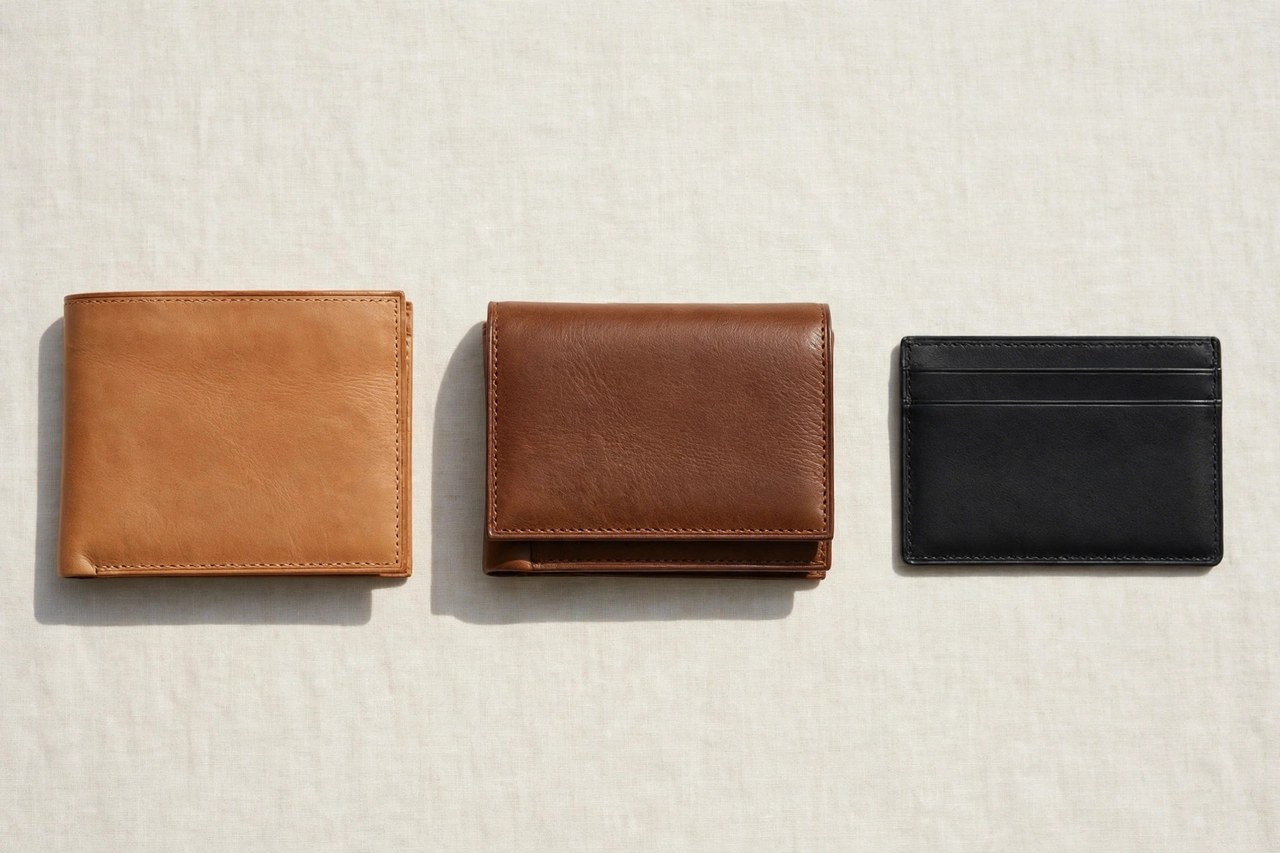
A men's wallet is the small leather or fabric case that organizes cash, cards and identification in a pocket. The right one is a capacity decision disguised as a style decision: bifolds, trifolds, card cases and money-clip designs each carry a different amount with a different footprint, and the wallet that works is the one sized to what you genuinely carry every day. This guide covers the styles worth knowing, the fit points that decide comfort, the fabrics and construction that separate a good buy from a regret, and the simple care that makes the garment last.
Styles and Construction
Full-grain leather is the durability benchmark - it is the top, tightest layer of the hide and ages by polishing rather than peeling. Top-grain is lightly corrected and more uniform; bonded leather is reconstituted scraps and fails early at folds. Construction tells: edges burnished or painted neatly, stitching even and unbroken at the corners, card slots cut so cards slide without forcing, and linings that are fabric rather than paper-thin synthetic. RFID-shielding linings exist for contactless cards; treat them as a preference, not a necessity. Nylon and technical fabrics suit sport and travel, and cork or recycled materials cover the non-leather options.
Accessories reward material honesty: solid metal over plated base metal, full-grain leather over bonded scraps, stitching over glue wherever fabric or hide is joined. Work every moving part through its full travel before paying - clasps, hinges, springs, adjusters - because small hardware fails before large materials do. And budget the care with the purchase: conditioner, the right cloth, a dry drawer; an accessory you can maintain will outlast a finer one you cannot.
Fit and Sizing
Fit a wallet to your pocket and your carry: load it in the shop if you can, because a bifold stuffed past its design thickness stresses every seam and prints through trousers. Slim card cases carry four to eight cards plus folded notes and disappear in a front pocket - the back-saving choice many men switch to. A wallet should close flat without forcing; if it springs open on the counter, it is over capacity for its pattern.
Accessories have exact fits and exact measures: belt length to the middle hole of a belt you own, hat size as head circumference, a watch case within the wrist's width. Makers' accessory charts vary more than apparel charts, so measure and use the chart rather than ordering a habitual letter - ninety seconds with a tape prevents the most avoidable returns in menswear.
Wearing and Care
Empty and reshape a leather wallet occasionally, keep it out of back pockets when sitting for long periods if you want it - and your posture - to age well, and condition leather lightly once or twice a year. Never wash a leather wallet; wipe with a barely damp cloth and dry naturally. Rotate the cards you carry and most wallets gain years: it is the daily overstuffing, not the leather, that kills them first.
Store accessories deliberately: leather away from sun and plastic, metal dry, belts rolled or hung by the buckle rather than folded at the same crease forever. Condition leather a few times a year, polish metal with the cloth meant for its finish, and repair hardware early - a loose screw today is a lost cufflink or a failed clasp next month. Rotate daily pieces in pairs and both will outlast a single workhorse.
Common Questions
Bifold or trifold - which is better?
A bifold is thinner, easier on pockets and cards, and suits men who carry mostly cards. A trifold carries more, including unfolded receipts and extra cash, but sits noticeably thicker. Choose by what you carry after an honest clear-out, not before it.
What does full-grain leather actually mean?
Full-grain is the outermost layer of the hide with its natural grain intact - the strongest, most durable leather, which develops a patina instead of cracking. It costs more than corrected or bonded leathers because only a fraction of each hide qualifies.
Should I carry my wallet in my back pocket?
A thick wallet in a back pocket twists your seated posture and wears a hole in the trouser seat; it is also the easiest pocket to pick. A slim wallet in a front pocket is the better habit for your back, your trousers and your security.
More in Men's Clothes Guide W
Background and History
The word “wallet” has been in use since the late 14th century to refer to a bag or a knapsack for carrying articles. The modern bi-fold wallet with multiple "card slots" became standardized in the early 1950s with the introduction of the first credit cards. Some innovations include the introduction of the velcro-closure wallet in the 1970s. Pocket-sized wallets remain extremely popular to this day. A wallet is a small, flat case that can be used to carry such personal items as cash, credit cards, and identification documents (driver's license, identification card, etc.), photographs, transit pass, gift cards, business cards and other paper or laminated cards. Wallets are generally made of leather or fabrics, and they are usually pocket-sized but not always foldable. The traditional material for wallets is leather or fabric, but many other flexible flat sheet materials can be used in their fabrication.
Looking for Men's Clothing Stores?
This guide explains men's wallets. To browse where to buy, visit our men's clothing store directory, where you can find retailers that carry them.