Men's Wool Blazers Guide
A men's wool blazer is the single tailored jacket in navy - traditionally with metal buttons - that pairs with everything from grey flannels to chinos and denim. In wool it gains the fiber's full skill set: a clean drape, wrinkle recovery between wears, natural temperature regulation and cloth options from smooth hopsack to brushed flannel that tune the same jacket from summer to winter.
Shop Men's Wool Blazers Now
Shop Men's Wool Blazers on Amazon Shop Men's Wool Blazers on eBayThe Amazon and eBay links on this page are affiliate links. If you make a purchase through them, Apparel Search may earn a commission.
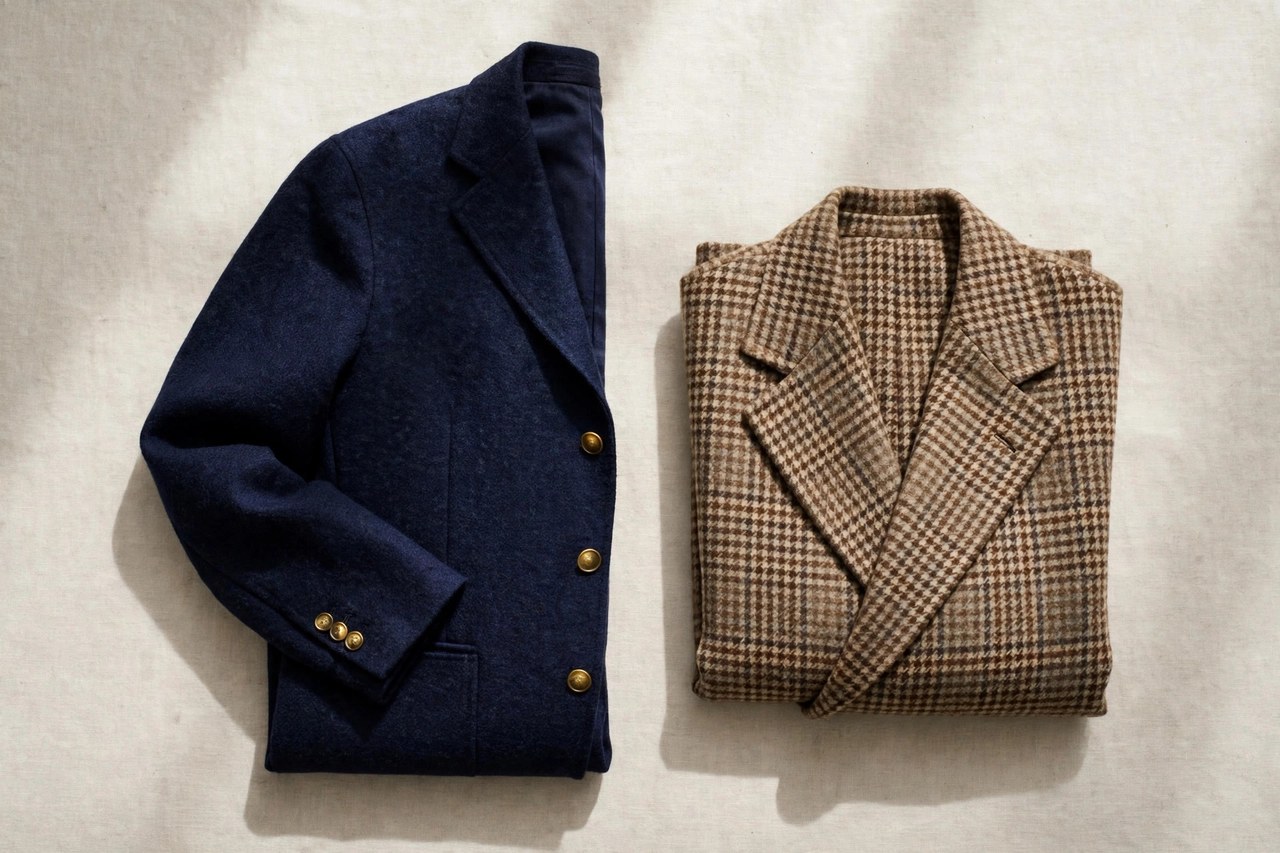
A men's wool blazer is the single tailored jacket in navy - traditionally with metal buttons - that pairs with everything from grey flannels to chinos and denim. In wool it gains the fiber's full skill set: a clean drape, wrinkle recovery between wears, natural temperature regulation and cloth options from smooth hopsack to brushed flannel that tune the same jacket from summer to winter. This guide explains what to look for, how the sizing actually works, which fabrics and constructions earn their price, and how to care for the garment so it keeps doing its job season after season.
Styles and Construction
Cloth decides the blazer's season and character. Hopsack and plain-weave worsteds breathe and resist wrinkles, making them the travel and summer choice; serge is the classic smooth standard; flannel gives a soft, matte, winter blazer that pairs beautifully with grey trousers in a different texture. Construction divides the market: a half-canvassed chest shapes and lasts, fused fronts cost less and risk bubbling with age, and patch pockets plus softer shoulders read casual while flap pockets and structure read formal. Metal buttons - brass, gilt or gunmetal - mark the true blazer; horn-look buttons move the jacket toward the sports coat family covered in its own guide.
A tailored wool coat or jacket is judged in layers: the cloth, the canvas or fusing that gives the chest and lapels their shape, and the lining that lets it glide over knitwear. Melton weaves dense and wind-tight for peacoats and overcoats, flannel reads soft and matte, tweeds hide wear and suit country styling, and gabardine runs smooth for rain-shedding trench styles. Sleeves should show clean pitch without diagonal drag lines, the collar should hug the neck, buttons should be sewn with thread shanks, and a half or full canvas front will drape and recover better than a fully fused one at the same cloth weight.
Fit and Sizing
Fit a blazer by its shoulders and button stance: shoulders end at yours, the buttoned front closes without an X-pull, the collar hugs the neck, and the length covers the seat. Wool's slight give means a neat new fit settles into a personal one within a few wears, but it will not fix a wrong shoulder. Sleeves should show a sliver of shirt cuff. Try it over the knitwear you will actually layer - a blazer fitted over a T-shirt alone is a size smaller than your winter wardrobe needs.
Tailored wool outerwear should be brushed after wear - a clothes brush lifts surface soil before it works into the weave - and rested a full day between outings on a broad hanger that carries the shoulders. Spot-clean promptly rather than washing; dry clean only a few times a season, since solvent and pressing fatigue cloth and canvas. Store coats clean, unbuttoned, in breathable garment bags with moth protection, never compressed in plastic. Set the creases and lapel roll with steam, not a hard press, and have loose buttons and lining tears repaired early - a coat's structure makes small repairs cheap and neglect expensive.
Wearing and Care
Brush a wool blazer after wear, rest it a day or two between outings on a broad hanger, and steam wrinkles out rather than pressing lapels flat - the roll is the jacket's life. Dry clean sparingly, a few times a season at most, spot-clean promptly, and store clean in a breathable bag with cedar. Buttons sewn with shanks can be re-sewn in minutes; a loose one ignored becomes a lost brass button that no shop can match.
Fit a wool coat or sports coat over the bulkiest layer it will honestly cover - a sweater for an overcoat, a shirt and light knit for a blazer - and test the working range: arms forward, arms crossed, sitting with the buttons fastened. Shoulders end at yours, the collar sits against the neck without a gap, and the fronts close without an X of pulling at the button. Coat length is coverage: a trench or overcoat should reach at least mid-thigh, a peacoat ends at the hip, and a blazer should cover the seat. Sleeve length shows a sliver of shirt cuff on tailored jackets; coat sleeves protect the wrist.
Common Questions
What is the difference between a blazer and a sports coat?
Traditionally the blazer is solid - usually navy - with metal buttons and a slightly nautical heritage, while sports coats come in patterns and textures like tweeds and checks with ordinary buttons. In modern shops the words blur, but solid navy plus metal buttons is still the blazer formula.
Which wool cloth makes the most versatile blazer?
A midweight hopsack or plain worsted in navy: it breathes in summer, layers in winter, sheds wrinkles on trips and pairs with grey, tan, denim and white trousers alike. Flannel is the cosier winter specialist; hopsack is the year-round generalist.
Can a wool blazer be worn with jeans?
Yes - it is one of the blazer's classic pairings. Keep the jeans dark, plain and well fitted, wear a neat shirt or fine knit beneath, and choose footwear a step up from trainers. The blazer dresses the denim up; ripped or faded jeans fight it.
More in Men's Clothes Guide W
Background
A blazer is a lightweight jacket, typically solid-colored (most often dark blue), often worn as part of a uniform by members of a club, sports team, or school. It is a plain jacket, typically in navy color, not forming part of a suit but considered appropriate for formal or semiformal wear. When it is made from wool fiber is it would be a wool blazer. Wool is the textile fiber obtained from sheep and other animals, including cashmere and mohair from goats, qiviut from muskoxen, angora from rabbits, and other types of wool from camelids. Wool can be woven into thick fabrics with a deep, rich texture. It can make anything from very fine and silky threads to thick, coarse yarns. The resulting fabrics can range from thick, hairy, and coarse to extremely lightweight and smooth to the touch. The fabric is often used for men's suits, sport coats, and blazers. In addition to its appearance, wool holds heat in extremely well.
Looking for Men's Clothing Stores?
This guide explains men's wool blazers. To browse where to buy, visit our men's clothing store directory, where you can find retailers that carry them.