Men's Wool Jackets Guide
Men's wool jackets are the shorter, everyday members of the wool outerwear family - sports jackets, tweed jackets, wool bomber and trucker styles, overshirts and field jackets - cut at hip to thigh length rather than the overcoat's knee. They are the jackets men actually live in from October to April, layered over knitwear and shirts wherever a full coat is more than the day requires.
Shop Men's Wool Jackets Now
Shop Men's Wool Jackets on Amazon Shop Men's Wool Jackets on eBayThe Amazon and eBay links on this page are affiliate links. If you make a purchase through them, Apparel Search may earn a commission.
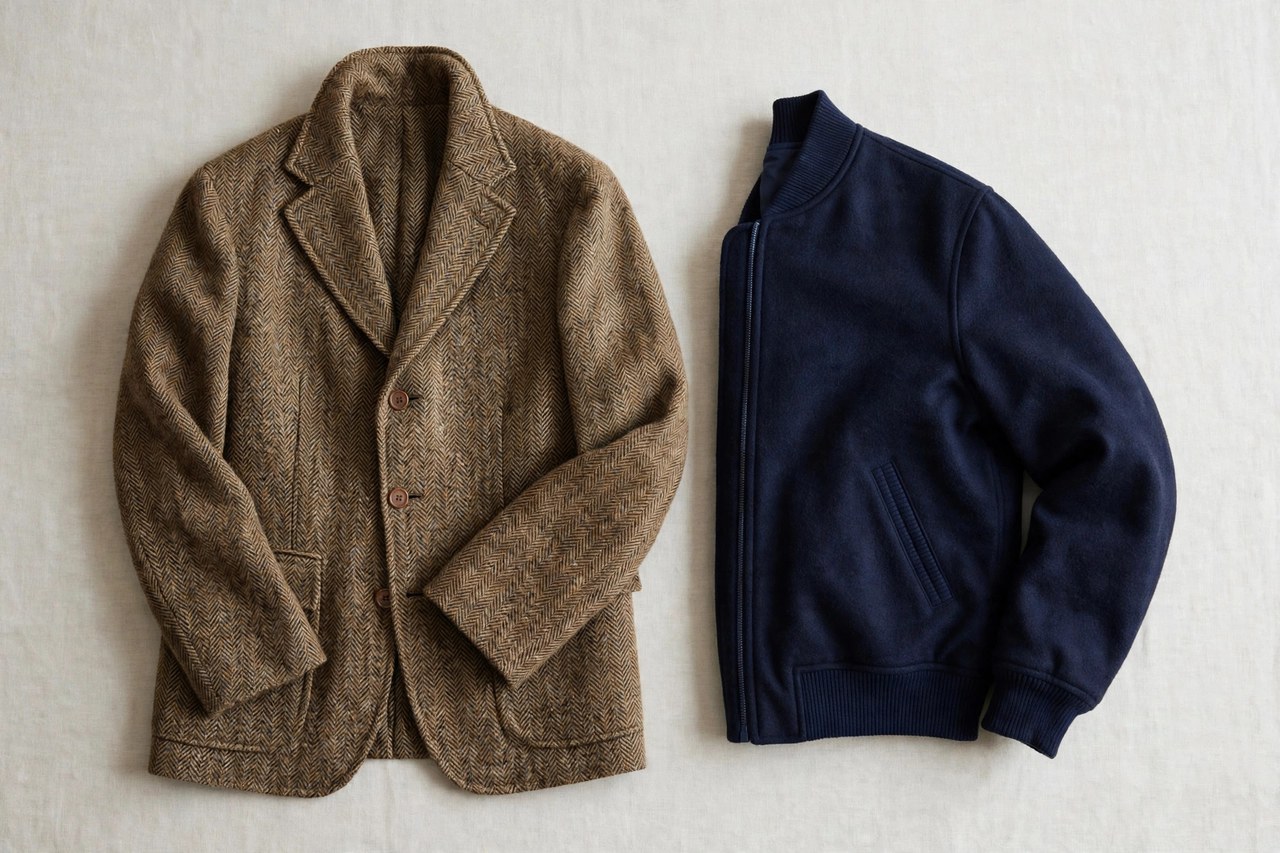
Men's wool jackets are the shorter, everyday members of the wool outerwear family - sports jackets, tweed jackets, wool bomber and trucker styles, overshirts and field jackets - cut at hip to thigh length rather than the overcoat's knee. They are the jackets men actually live in from October to April, layered over knitwear and shirts wherever a full coat is more than the day requires. This guide is built around the questions buyers actually ask: which style, which size, which fabric, and what will it look like after a year of real use - answered in order, with the trade-offs stated plainly.
Styles and Construction
The family splits into tailored and casual builds. Tailored wool jackets - the sports coat's territory, detailed in its own guide - use canvas and structure; casual wool jackets use softer construction: unlined or half-lined bodies, shirt-style or blouson cuts, patch pockets, and cloths like tweed, flannel, blanket checks and melton that take hard wear gracefully. Wool overshirts (shackets) in heavy flannel or blanket cloth have become the layering staple of the group. Check any wool jacket for cloth density (thin cloth in a jacket reads cheap and chills fast), sleeve and body lining that lets layers slide, hardware in metal, and seams finished to survive being thrown over chairs and car seats daily.
A tailored wool coat or jacket is judged in layers: the cloth, the canvas or fusing that gives the chest and lapels their shape, and the lining that lets it glide over knitwear. Melton weaves dense and wind-tight for peacoats and overcoats, flannel reads soft and matte, tweeds hide wear and suit country styling, and gabardine runs smooth for rain-shedding trench styles. Sleeves should show clean pitch without diagonal drag lines, the collar should hug the neck, buttons should be sewn with thread shanks, and a half or full canvas front will drape and recover better than a fully fused one at the same cloth weight.
Fit and Sizing
Fit a wool jacket over a sweater, since that is how it will work: shoulders at yours, enough chest to button or zip without the cloth pulling across the back when you reach forward, and sleeves to the wrist with a hint of the knit cuff showing. Casual cuts should still end cleanly - blousons at the waistband, overshirts at mid-hip, field styles at the thigh. Wool's give means a good fit settles in; a sloppy one just settles further. Compare the jacket's weight against your climate before style: a heavy tweed jacket in a mild winter is a wardrobe ornament.
Tailored wool outerwear should be brushed after wear - a clothes brush lifts surface soil before it works into the weave - and rested a full day between outings on a broad hanger that carries the shoulders. Spot-clean promptly rather than washing; dry clean only a few times a season, since solvent and pressing fatigue cloth and canvas. Store coats clean, unbuttoned, in breathable garment bags with moth protection, never compressed in plastic. Set the creases and lapel roll with steam, not a hard press, and have loose buttons and lining tears repaired early - a coat's structure makes small repairs cheap and neglect expensive.
Wearing and Care
Casual wool jackets take more wear and less ceremony than coats: brush them, hang them on decent hangers, rest them between wears, and spot-clean the inevitable marks promptly. Many soft wool jackets tolerate a professional wet clean better than repeated dry cleaning; follow the label. Store clean with moth protection, and mend cuff and pocket-edge wear early - jackets fail at edges, and a small darn on tweed is nearly invisible.
Fit a wool coat or sports coat over the bulkiest layer it will honestly cover - a sweater for an overcoat, a shirt and light knit for a blazer - and test the working range: arms forward, arms crossed, sitting with the buttons fastened. Shoulders end at yours, the collar sits against the neck without a gap, and the fronts close without an X of pulling at the button. Coat length is coverage: a trench or overcoat should reach at least mid-thigh, a peacoat ends at the hip, and a blazer should cover the seat. Sleeve length shows a sliver of shirt cuff on tailored jackets; coat sleeves protect the wrist.
Common Questions
What is the difference between a wool jacket and a wool coat?
Length and intent: jackets end between waist and thigh and serve as everyday outer or layering pieces, while coats reach the knee or beyond to cover suits and trousers in serious cold. In practice a man needs the jacket weekly and the coat seasonally, climate permitting.
Are wool jackets warm enough without a lining?
A dense tweed, melton or blanket cloth is warm in itself; the lining's main jobs are wind-slipping and helping the jacket slide over knitwear. Unlined wool jackets breathe better and layer more comfortably indoors. For raw wind, a lined jacket or an added gilet beats cloth alone.
Can a wool overshirt replace a jacket?
In mild autumn and spring weather, yes - a heavy flannel or blanket-cloth overshirt over knitwear handles most days and layers under a coat when it turns. It will not replace a jacket's wind resistance or structure in mid-winter, and it reads more casual than any tailored option.
More in Men's Clothes Guide W
Background
Wool is the textile fiber obtained from sheep and other animals. Boiled wool is a special type of fabric primarily used in berets, scarves, vests, cardigans, coats and jackets. Created by a mechanical process using water and agitation, shrinking knitted or woven wool or wool-blend fabrics, compressing and interlocking the fibers into a tighter felt-like mass. A jacket is a mid-stomach–length garment for the upper body. A jacket typically has sleeves, and fastens in the front or slightly on the side. A jacket is generally lighter, tighter-fitting, and less insulating than a coat, which is outerwear. Some jackets are fashionable, while others serve as protective clothing. A sport coat (or sports coat) also called a sports jacket (British English), less commonly known as a sportcoat, is a jacket for men. Though it is of a similar cut and length to a suit jacket, a sport coat is less formal and is designed to be worn on its own without matching trousers.
More to Explore on Apparel Search
Looking for Men's Clothing Stores?
This guide explains men's wool jackets. To browse where to buy, visit our men's clothing store directory, where you can find retailers that carry them.