Men's Wool Hats Guide
Men's wool hats span three constructions that share one fiber: shaped wool felt hats (fedoras, trilbies, bowlers and country styles), woven wool caps (flat caps, newsboys and baseball styles in tweed and flannel), and knitted wool hats (beanies and watch caps). Each uses wool differently - felted, woven or knitted - and each answers a different kind of cold and a different level of formality.
Shop Men's Wool Hats Now
Shop Men's Wool Hats on Amazon Shop Men's Wool Hats on eBayThe Amazon and eBay links on this page are affiliate links. If you make a purchase through them, Apparel Search may earn a commission.
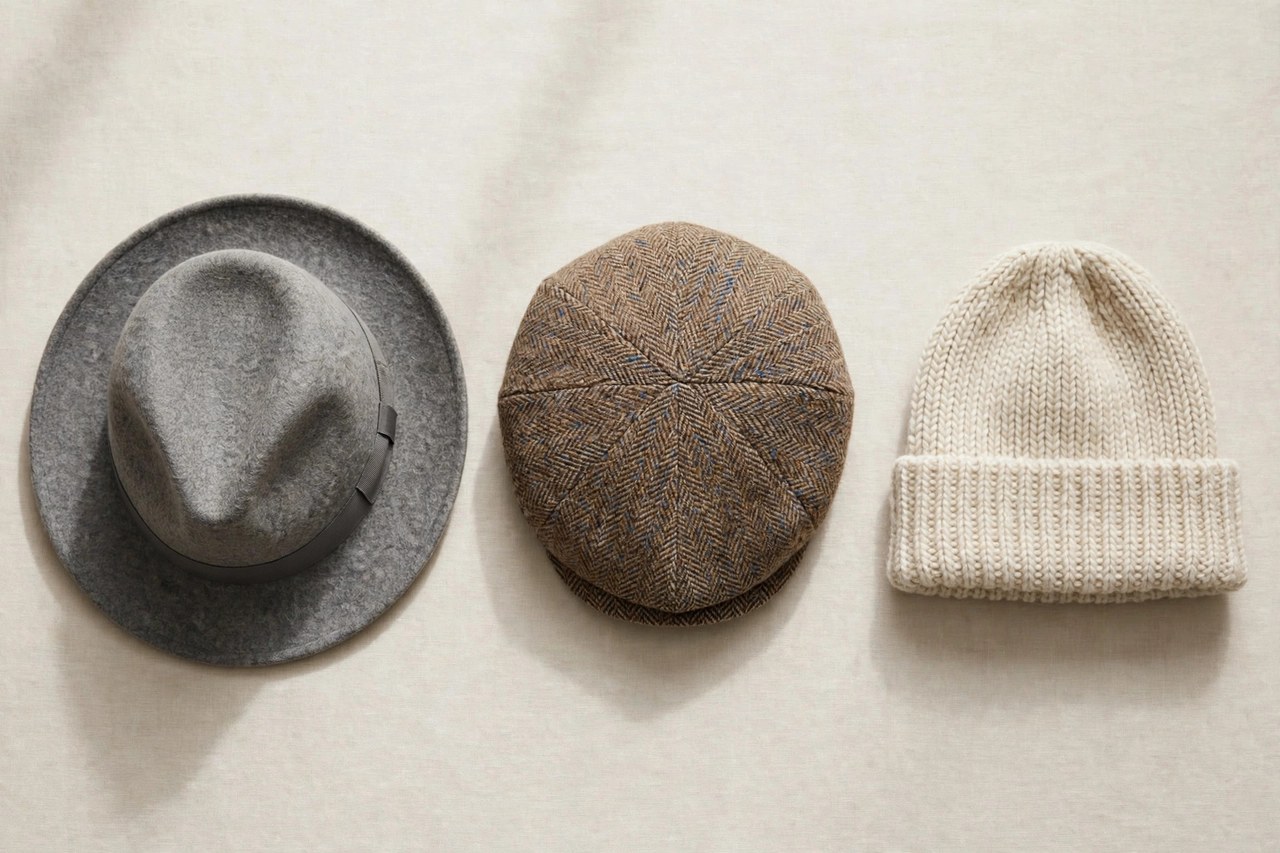
Men's wool hats span three constructions that share one fiber: shaped wool felt hats (fedoras, trilbies, bowlers and country styles), woven wool caps (flat caps, newsboys and baseball styles in tweed and flannel), and knitted wool hats (beanies and watch caps). Each uses wool differently - felted, woven or knitted - and each answers a different kind of cold and a different level of formality. This guide covers the styles worth knowing, the fit points that decide comfort, the fabrics and construction that separate a good buy from a regret, and the simple care that makes the garment last.
Styles and Construction
Felt hats are made by matting wool fibers with heat, moisture and pressure into a dense, brim-holding sheet; better felt is denser, smoother and more water-resistant, and a quality wool felt hat carries a leather sweatband, a lined crown and a brim that snaps rather than flops. Woven caps live on cloth: tweeds, herringbones and flannels sewn in panels, where pattern matching at the seams and a properly shaped peak mark the good ones. Knitted hats are gauge and yarn decisions - fine merino for a smooth close fit, chunky lambswool for loft - with ribbing that must recover to keep the hat seated. Across all three, honest fiber content on the label predicts performance; acrylic-diluted 'wool blend' hats lose warmth and shape first.
Wool accessories live or die on fiber and finishing: a scarf, hat or pair of gloves in fine merino feels soft at the throat and skin, while lambswool and Shetland yarns trade a little softness for loft and durability. Look for fully-fashioned shaping on knitted pieces, linked or neatly seamed joins, ribbing that recovers after stretching, and - on felt hats - even, dense felting with a clean brim edge and a sweatband that is stitched, not glued. Woven scarves should have straight, tight fringes and even selvedges; woven labels should state fiber content honestly, because acrylic blends wear warmer-looking than they feel.
Fit and Sizing
Hat fit is circumference, measured around the head just above the ears and eyebrows, matched to the maker's chart - felt hats give almost nothing, so they must start right, while knitted hats forgive a centimeter through stretch. A felt hat should sit level, snug enough for wind, never tight enough to leave a mark within minutes. Flat caps sit slightly fuller and lower. Try hats with the coat you will wear them with: proportion between brim width, crown height and your shoulders is what makes a hat look chosen rather than borrowed.
Wash wool accessories gently and rarely: cool water, wool detergent, no wringing - press the water out, roll in a towel, and dry scarves and knits flat, reshaped to size. Gloves dry flat away from heat so the leather or knit palms do not stiffen; felt hats are brushed, never washed, steamed back to shape if they droop, and stored crown-down on a stand or in a box. Keep all wool accessories clean before seasonal storage and use cedar or lavender against moths - a scarf or hat put away with skin oils on it is the piece the moths will find.
Wearing and Care
Brush wool hats after wear - a hat brush restores felt nap and lifts dust before it settles - and store felt on a stand or in a box, never by the brim on a hook, which warps the shape. Steam coaxes felt back to form; washing destroys it. Knitted hats wash gently and dry flat; caps are spot-cleaned and air-dried. Store the season's hats clean with cedar protection - moths love an undisturbed hat box most of all.
Size wool accessories by measurement, not habit: hat size is head circumference measured above the ears, glove size is the circumference of the dominant hand around the knuckles, and a scarf's useful size is its length against your coat - long enough to cross and tuck, or to loop once with ends at the chest. Knitted wool relaxes with wear, so gloves and hats should start snug but never tight enough to leave marks; felt hats do not stretch meaningfully and must start right. Socks should reach mid-calf or over it so they stay up by their own ribbing rather than by elastic alone.
Common Questions
Is a wool felt hat warm and waterproof enough for winter?
Warm, yes - dense felt is an excellent insulator and naturally sheds light rain and snow, which melt and brush off. In sustained rain it will eventually wet through and can lose shape if dried badly; it is a cold-weather hat first and a rain hat second. Dry it naturally, crown supported, never on a radiator.
Flat cap or beanie - which suits a coat better?
A tweed or flannel flat cap pairs with tailored coats, sports jackets and country clothing - it shares their woven texture. A beanie pairs with casual coats, parkas and knitwear. Both are warm; the difference is register, and matching the hat's formality to the coat's is the whole trick.
How do I find my wool hat size?
Measure your head circumference in centimeters or inches just above the ears, where the hat will sit, and use the maker's chart rather than a generic S/M/L when the hat is felt - felt does not stretch, so the chart and a snug-but-kind fit in the shop decide. Knitted hats are more forgiving.
More in Men's Clothes Guide W
Background
A hat is a head covering which is worn for various reasons, including protection against weather conditions, ceremonial reasons such as university graduation, religious reasons, safety, or as a fashion accessory. Headwear made from wool fiber would be a "wool hat". They are often referenced as knit hats or caps. Wool is the textile fiber obtained from sheep and other animals. Knit caps are common in cold climates, and are worn worldwide in various forms. A knit cap, originally of wool (though now often of synthetic fibers) is designed to provide warmth in cold weather. Typically, the knit cap is of simple, tapering constructions, though many variants exist. Historically, the wool knit cap was an extremely common form of headgear for seamen, fishers, hunters and others spending their working day outdoors from the 18th century and forward, and is still commonly used for this purpose in Scandinavia and other cold regions of the world.
Looking for Men's Clothing Stores?
This guide explains men's wool hats. To browse where to buy, visit our men's clothing store directory, where you can find retailers that carry them.