Women's Cashmere Skirts Guide
Knit skirts with real drape — pencil, A-line, and pleated cashmere skirts, and how to buy one that keeps its shape.
Shop Women's Cashmere Skirts Now
Shop Women's Cashmere Skirts on Amazon Shop Women's Cashmere Skirts on eBayThe Amazon and eBay links on this page are affiliate links. If you make a purchase through them, Apparel Search may earn a commission.
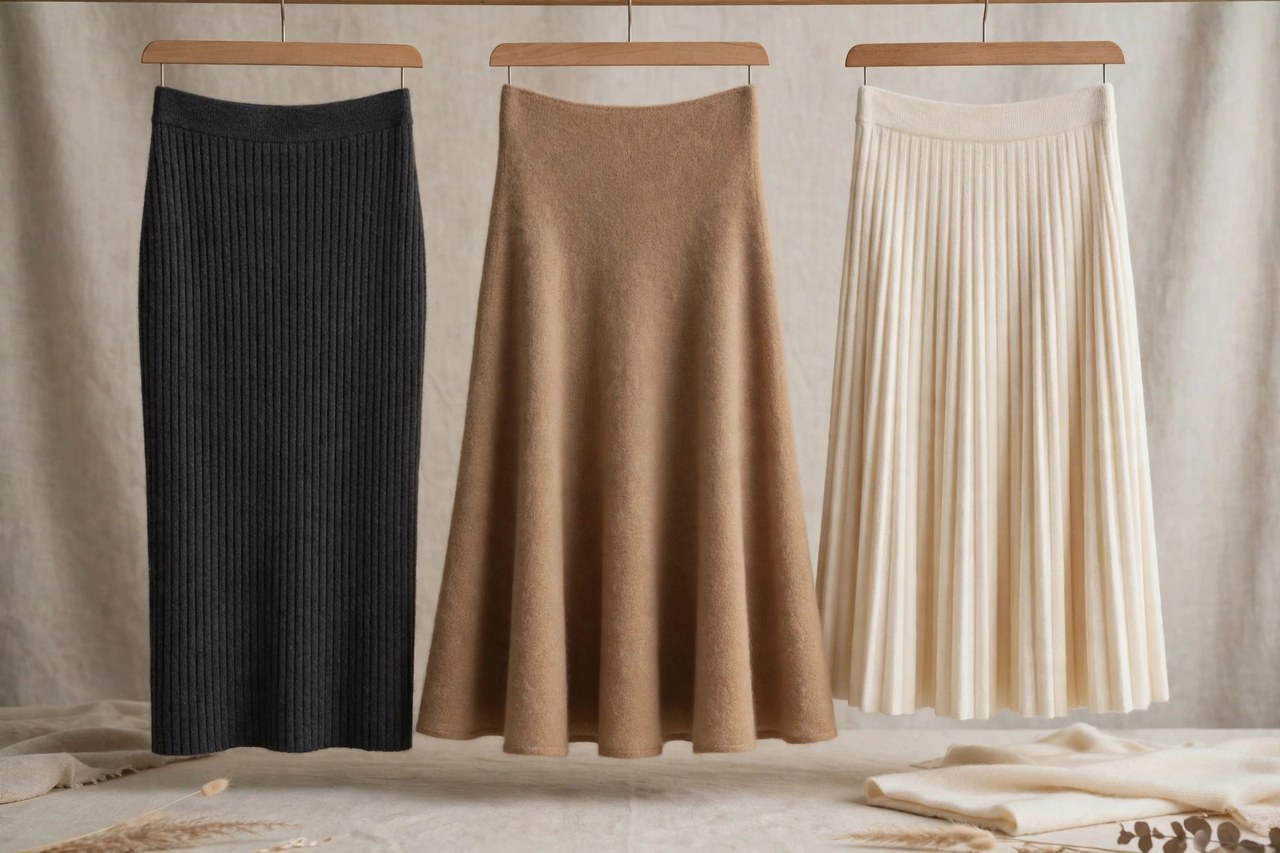
A cashmere skirt is knitwear worn where knitwear rarely goes: in place of tailored cloth, with all the ceremony of a skirt and all the comfort of a sweater. The best ones are minor miracles of knitting — smooth, dense, and cut to move like fabric while feeling like a blanket. The worst are cautionary tales that sag at the seat by lunchtime. This guide explains the difference. We cover the three great styles — pencil, A-line, and pleated — the construction choices that keep a knit skirt's shape, the lining question, lengths and what to wear above and below them, honest prices, and the resting and storage routine that knit skirts need. Paired with the right top, a cashmere skirt is also half of the tonal knit set, one of the most elegant cold-weather looks there is.
Cashmere Skirt Styles: Pencil, A-Line, Pleated
The pencil skirt is the tailored translation: a straight, close knit, often ribbed or in a firm Milano stitch, ending at or below the knee. Worn with a matching or tonal top, it is effectively a knitted suit — boardroom-appropriate with knitwear's comfort secret underneath. The A-line skirt flares from a ribbed waistband into a swingy hem, midi or maxi, and is the most forgiving and feminine of the three, moving beautifully and asking nothing of the wearer's shape. Pleated cashmere skirts — usually engineered pleats knitted into the structure rather than pressed in — combine the A-line's movement with a dressier rhythm, and their pleats spring from the knitting itself, so they do not wash out. All three appear in matching sets with sweaters, and the skirt alone pairs with blouses, fine tops, and boots across the whole cold season.
Knit Structure and the Sagging Question
Every knit skirt fights gravity at one point: the seat. Sitting stretches the knit, and poor fibers relax into a permanent bag that announces itself from behind. Quality construction fights back with four tools. First, stitch choice: dense structures like Milano stitch and half-cardigan rib hold shape far better than loose stockinette. Second, fiber: long-staple cashmere recovers; some makers add a core of silk or a whisper of elastane for spring. Third, weight: a skirt with real substance resists better than a flimsy one, so heft in hand is a good sign here. Fourth, lining: a smooth half or full lining lets the skirt slide over the body and tights instead of gripping and stretching, and protects the seat from friction. Test a skirt by sitting in it in the fitting room for a full minute, then standing to inspect. A well-built cashmere skirt shows you nothing; a poor one shows you the future.
Lengths and Pairings
Length decides a knit skirt's register. Knee and below-knee lengths in pencil form are the working and formal choices, pairing with fine tops, shirts, and heeled boots or pumps. Midi A-lines and pleats are the versatile middle — with a tucked sweater and boots they cover everything from offices to winter weddings. Maxi knit skirts are pure comfort-luxury, worn with fitted tops to balance their sweep, and they double as travel gold, arriving unwrinkled. Proportion is the styling key with all knit skirts: the skirt carries softness and volume, so the top should supply definition — tucked, belted, cropped, or close-fitting — and in a matching set, a front tuck or a belt keeps the column of knit from reading as a robe. Footwear should be equally deliberate: boots that meet the hem, or a clean shoe with tights in a matching tone.
What to Pay and What to Check
Cashmere skirts sit in the upper-middle of the fiber's price range, above sweaters of similar weight because the knitting is denser and often the panels are larger; quality examples from knitwear specialists are the sensible tier, and very cheap knit skirts should be assumed to be short-fiber and sag-prone until proven otherwise. In the hand and on the body, check: the waistband, which should be firm ribbing or a proper elasticated band that will not roll; the seat test described above; the hem, which should hang level all round; and whether the knit is opaque in a squat and in bright light, since knit skirts worn with the wrong underpinning can turn sheer at the stretch. If the skirt is lined, check that the lining is smooth and attached at the waist only, free to move. These five minutes of checking are the difference between the miracle and the cautionary tale.
Care and Storage
Rest is the skirt's first care rule: a day off between wears lets the seat recover, and rotating two skirts through the week doubles both their lives. Store knit skirts folded or draped over a padded hanger bar — never clipped by the waistband on a skirt hanger, which dents and stretches the rib — and give pleats room so they are not crushed flat in a packed drawer. Wash by hand in cool water, dry flat and squared, and resist the urge to block a skirt back into shape while wet beyond gentle easing. De-pill the seat and the sides where bags swing, little and often. Before summer storage, clean the skirt, since the seat and hem carry the season's traces that moths love, and store it in a breathable bag with cedar. A cashmere skirt cared for this way keeps its line for years — and its line is the entire garment.
Related Women's Guides
Photos

More to Explore on Apparel Search
Looking for Women's Clothing Stores?
This guide helps you choose women's cashmere skirts by style and length. To browse where to buy, visit our women's clothing store directory, where you can find retailers that carry them.