The Top Half
Tops, Tanks, Cardigans and Vests in Openwork
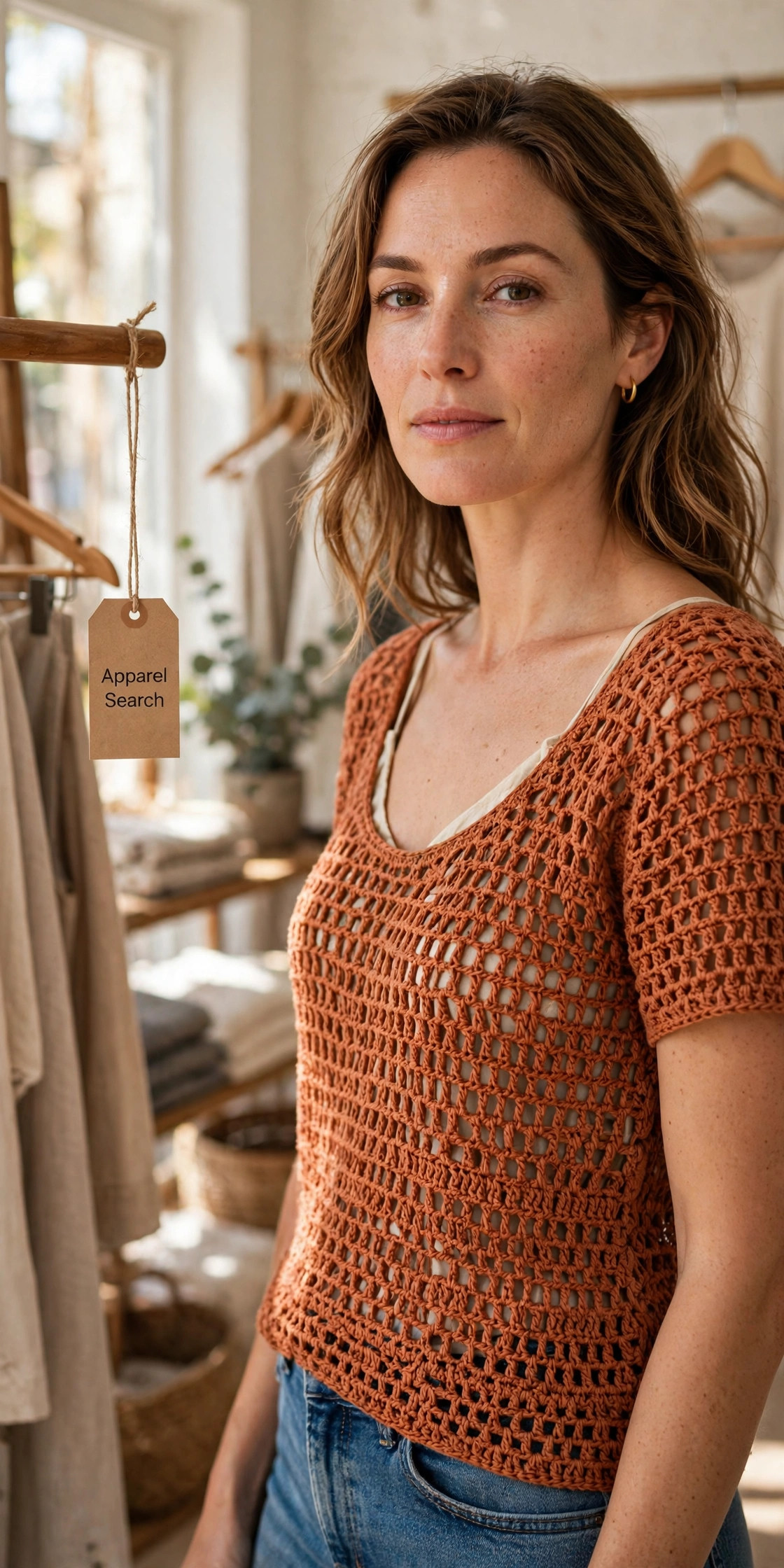
If dresses are crochet’s special occasion, tops are its everyday life. A crochet top, tank, cardigan or vest is a texture layer: worn over a camisole, a shirt or a dress, it adds pattern and hand-made character without asking the whole outfit to commit. That makes tops the sensible first crochet purchase — and the category where small decisions about openness, proportion and storage decide whether the piece gets worn weekly or never.
This guide covers the four shapes and how each one layers. The parent crochet clothing guide explains yarns and hand- versus machine-made construction, and how to style crochet turns the pieces below into complete outfits.
Openness & Camisoles
How Much Skin the Pattern Shows — and What Sits Beneath
Read a crochet top the way you would read a lace top: by how much of the layer beneath becomes part of the design. Dense tops in tight stitch patterns behave like a light knit — wear them with ordinary underwear and no camisole. Mid-open tops — shells, fans, spaced motifs — show the camisole in pattern; choose it as carefully as the top. Fully open mesh and motif tops are frames: the camisole, bandeau or shirt beneath is effectively the garment, and the crochet is jewellery for it.
Camisole rules are short. Match the neckline so straps and edges do not compete; keep the fabric smooth so motifs do not catch; pick the tone by intent — skin tone to soften, matching tone to solidify, black under pale crochet to sharpen the pattern. The women’s camisoles guide covers fits and fabrics. A good test in the changing room: raise your arms — if the layer beneath still looks deliberate, the pairing works.
Shapes & Proportions
Cropped, Classic and Longline — Pairing With High-Rise Bottoms
Crochet tanks are the summer staple: sleeveless, often the most open, worn over camisoles or swimsuits. Short-sleeve and fitted tops are the dressiest, able to carry a motif pattern into an evening outfit. Crochet cardigans trade coverage for flexibility — a longline openwork cardigan over a slip dress or jeans and a tee is the most wearable crochet outfit there is. Vests, usually in denser stitch, layer over shirts and dresses and give texture without warmth.
Proportion is where crochet tops succeed or fail, because openwork draws the eye and adds visual volume. The reliable anchor is a high-rise bottom: high-rise jeans, trousers or a skirt meet a standard or cropped top at the waist, so the outfit has a defined middle and the texture sits in a contained block. A long, loose crochet top over low, loose trousers dissolves the waist entirely — fine at the beach, shapeless in town. Tuck where the stitch allows, belt over cardigans, and let one piece carry the pattern: crochet on top, plain below, or the reverse.
At Work
Work-Appropriate Crochet: Denser, Lined, Quieter
Crochet can work at work, but only its most conservative branch. The conditions are cumulative: a dense stitch pattern with no see-through panels, a complete camisole or lining in a matching tone, a classic shape — a neat short-sleeve top, a fine cardigan, a structured vest over a shirt — and a restrained colour: black, navy, cream, camel. Worn that way, crochet reads as texture, in the same family as a lace-trim blouse, and pairs naturally with tailored trousers and midi skirts.
What stays home: mesh, motifs with large open flowers, cropped festival tanks, fringe, and anything whose underlayer is doing visible work. If you have to wonder whether a top is office-safe, it is not — the test is whether a colleague would describe the outfit as crochet at all, or simply as a textured top. Keep one genuinely dense, dark crochet cardigan in the work wardrobe and it will rescue summer dresses in air-conditioning for years; the general cardigan rules are in the women’s cardigan sweaters guide.
Storage & Care
Keeping Openwork From Stretching on the Hanger
More crochet tops are ruined by storage than by washing. A hanger pulls openwork into shoulder points and lengthens the body a little every week; within a season a top can gain an inch it never recovers. Store every crochet top folded — rolled for tanks — in a drawer or on a shelf, with nothing heavy stacked on motif work. Cardigans fold with buttons done up so the fronts keep their alignment.
Washing follows the family logic: cool water, a gentle cycle in a mesh bag or a hand-wash, no wringing, drying flat reshaped to size. Check underarms and shoulder seams after washing — the stress points where loops first distort. Give a worn top a day’s rest before wearing it again: yarn recovers its shape between outings. Folded, rested and washed gently, a crochet top keeps its pattern crisp for many summers.
Questions
Common Questions
What do you wear under a crochet top?
A smooth camisole whose neckline sits inside the top’s own lines. Skin tone softens the look, a matching tone makes the top read more solid, and black under pale crochet sharpens the pattern into a graphic. Dense crochet tops need no camisole at all — treat them like a light knit and wear ordinary underlayers.
Can crochet tops be worn to work?
Yes, in their most conservative form: a dense stitch with no see-through panels, a complete matching camisole or lining, a classic shape such as a fine cardigan or a structured vest over a shirt, and a quiet colour like black, navy or cream. Mesh, large open motifs, cropped festival styles and fringe stay out of the office.
Why should crochet tops never be hung up?
Because the looped structure stretches under its own weight. A hanger pulls the shoulders into points and lengthens the body a little each week, and the gain does not wash out. Fold crochet tops — or roll light tanks — and store them flat in a drawer or on a shelf, and dry them flat after washing for the same reason.
More to Explore
Search Apparel Search