Women's Yarn Dyed Flannel Sleepwear
Yarn-dyed flannel is the premium tier of flannel sleepwear: the yarns are dyed before weaving, so every check is woven into the cloth itself — visible on both sides, and built to stay true for years.
Shop Women's Yarn Dyed Flannel Sleepwear Now
Shop Women's Yarn Dyed Flannel Sleepwear on Amazon Shop Women's Yarn Dyed Flannel Sleepwear on eBayThe Amazon and eBay links on this page are affiliate links. If you make a purchase through them, Apparel Search may earn a commission.
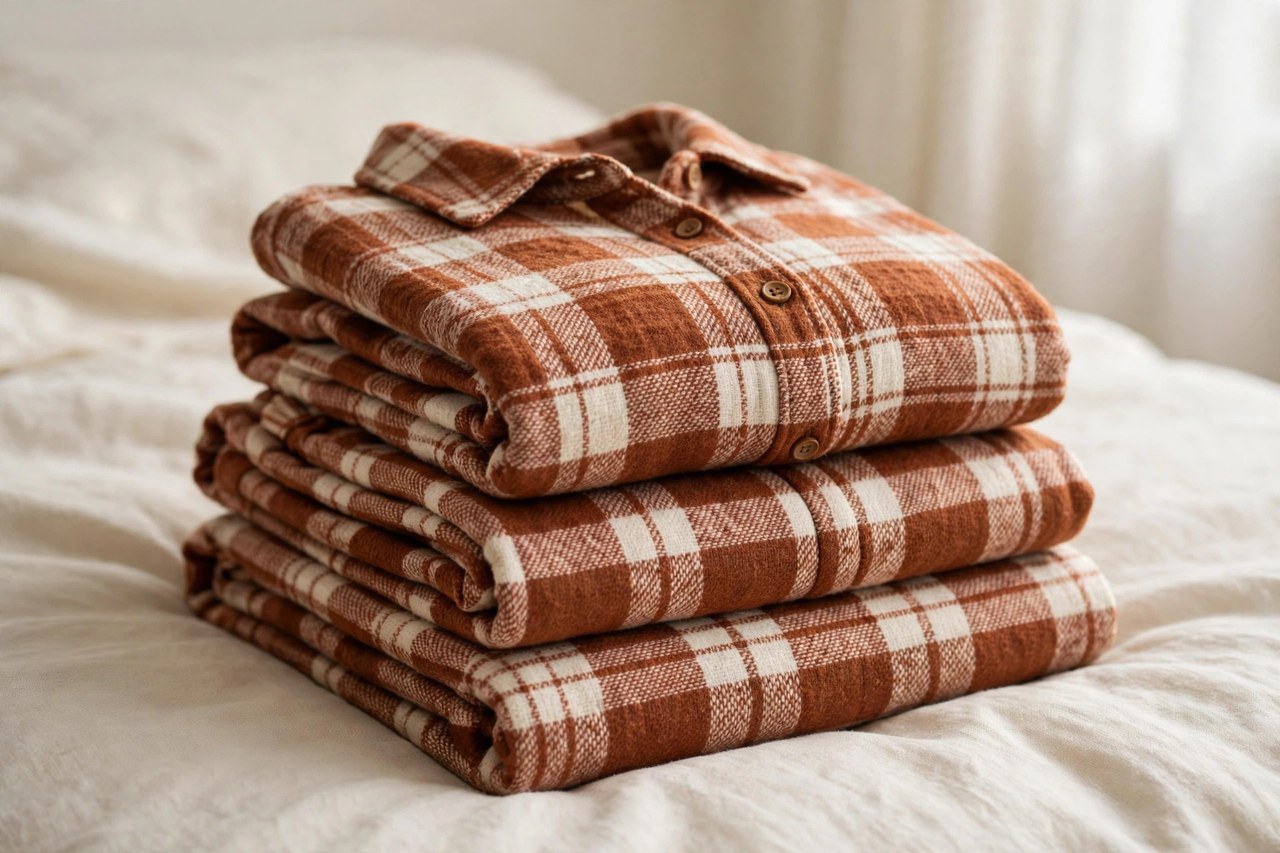
Yarn-dyed flannel sleepwear sits at the top of the flannel range, and the reason is decided long before the fabric reaches a sewing table. In printed flannel, plain cloth is woven first and the pattern is applied to the surface afterwards. In yarn-dyed flannel, each yarn is dyed to its finished colour before weaving, and the checks, stripes and plaids are created by the loom itself as the coloured yarns cross. The pattern is not on the fabric — it is the fabric.
That single change in the order of production explains everything shoppers notice about this sleepwear: the pattern shows on both sides of the cloth, the colours hold true wash after wash, and there is no printed surface to fade, crack or rub away. Pajama sets, sleep shirts, sleep pants and robes all come in yarn-dyed versions, and this guide covers how to recognise the genuine article, why it costs more, and how to choose pieces that will still be in the drawer years from now.
Colour Woven In, Not Put On Top
Yarn dyeing happens while the yarn is still in its pre-weaving form. Cotton yarns are most often dyed wound on perforated cones — called package dyeing — while wool and acrylic yarns are frequently dyed loose, in hank form. Either way, the dye penetrates the whole yarn, so the colour runs through every fibre rather than sitting on a finished surface. The dyed yarns are then set up on the loom in a planned sequence: one order of colours lengthwise (the warp), another across (the weft).
Where warp and weft colours cross, they blend optically into a third, softer tone — the muted half-shades inside a tartan are exactly that. It is why woven checks have a depth that printing struggles to copy, and why most genuine plaid flannel is yarn-dyed. The alternative, piece dyeing, colours the whole finished cloth one shade at a time and cannot produce a true multi-colour check at all.
The Reverse-Side Test
There is a simple shop-floor test that separates true yarn-dyed flannel from printed imitations: turn the garment inside out. On genuine yarn-dyed cloth, the pattern appears on the reverse nearly as strong as on the face, because the coloured yarns run all the way through. On a printed check, the back is a pale ghost of the front — often close to white — because the colour only ever touched one surface.
Two supporting clues: on yarn-dyed sleepwear the pattern continues uninterrupted across seams, pockets and plackets, and the crossing bands show those blended half-tones mentioned above. A printed plaid usually looks flat and uniform, with every band one solid, unvarying colour. If a listing just says “plaid flannel” without mentioning yarn dyeing, the reverse-side test in the product photos — or on arrival — settles the question.
What the Yarn-Dyed Sleepwear Family Includes
The family covers the full nightwear wardrobe. Pajama sets pair a button-front top with matching pants in classic tartans. Sleep shirts use the same woven checks in a single long top, and sleep pants are sold as separates so a favourite pair can be replaced or mixed with plain tops. Robes in yarn-dyed flannel are the longest-lived pieces of all, cut generously and expected to serve for a decade.
Colour stories lean traditional: red-based tartans, navy-and-green checks in the Black Watch manner, burgundy and cream windowpanes, and softer pastel checks on lighter-weight cloth for the shoulder seasons. Because the colour is structural, mills keep the same woven patterns in production for years — a replacement piece bought later can still match a set bought earlier.
Why It Costs More — and Why It Lasts
Yarn dyeing costs more because it is more work: each colour in the check needs its own dye lot, the loom must be set up with the full colour sequence, and patterned pieces are cut and sewn with the checks matched at seams and pockets. Mills also brush yarn-dyed flannel fully, on both sides — something they cannot do as freely with printed flannel, where heavy brushing would damage the print. The result is the deepest, softest nap in the flannel family.
The durability story follows from the construction. Colour that runs through the yarn cannot wash off the surface, so checks stay crisp instead of greying at the folds and friction points. There is no print layer to crack across the seat or elbows. A well-made yarn-dyed set typically outlasts several printed equivalents, which is the real arithmetic behind the higher price.
Care That Keeps the Colour True
Yarn-dyed flannel asks for nothing exotic: wash warm or cool with like colours, skip chlorine bleach (it attacks even through-dyed cotton over time), and tumble dry low or line dry. Turning garments inside out protects the raised nap rather than the colour — the colour needs no protection. Brush up the nap with a soft clothes brush after washing if it flattens, wash new pieces once before wearing to lift loose fibres, and expect the checks to look essentially unchanged season after season.
Related Women's Guides
More to Explore on Apparel Search
Women’s Clothes Guide by Letter: Women's Clothes Directory A · Women's Clothes Directory B · Women's Clothes Directory C · Women's Clothes Directory D · Women's Clothing Directory E
Looking for Women's Clothing Stores?
This guide helps you choose women's flannel sleepwear by construction — yarn-dyed, plaid and printed — and by garment. To browse where to buy, visit our women's clothing store directory, where you can find retailers that carry them.