Women's Over the Knee Leather Boots Guide
Leather is the material that built the tall boot: only leather gives a high shaft the structure to stand, the strength to stretch over a leg daily, and the ability to mold into a personal fit.
Shop Women's Over the Knee Leather Boots Now
Shop Women's Over the Knee Leather Boots on Amazon Shop Women's Over the Knee Leather Boots on eBayThe Amazon and eBay links on this page are affiliate links. If you make a purchase through them, Apparel Search may earn a commission.
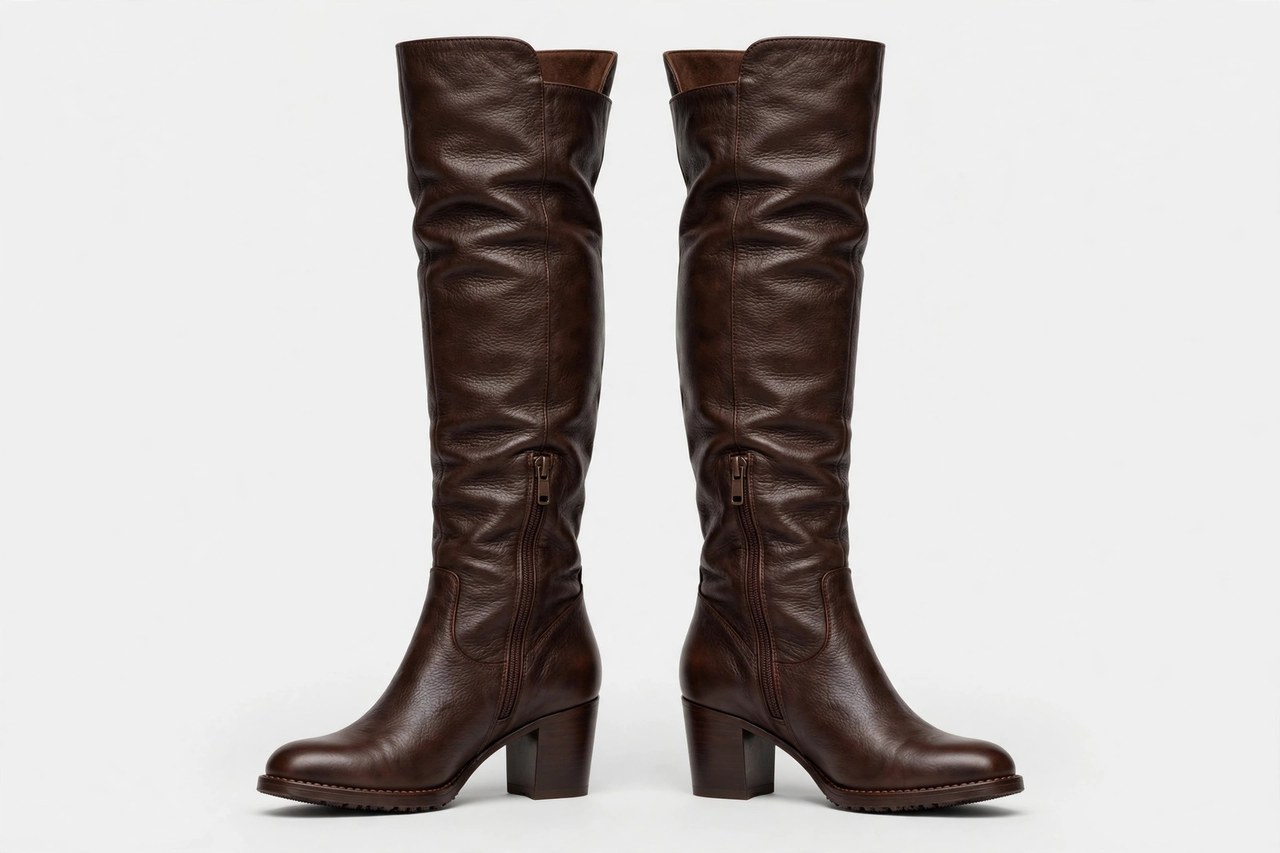
Every material decision in a tall boot is amplified by height, and leather is the benchmark the others are judged against. A shaft that rises above the knee needs a material with body — enough substance to hold a cylindrical shape against gravity and the leg's movement — and leather, a tanned hide with a fibrous structure no woven fabric matches, supplies that body naturally. It also stretches where the leg demands and then holds the new shape, which is why a leather tall boot, uniquely, fits better in month three than it did in the shop.
This guide is the material guide to leather over-the-knee boots: the leather types used at this height, how structure and lining interact, the break-in process (real, and worth planning), and the care regime that lets a large piece of leatherwork live for years. For the category overview and the suede alternative, see the umbrella and suede guides linked below.
Leather Types at Tall-Boot Height
Smooth calf and nappa leathers are the classic tall-boot materials: fine-grained, supple, able to take a high polish or a soft matte finish. Full-grain leather in a firmer temper builds the most structured shafts — the riding-boot branch of the family — standing poker-straight and shrugging off scuffs. Patent leather gives the dress and evening end its gloss, with a coated surface that sheds water but shows creasing at the ankle and knee flex points more honestly than matte leather does. Stretch leather — leather laminated to an elastic backing — builds the close, pull-on shafts that grip the thigh; it trades some of leather's legendary longevity for a fit nothing else achieves. Embossed leathers (crocodile, lizard and saffiano prints stamped into cowhide) supply texture at a fraction of exotic prices.
Inside the shaft, construction decides comfort: a full leather or textile lining makes the boot slide over trousers and feel finished, but adds warmth and cost; many tall boots line only the foot and the shaft's top band, leaving the shaft's interior as the hide's sueded back, which grips leggings helpfully and bare hosiery less so. At the ankle and knee, better makers add subtle flex panels or a slightly softer leather grade so the shaft can bend where the leg bends without cracking its finish in white creases.
Break-In and the Molding Fit
A structured leather tall boot has a genuine break-in, and planning for it is the difference between a beloved boot and a returned one. The stiff points are predictable: the ankle, where the shaft must learn its hinge; the back of the knee, where the shaft's top edge meets the bending leg; and the instep, where new leather resists the foot's flex. The method is graduated wear: an hour at home, then short outings, with thick socks as negotiators, over one to two weeks. Leather stretches roughly where pressure is applied and nowhere else, so the molding is personal — never lend a breaking-in boot, and never buy one pre-stretched by a previous owner's leg.
Two failures masquerade as bad fit during break-in. A shaft that slips down in the first wears often settles once the ankle hinge forms and the boot stops levering itself downward with each stiff step. A top edge that digs at the back of the knee usually softens as the leather at that fold conditions — but a shaft that is simply too tall for your leg (measure against the umbrella guide's method) will never soften enough; height is geometry, not break-in. Know which problem you have before the return window closes.
Leather Care for a Large Surface
A tall boot presents roughly three times a shoe's leather area, and it all wants the same regime: brush after wear, condition when the surface looks dry or after wet weather, and polish smooth leathers to keep the finish fed. Work in sections and let conditioner absorb before buffing; the shaft's front, which takes the weather and the photographs, deserves the most attention, while the inner calf panel takes the abrasion of the other boot and should be checked for finish wear. Salt is the tall boot's winter enemy at every height of the shaft that road spray reaches — wipe it off the same day with a damp cloth.
Storage decides the shaft's old age. Stand the boots with shaft shapers or boot trees so the leather never folds; a crease folded into a stored shaft becomes a crack line in the finish. Keep them out of plastic (leather needs air) and away from radiators. Heels and soles are replaceable, zips are repairable, and a quality leather tall boot can be resoled and reconditioned for a decade — the economics of leather at this size only work if the boot is maintained like the investment it is. Suede's different regime is covered in its own guide, linked below.
Related Women's Guides
Photos

More to Explore on Apparel Search
Looking for Women's Clothing Stores?
This guide helps you choose women's over the knee leather boots. To browse where to buy, visit our women's clothing store directory, where you can find retailers that carry them.