Women's Over the Knee Zip Boots Guide
The zip is what makes a tall boot practical for every leg: a closure running the shaft that lets an over-the-knee boot open wide, step in easily and close to a close, clean fit.
Shop Women's Over the Knee Zip Boots Now
Shop Women's Over the Knee Zip Boots on Amazon Shop Women's Over the Knee Zip Boots on eBayThe Amazon and eBay links on this page are affiliate links. If you make a purchase through them, Apparel Search may earn a commission.
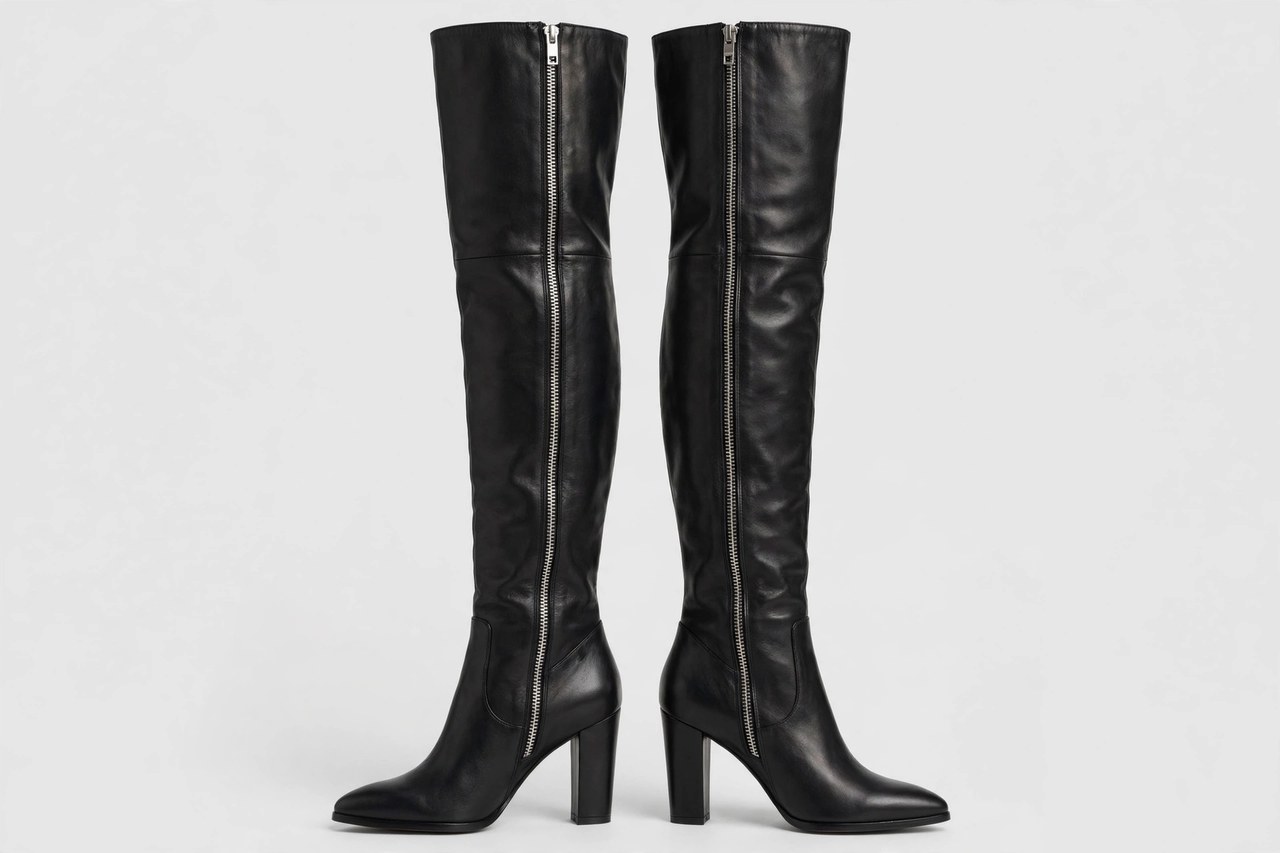
A pull-on tall boot fits the legs it fits, and no others. The zip changes that arithmetic. By letting the shaft open along a seam, a zip lets the bootmaker cut a closer, more anatomical shaft than any pull-on could be dragged over a heel and calf — and lets far more women into the tall-boot category in the first place. The over-the-knee zip boot is therefore not a variation on the style; it is the construction that democratized it, and its details (where the zip runs, how far, and how well it is made) decide the boot's fit, look and lifespan.
This guide is the construction guide to zip tall boots: the three zip placements and what each does, the quality checks that separate a zip that serves for years from one that fails in a season, fitting technique for a zipped shaft, and the care and repair facts — because a boot organized around a zip lives and dies by it. Material choices sit in our leather and suede guides, linked below.
Zip Placements: Full, Half and Back
The full-length inside zip is the standard: it runs from the top of the shaft down the inner leg to the ankle, invisible in wear (the inner leg faces the other boot, not the room), opening the shaft completely for the easiest entry and the closest fit. The half zip runs only the lower portion — ankle to mid-calf — just enough to let the heel pass; the upper shaft stays a pull-on stretch, which keeps the thigh fit sleek. Half zips suit stretch shafts; full zips suit structured leather, whose ankle cannot otherwise be passed. The back zip runs down the center back of the shaft: a deliberate design line as much as a closure, featured in fashion styles, and the placement to check most carefully, since it sits exactly where the knee bends and the calf flexes.
Hardware details matter at this scale. The zip should be a sturdy molded or metal-toothed boot zip, not a dress-weight coil, with a pull tab you can grip in gloves and a zip guard or keeper at the top — a small snap, hook or elastic loop that stops the slider migrating down during wear, the classic tall-boot annoyance. A fabric or leather placket behind the teeth protects hosiery and skin from the zip's underside. On a two-boot pair, run both zips fully in the shop: a gritty, catching travel at new is a failure forecast, not a break-in trait.
Fitting a Zipped Shaft
Fit a zip boot in the order you will dress: trousers or tights on first, foot into the boot, shaft gathered and drawn up the leg, then zip from the bottom with the shaft held aligned so the seam does not spiral. The zipped fit should be close without the zip straining: teeth fully closed and covered by their placket, no gaping between teeth along the calf, and no pulling sensation when you bend the knee or sit. A zip under constant strain is a zip with a shortened life, so a boot that only closes by force is a size (or a calf width) too small, however flattering the struggle's result.
Zips widen the fit window but do not abolish measurements: the umbrella guide's shaft height and circumference rules still govern. What the zip adds is adjustability at the margin — a slightly fuller calf accommodated because entry no longer limits the cut, and in some designs a short elastic gore beside the zip's top that gives the final inch. Petite and wide-calf tall boots are overwhelmingly zip designs for exactly this reason. When comparing candidates, zip each one fully and walk: the correct boot disappears as a concern within a minute; the wrong one keeps announcing its zip.
Zip Care and Repair
A zip is a machine with hundreds of moving engagements, and it likes to be kept clean and occasionally fed: brush grit out of the teeth (grit is the abrasive that wears them), and if travel stiffens, a trace of zip lubricant or plain paraffin on the teeth restores it — never force a stuck slider, which bends teeth and converts a cleaning job into a repair bill. Keep the top keeper fastened in wear; a slider that creeps down flexes the teeth at a point they were not designed to bend, mid-shaft.
The good news is that zips are the most repairable part of a boot. A failed slider is a cheap cobbler's job; a separated zip can often be re-engaged; even a full zip replacement costs a fraction of the boot and is routine work on quality footwear. Judge a boot's longevity by everything around the zip — leather, sole, heel — since the zip itself can be renewed. Store zip boots with zips closed and shafts shaped, so the teeth rest aligned rather than stressed, and your zip tall boots will outlast several generations of the pull-on styles they share a closet with.
Related Women's Guides
Photos

Looking for Women's Clothing Stores?
This guide helps you choose women's over the knee zip boots. To browse where to buy, visit our women's clothing store directory, where you can find retailers that carry them.