Over the Knee Boots Guide
An over-the-knee boot is defined by its shaft: a boot whose top rises above the knee — and everything about the style, from fit to fabric, follows from that extra height.
Shop Over the Knee Boots Now
Shop Over the Knee Boots on Amazon Shop Over the Knee Boots on eBayThe Amazon and eBay links on this page are affiliate links. If you make a purchase through them, Apparel Search may earn a commission.
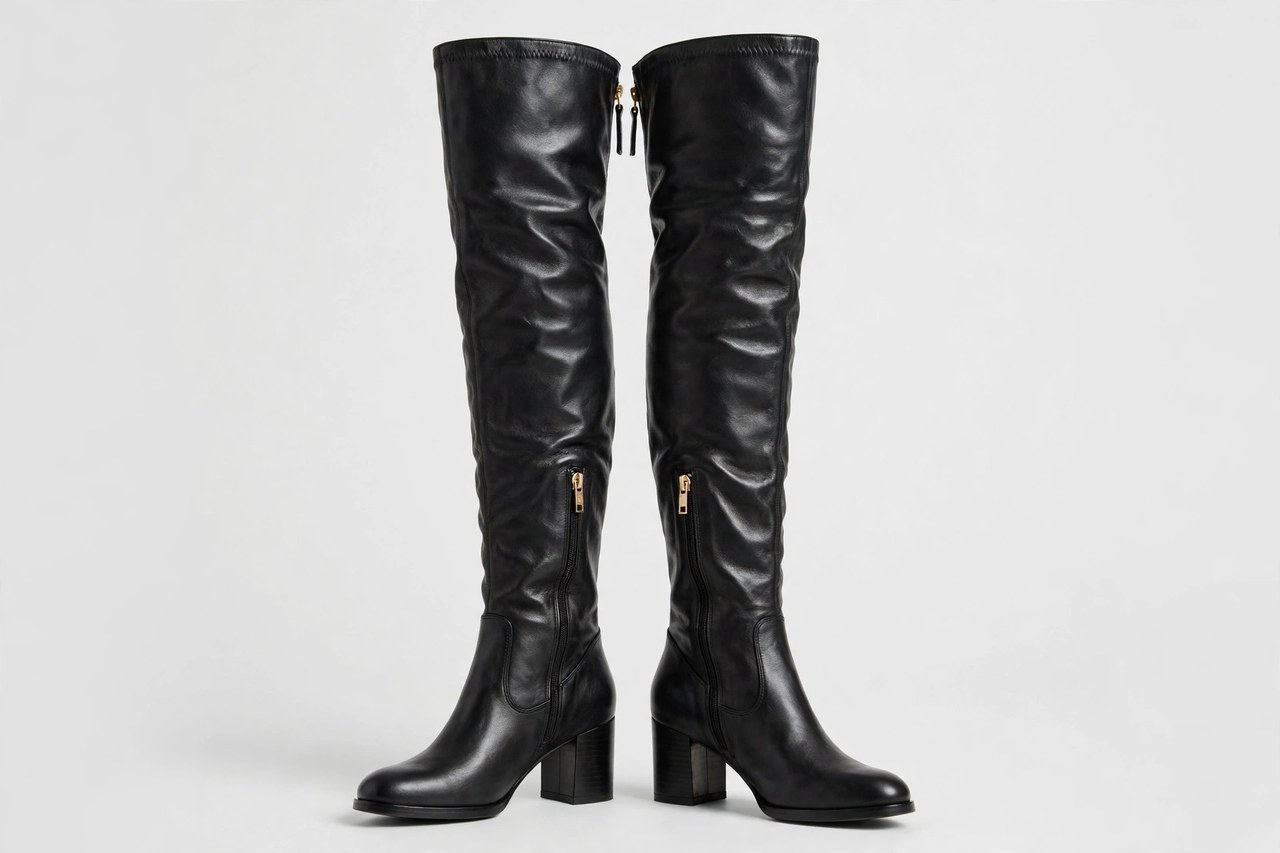
Boots are named by where the shaft ends, and the over-the-knee boot is the tall end of the scale: its shaft rises past the knee, typically ending two to four inches above the kneecap, where its even taller relative, the thigh-high boot, continues toward mid-thigh. That extra shaft is not a detail — it is the garment. An over-the-knee boot covers the leg like a second trouser leg, which is why the style behaves in a wardrobe more like clothing than like footwear, and why its fit is measured in circumferences and shaft heights rather than in shoe sizes alone.
This is the umbrella guide to the category: how the shaft is measured and fitted, the closure systems that get a tall boot onto a leg, the materials from leather to stretch suede, and the heel range from flat riding styles to stilettos. The specialist guides linked below take each branch further — leather and suede as materials, the zip boot as a construction, three designer houses' versions, and our women's styling guide to wearing the boots well.
Measuring Shaft Height and Calf Fit
Three measurements decide whether an over-the-knee boot fits, and none of them is your shoe size. Shaft height is measured up the back of the leg from the heel's base to the shaft's top edge; for a true over-the-knee fit it must clear your own knee point, which varies with your height — the same 22-inch shaft is over-the-knee on a petite leg and merely at-the-knee on a tall one. Calf circumference is taken at the widest point, and thigh circumference at the point where the shaft will end; a boot that fits the calf and strangles the thigh (or fits the thigh and bags at the calf) is the wrong last for your leg, full stop.
Manufacturers grade these measurements differently, and the honest ones publish them. Compare the boot's shaft height against your leg measured in the shoes' heel height, since a heel changes the leg's geometry. Fit in the afternoon, wearing the tights, leggings or skinny trousers you will actually wear inside the boot: over-the-knee boots are fitted over a layer, not on a bare leg in a shop in July. A correct fit stands up on its own around the leg without being held, allows a finger's ease at the top, and lets you bend the knee fully without the shaft's back digging in.
Closures and Materials
Getting into a tall boot is an engineering problem with three standard solutions. Pull-on stretch shafts, cut from stretch suede, stretch leather or knit-backed synthetics, rely on elastic recovery to grip the leg — the sleekest silhouette and the one most sensitive to exact circumference. Zip closures, the subject of our zip boots guide, run the inner shaft (full or partial) or the back, and make the boot accessible to more leg shapes. Lace-up and corset backs adjust the fit along the whole shaft and appear on both workwear-derived and fashion styles. Many pull-on boots add a small elastic gore panel at the top back — a hidden inch of give that is often the difference between a boot that fits and a boot that almost fits.
Materials rank by structure. Leather (our leather guide has the full story) holds a tall shaft upright by its own substance and molds to the leg over weeks. Suede is softer and slouchier by nature, draping rather than standing — see the suede guide. Stretch fabrics and microfibers give the closest, sock-like fits and the lowest prices, with the least repair potential. Inside, a partial lining at the foot and a smooth shaft interior (or a full lining in premium boots) decides how the boot slides over trousers and how it feels at hour six.
Heels, Soles and Care
The heel range covers the whole of bootmaking: flat and riding styles (the equestrian branch, where the tall shaft began), block heels for stable height, chunky and platform soles for fashion height with a walking base, and stiletto over-the-knee boots at the formal extreme. Choose by the day the boot must survive: a tall shaft adds visual weight that a fragile heel cannot balance, physically or aesthetically, which is why the block heel is the category's modern default. Soles follow the same logic — lugged and rubber for real weather, leather for the dress end, always with a heel breast and tip that can be replaced.
Care for a tall boot is mostly storage. Keep over-the-knee boots standing with boot trees, shapers or rolled inserts in the shafts: a tall shaft folded over in a closet takes a permanent crease at the fold and cracks its finish there. Clean leather and condition it as for any boot (the material guides below go deeper), keep suede brushed and sprayed, and store the pair away from heat vents that dry the top of the shaft unevenly. Resole and re-heel before the wear reaches the boot's structure. A tall boot is a large piece of leatherworking; treated as one, it is a five-year garment at minimum.
Related Women's Guides
Looking for Women's Clothing Stores?
This guide helps you choose women's over the knee boots. To browse where to buy, visit our women's clothing store directory, where you can find retailers that carry them.