Women's Pantyhose Guide
Pantyhose combine sheer leg coverage and a brief in one garment — and the differences that matter are denier, top construction and a size chart based on your height and weight, not your dress size.
Shop Women's Pantyhose Now
Shop Women's Pantyhose on Amazon Shop Women's Pantyhose on eBayThe Amazon and eBay links on this page are affiliate links. If you make a purchase through them, Apparel Search may earn a commission.
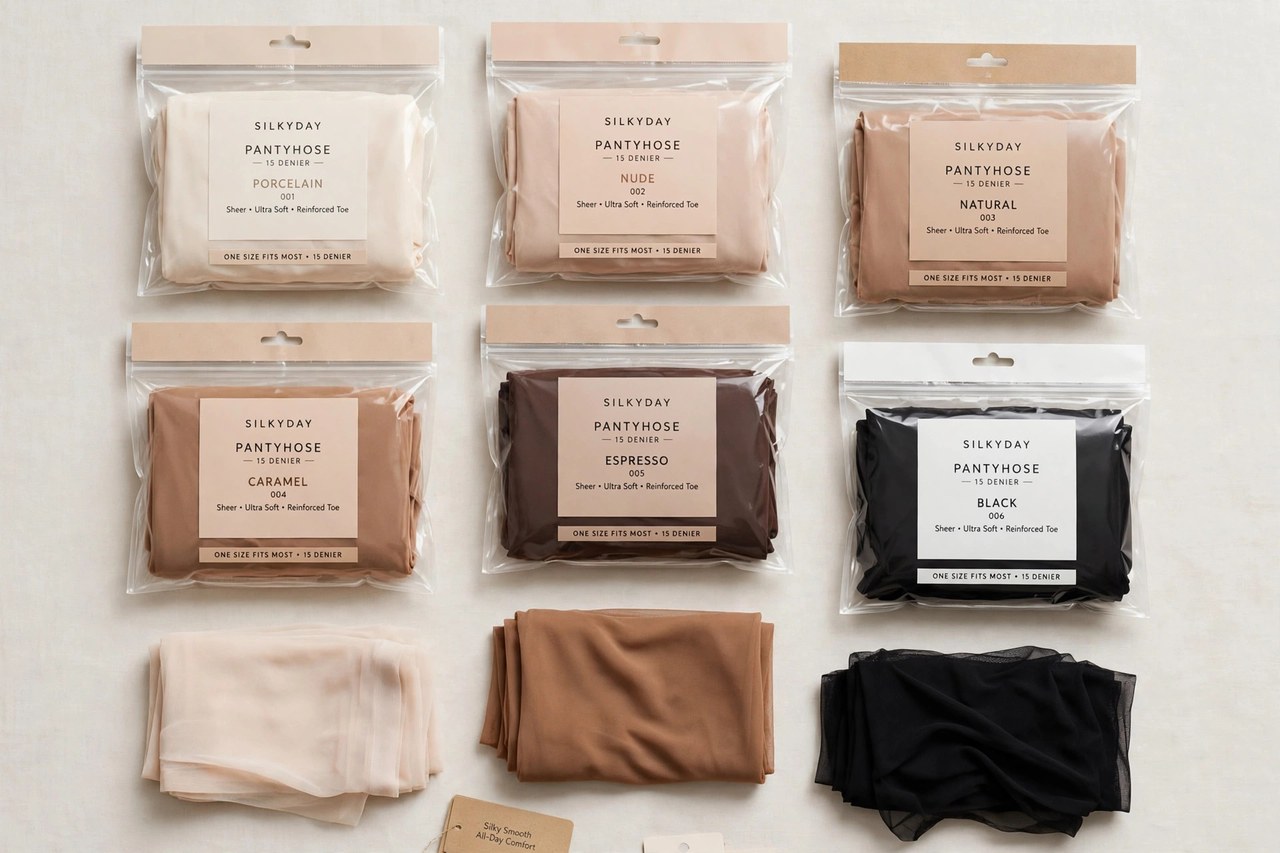
Pantyhose are a one-piece hosiery garment combining a brief-style top with two sheer legs, worn under skirts, dresses and tailored shorts. They arrived in the 1960s, when miniskirts made stockings and garter belts impractical, and they remain the standard sheer leg covering for formal, professional and cold-weather dressing. Modern pantyhose are knitted mainly from nylon with elastane, in weights from nearly invisible to fully opaque.
Buying them well requires learning a small technical vocabulary that other garments do not use. Sheerness is measured in denier, the top of the garment comes in three distinct constructions, support is a separate functional category, and sizing is read from a height-and-weight grid printed on every package. This guide explains each in turn, then covers the handling habits that keep a delicate garment from snagging or running on its first wear.
Denier: The Measure of Sheerness
Denier measures the thickness of the yarn: the lower the number, the sheerer and more delicate the hose. Ultra-sheer styles, roughly 5 to 15 denier, are nearly invisible on the leg and are chosen for evening and formal wear and warm weather; they are also the most fragile. Sheer styles around 15 to 30 denier are the everyday professional standard, giving even color and light coverage with reasonable durability. Semi-opaque 30 to 50 denier and opaque styles above 50 denier read increasingly like tights, adding warmth, hiding more, and lasting considerably longer.
Choose denier by occasion and season together. A sheer 15-denier pair suits a summer wedding; the same event in January calls for 40 denier or opaque. If you wear pantyhose daily for work, the economics favor mid-denier styles: ultra-sheer pairs may survive only a few wears, while a 20 to 30 denier pair balances appearance and lifespan.
Top Constructions: Sheer-to-Waist, Control Top and Support
In sheer-to-waist pantyhose, the same sheer knitting runs from toe to waistband with no heavier brief section. They are the choice under short hemlines, high slits and light-colored clothing, where a visible brief line would show. In control top styles, the brief section is knitted firmer with more elastane to smooth the tummy and hips; the brief is visibly denser, so hemlines must cover it, but the shaping and the durability at the top are both better, and the reinforced brief also resists the fingertip tears that happen when pulling hose on.
Support pantyhose use graduated compression — firmest at the ankle, easing upward — to reduce leg fatigue during long standing or travel. They feel tighter to put on and are sized especially carefully. Other construction details worth checking: a cotton gusset for comfort, reinforced toes for wear with closed shoes (sandalfoot styles omit this for open shoes), and a waistband that is wide enough not to roll. Each feature maps to a use; match the construction to the outfit and the day, not just to the color.
Sizing by Height and Weight
Pantyhose are sized from a grid of height against weight printed on the package, because the garment must stretch in both length and width at once, and dress size captures neither properly. Find your height row and weight column; the letter or size where they meet is yours. If you fall on a border, size up — an over-stretched pair is more likely to run, sags at the ankle, and pulls down at the waist through the day, while a slightly larger pair sits smoothly. Tall and plus ranges extend the grid and are worth seeking out rather than forcing a standard size.
Put pantyhose on carefully, because most damage happens in the dressing. Remove rings, smooth rough nails, gather one leg down to the toe, place it over the foot, and ease the leg up gradually, alternating legs, never yanking from the waistband. Position the gusset correctly before pulling the brief fully up, and check that the legs are not twisted. A correct size put on this way should feel even and smooth, with no tight band behind the knee and no webbing between the toes.
Runs, Snags and Care
A run starts as a snag — a pulled loop, often from a rough nail, a splintered desk edge, jewelry or a rough heel. A dot of clear nail polish or hosiery adhesive on a small snag can stop it laddering further, at least for the day. Prevention is better: keep nails smooth, moisturize dry heels, put hose on after shoes with rough interiors are checked, and keep a spare pair at work or in a bag for formal occasions. Store pairs separately in individual bags or a divided drawer so they cannot catch on each other's packaging or on other garments.
Wash pantyhose by hand in cool water with mild soap, or in a mesh bag on a gentle machine cycle; never wring, and dry draped away from heat. Rotate pairs rather than wearing the same one daily, since elastane recovers between wears. Even with perfect care, sheer pantyhose are a limited-life garment — buy the quality level that matches the occasion, keep everyday pairs in the durable mid-deniers, and treat ultra-sheer formal pairs as the near-disposable luxury they are. That realistic approach costs less, over a year, than hoping one fragile pair will do everything.
Related Women's Guides
More to Explore on Apparel Search
Looking for Women's Clothing Stores?
This guide helps you choose women's pantyhose. To browse where to buy, visit our women's clothing store directory, where you can find retailers that carry them.