Women's Stockings Guide
A stocking is a separate close-fitting leg covering for each leg, foot to thigh — held up by a garter belt, a garter, or its own stay-up band, and distinct from pantyhose and tights.
Shop Women's Stockings Now
Shop Women's Stockings on Amazon Shop Women's Stockings on eBayThe Amazon and eBay links on this page are affiliate links. If you make a purchase through them, Apparel Search may earn a commission.
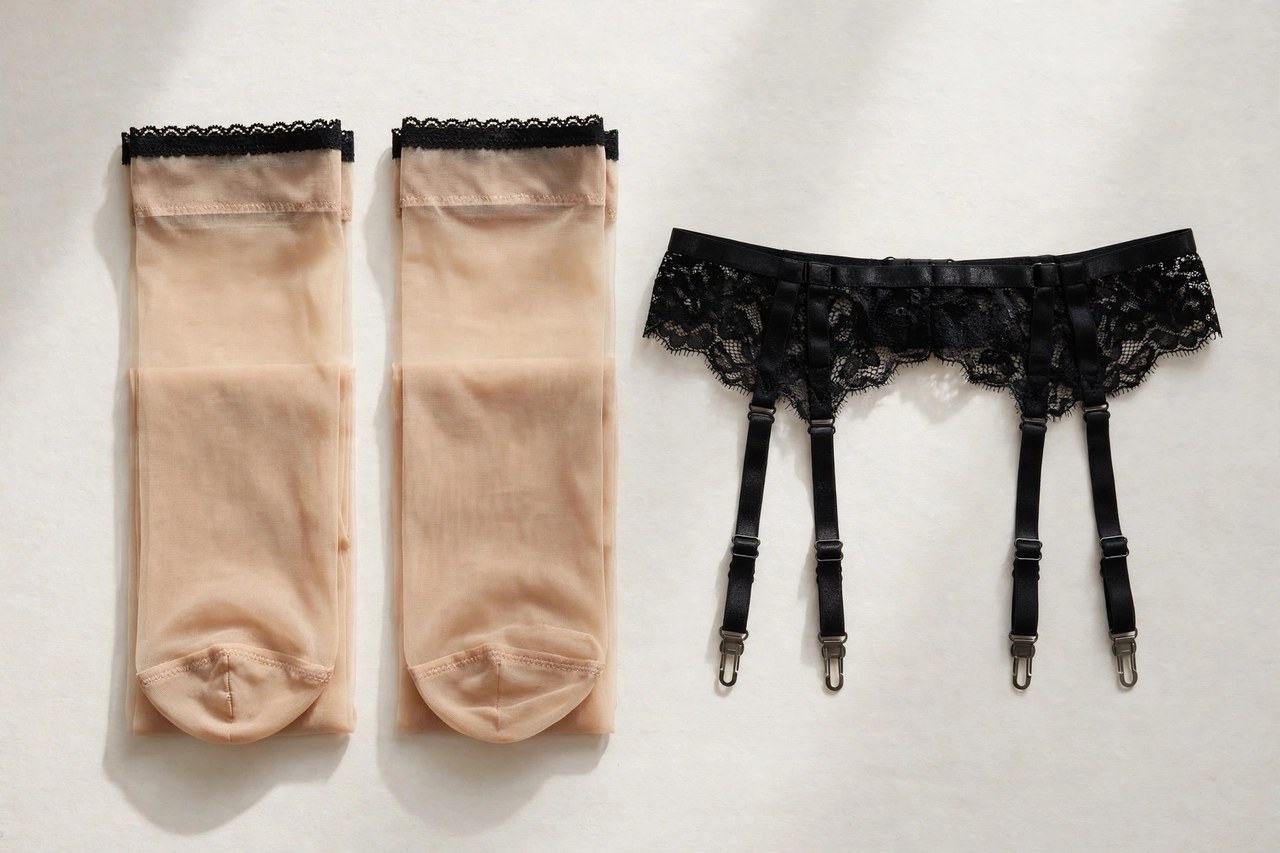
A stocking is a close-fitting, elastic garment covering the leg from the foot up to the knee, or to part or all of the thigh, made as two separate pieces, one for each leg. That two-piece construction is the definition that matters: in modern usage the stocking is distinct from pantyhose and tights, which are one garment with a built-in brief. Stockings vary in color, design and transparency, and because they are separate, each one must be held up on its own — by a garter belt, by a garter, or by a built-in stay-up band.
This guide covers stockings as hosiery: the hold-up systems and how to choose among them, denier and sheerness, a short history from silk to the nylon sensation of 1939 and 1940, and the handling habits that keep a ladder-prone garment alive. Stockings are worn primarily for fashion, usually with mid-length or short skirts, and their separate-piece nature is a practical advantage: run one leg, and you replace one stocking, not a whole pair of pantyhose.
Three Ways a Stocking Stays Up
The oldest system is the garter belt, also called a suspender belt: a band worn around the waist under clothing, with straps — suspenders or stays — ending in clips that grip the stocking's reinforced top, called the welt. A good belt has four to six straps, metal rather than plastic clips, and adjustable lengths, and it holds stockings at an even height all day regardless of leg shape. Traditional stockings without any elastic band of their own are made for this system.
Stay-ups, or hold-ups, hold themselves: the inside of the top band carries a strip of silicone or highly tractive elastic that grips the thigh. They are quick to wear and need no belt, but there is no consistent sizing for differences in thigh circumference, so some stay-ups either slide down or bind too tightly — trying one brand's size chart against your own thigh measurement is essential. The third method, the single garter slipped over the stocking top to clamp it to the leg — the garter familiar from weddings — shares the stay-up's fit gamble and is best for short wear rather than a full day.
Denier, Sheerness and Finishes
Denier measures the yarn's weight and, in practice, the stocking's opacity. Low deniers, roughly 5 to 15, are ultra-sheer, giving the bare-leg finish that made flesh-colored stockings popular in the 1920s when hemlines rose and exposed legs were covered with sheer silk or rayon instead. Mid deniers around 20 to 30 add durability and a light tint of color; higher deniers turn semi-opaque and then opaque, behaving more like tights in appearance while remaining two separate pieces.
Finishes refine the effect: matte stockings read as bare skin, a slight sheen catches light along the leg, and seamed stockings carry a line up the back — the descendant of the seam that once joined a fully-fashioned knitted leg. Reinforced toes and heels extend wear at the friction points, and sandalfoot versions leave the toe sheer for open shoes. Choose denier by occasion and season: the sheerest finishes are the most fragile, and a spare pair carried in a bag is easy insurance because stockings are quick-drying and take almost no room.
From Silk to Nylon: A Short History
Before the 1920s, stockings were worn mainly for warmth, in wool and cotton. The 1920s changed their purpose: as hemlines rose and central heating was not yet widespread, women wore flesh-colored sheer stockings to cover exposed legs, first in silk or rayon, then known as artificial silk. The revolution came in 1939, when DuPont introduced nylon; when nylon stockings went on sale in 1940, demand was so intense that up to four million pairs were bought in a single day. Nylons were cheap, durable and sheer compared with cotton and silk alike.
Wartime shortages, when nylon was diverted to parachutes, made stockings precious enough that drawn-on seams became a famous substitute. After the war, nylon stockings became the standard, joined later by elastane for fit. Today stockings are commonly knitted from nylon, silk, cotton or wool blends — with the garter-belt and stay-up systems surviving alongside the pantyhose that were supposed to replace them, kept alive by comfort in warm weather and by the sheer elegance of the separate garment.
Sizing, Wearing and Care
Stockings are sized by height and weight charts, and for stay-ups additionally by thigh fit, so measure rather than guessing from dress size. Put stockings on gathered from toe to knee and eased up the leg, never pulled by the welt, with smooth hands and short nails — most ladders are born in the dressing, not the wearing. Align any back seam by mirror before fastening garter clips, and clip through the welt's doubled fabric, not the sheer leg.
Hand wash in cool water with mild detergent, roll in a towel rather than wringing, and dry away from heat; both nylon and elastane age quickly in hot water and tumble dryers. Store pairs rolled or in individual bags so they cannot snag on each other or on lingerie hardware. Only the stocking lets you retire a single laddered leg. With gentle handling, a quality pair survives far longer than its fragile reputation suggests.
Related Women's Guides
Looking for Women's Clothing Stores?
This guide helps you choose women's stockings. To browse where to buy, visit our women's clothing store directory, where you can find retailers that carry them.