Women's Petite Intimate Apparel Guide
Intimate apparel is the umbrella term for undergarments and sleepwear — and in petite sizing, shorter rises, narrower straps and scaled cups make the base layer fit the frame it starts from.
Shop Women's Petite Intimate Apparel Now
Shop Women's Petite Intimate Apparel on Amazon Shop Women's Petite Intimate Apparel on eBayThe Amazon and eBay links on this page are affiliate links. If you make a purchase through them, Apparel Search may earn a commission.
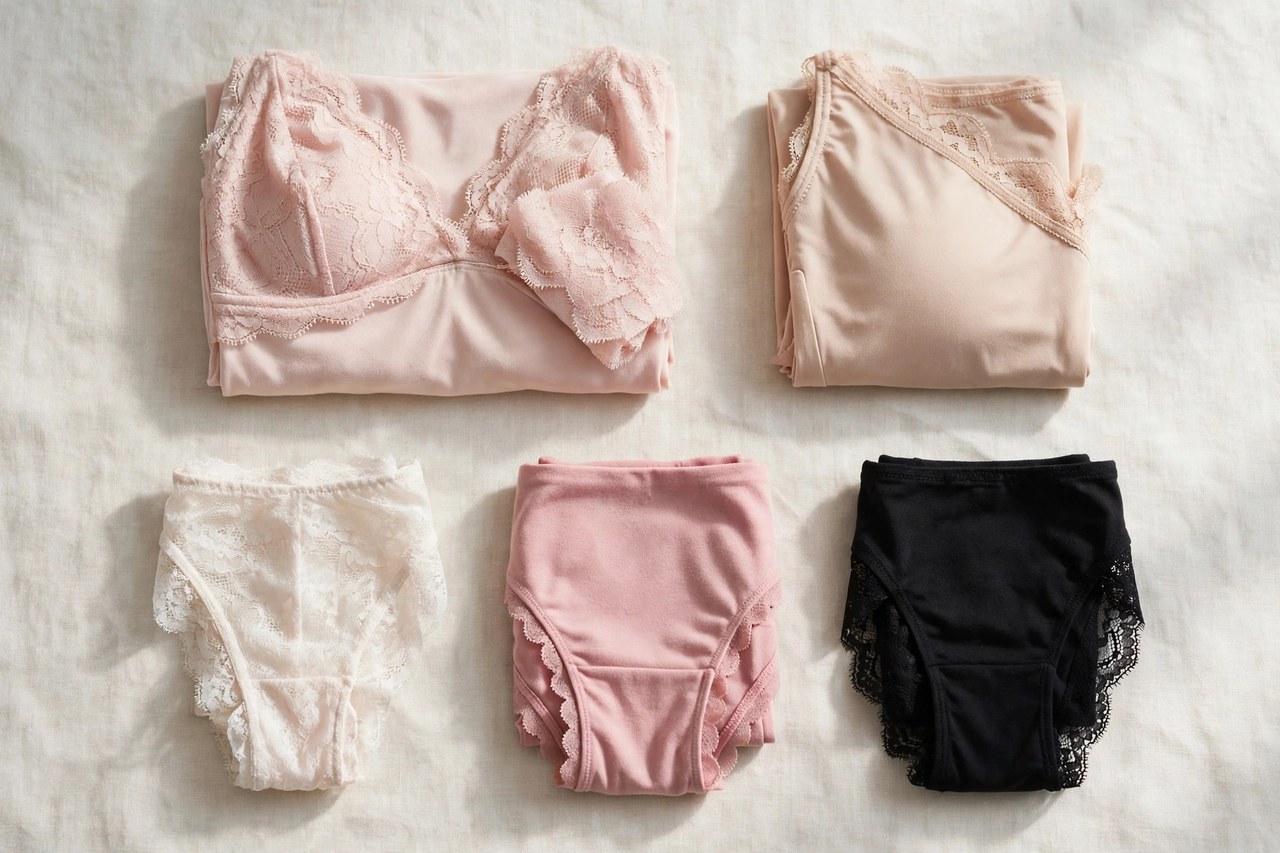
Intimate apparel is the industry's umbrella term for the garments worn closest to the body: bras, panties, slips, camisoles, shapewear foundations and, in many classifications, sleepwear and robes. It is a category name rather than a single garment, and this guide treats it that way — a neutral, product-focused overview of what belongs in the category and what petite sizing changes across all of it.
Petite fit in intimates is about placement, not just size. A woman 5'4" and under typically has a shorter torso, a shorter rise, narrower shoulders and a shorter strap drop. Standard intimates put waistbands, leg elastics, strap adjusters and slip hemlines where a longer frame expects them. Petite ranges re-place each of those points, and the difference is felt all day because these are the first garments on and the last ones off.
What Belongs in the Category
The core of intimate apparel is underwear: bras, covered in depth in their own guide, and panties in brief, bikini, hipster and boyshort cuts. Around that core sit the layering foundations: full and half slips that let skirts and dresses hang smoothly, camisoles worn as liners or sleep tops, and undershirts in warm fabrics. Shapewear and foundation garments — briefs, shorts and bodysuits with firmer knitting — form the functional branch of the category.
Many retailers also shelve sleepwear and loungewear under intimate apparel: pajama sets, nightgowns, robes and sleep shirts. The common thread is construction: soft fabrics, elastic or drawstring waists, minimal hardware, and seams designed to be comfortable against skin for long, unobserved hours. Knowing the umbrella helps you shop it: a petite specialist's intimate range will scale all of these consistently, so your slip length, camisole strap drop and pajama inseam follow the same proportions as your day clothes.
Petite Proportions: Rise, Torso and Strap Length
The rise is the signature petite measurement in this category. Petite panties and shapewear are cut with a shorter front and back rise, so the waistband sits at the waist rather than drifting above it and the leg elastics sit in the leg crease rather than below it. A standard brief in a smaller size keeps the standard rise and merely narrows — which is why sizing down never quite fixes a rolling waistband, and a true petite cut does.
In the top half, strap length and placement are the petite variables: camisole and slip straps are shorter and set closer together for narrower shoulders, strap adjusters have enough range to actually shorten fully, and slip and camisole bodies are shorter so hemlines land mid-thigh as intended rather than at the knee. Sleepwear follows the same logic — petite pajama pants carry inseams around 26 to 28 inches instead of 30-plus, nightgown lengths are graded from the shoulder, and robe sleeves end at the wrist instead of past the fingertips.
Fabrics and Construction Across the Category
Cotton and cotton blends anchor everyday intimates for breathability and easy washing. Microfiber and nylon-elastane knits provide the smooth, low-profile finish needed under tailored petite clothing, where any extra bulk shows sooner on a smaller frame. Modal and bamboo-derived knits bring a cool, soft hand to sleepwear and camisoles. Lace appears as trim and panels; flat lace often lies smoother than folded elastic and is a legitimate functional choice, not only a decorative one.
Construction checks are consistent across the category: a cotton-lined gusset in panties, flat or bonded seams where the garment meets fitted clothing, elastics that recover after stretching, and strap hardware that does not dig into a narrower shoulder. In petite lines, also check that patterns and lace are scaled — a wide lace band designed for a standard waistband can occupy half the front of a petite brief. The best petite intimates look unremarkable on the hanger and disappear completely in wear, which is exactly their job.
Sizing, Wardrobe Planning and Care
Size intimates by measurement, category by category: hip for panties, band and cup for bras, and your usual petite dress size as the starting point for slips, camisoles and sleepwear, adjusted by torso length. If waistbands roll, leg edges ride or straps slip despite adjustment, treat those as proportion problems before size problems — the petite version of the same size is usually the correction. Keep notes per brand; petite grading varies more between makers in this category than in any other.
A workable petite intimates wardrobe is small and matched: everyday cotton underwear, a few seamless microfiber pieces for fitted clothes, a slip and camisole in lengths that match your petite skirts and dresses, and sleepwear with inseams you do not have to roll. Care is gentle and uniform — cool washes, mesh bags for anything with straps or lace, low or no dryer heat to protect elastic — and replacement is by condition: when elastic stops recovering or fabric thins, the garment is done, whatever the calendar says.
Related Women's Guides
More to Explore on Apparel Search
Looking for Women's Clothing Stores?
This guide helps you choose women's petite intimate apparel. To browse where to buy, visit our women's clothing store directory, where you can find retailers that carry them.