Women's Petite Lingerie Guide
Petite lingerie scales the delicate parts down: shorter straps and slips, smaller lace motifs and rises cut for a shorter torso, in a strictly product-focused guide to styles, fabrics and fit.
Shop Women's Petite Lingerie Now
Shop Women's Petite Lingerie on Amazon Shop Women's Petite Lingerie on eBayThe Amazon and eBay links on this page are affiliate links. If you make a purchase through them, Apparel Search may earn a commission.
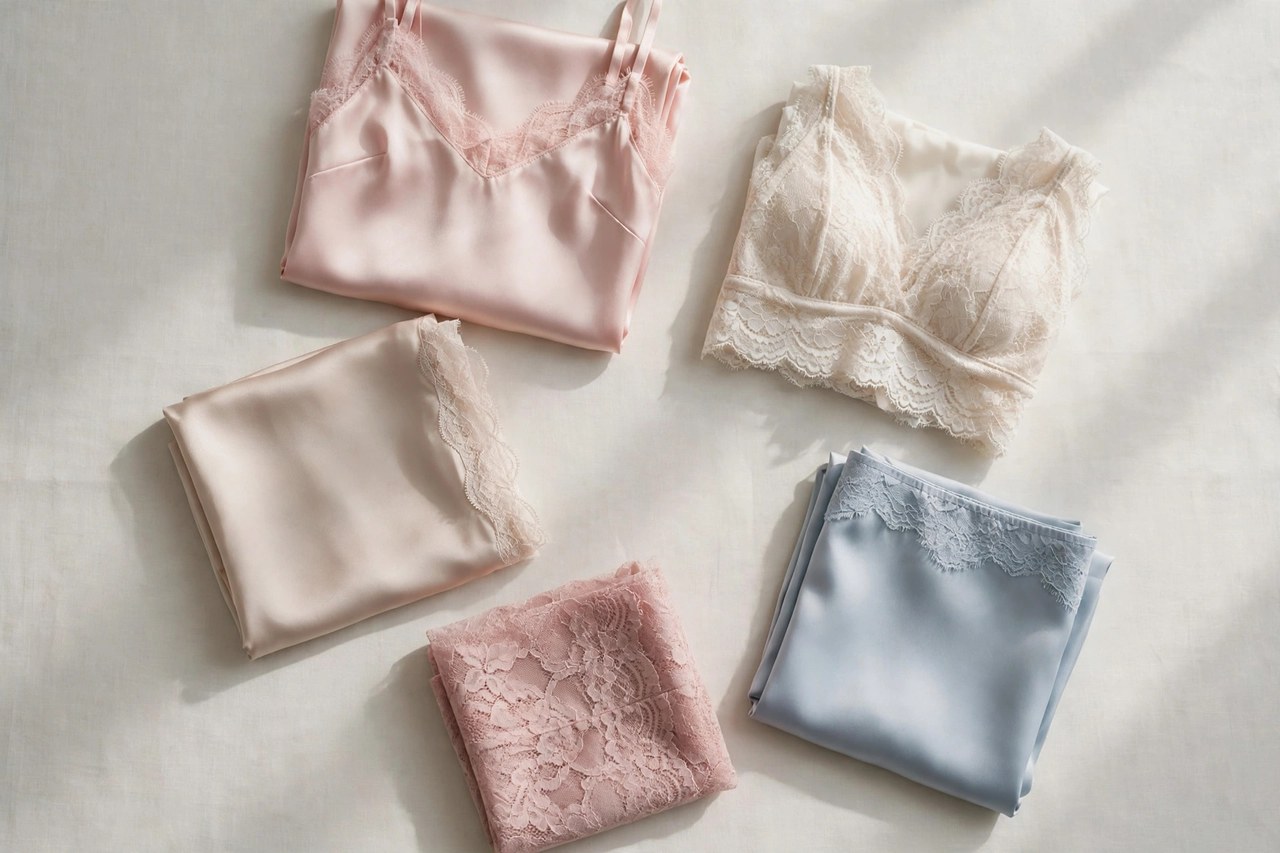
Lingerie is the finer branch of women's undergarments and sleepwear: bras, panties, slips, camisoles, chemises and related pieces made in lighter fabrics, with lace, silk and sheer knits, and more attention to finish than everyday intimates receive. This guide treats the category strictly as product — styles, fabrics, sizing, construction and care — and through the petite lens: how these garments are re-proportioned for women 5'4" and under.
Delicate garments show proportion errors fastest. A strap that will not shorten enough, a slip that hangs to the knee instead of mid-thigh, a lace motif sized for a longer torso — on fine fabrics there is no bulk to hide behind. Petite lingerie addresses exactly those points: shorter strap drops, rises and bodies cut to a shorter torso, narrower strap placement for smaller shoulders, and embellishment scaled to the frame.
The Main Pieces in Petite Proportion
Bras in petite ranges use closer-set, shorter straps, cups graded on a smaller ribcage and frame, and centers that sit correctly on a shorter torso; balcony and demi styles, whose geometry depends on placement, benefit most visibly. Panties in petite cuts carry the shorter rise discussed across these guides, with lace widths narrowed so a trimmed edge stays an edge rather than becoming the garment. Fit principles are the everyday ones — flat waistbands, leg edges in the crease — executed in finer materials.
Slips and camisoles are where petite length is non-negotiable: a half slip should end above the knee of the skirt it serves, and petite skirt lengths are shorter, so the slip must be too. Petite full slips are graded from the shoulder, keeping the bust shaping at the bust. Chemises and babydoll styles — loose, short nightdress-style garments — in petite cuts end at the intended mid-thigh rather than the knee, and their empire seams sit under the bust as designed. Teddies and bodysuits are the most torso-sensitive pieces of all: body length is the fit, and petite versions shorten it so snaps and seams align without strain.
Fabrics: Silk, Lace, Satin and Fine Knits
Silk is the classic lingerie fabric: light, smooth, temperature-regulating and strong for its weight, used in slips, chemises and camisoles, usually as washable silk charmeuse in modern ranges. Lace ranges from fine Chantilly to firmer Leavers and stretch laces; in petite garments, look for motifs scaled to the piece — a large floral lace designed for a standard garment can cover a petite camisole front entirely, changing the design. Stretch lace adapts best to smaller frames because it follows proportion rather than imposing its own.
Satin (a weave, in silk or polyester) gives the glossy, fluid surface of classic slips and robes at several price levels. Sheer knits and mesh are used in panels and lightweight bras, with elastane for fit. Cotton and modal appear in the softer, everyday end of lingerie — camisoles and sleep pieces where comfort leads. Across fabrics, petite construction should also scale the trims: narrower elastic, smaller bows and rings, and strap hardware sized to the strap, all of which keep the piece in proportion visually as well as functionally.
Sizing and Fit Checks
Size lingerie by the same measurements as intimates — band and cup, hip, and your petite dress size for slips and chemises — but fit-check the proportion points explicitly. Straps should adjust to stay on the shoulder with room to spare in the slider, not at its last notch. A slip's hem should clear the hem of the dress or skirt it is bought for by at least an inch. A chemise's seam lines should sit where the style puts them on the model imagery only if that imagery is on a petite model; otherwise trust your mirror over the photograph.
Torso length is the measurement most worth knowing here: measure from shoulder, over the bust, to the waist, and compare with size charts for bodysuits and teddies, where a single number decides success. If you fall between petite and standard torso lengths, bodysuits with adjustable straps and multi-row closures forgive the most. Keep brand notes: petite lingerie grading varies widely, and a maker whose strap placement suits your shoulders is worth returning to across the whole category.
Care and Building a Petite Lingerie Drawer
Fine fabrics earn gentle handling: hand wash or use a mesh bag on a delicate cycle in cool water, mild detergent, no wringing, and dry flat or draped away from heat. Silk benefits from washing with like colors and occasional pressing on low from the reverse. Lace should not be hung by its edges, which stretch; store pieces folded, with bras nested cup-in-cup or laid flat so molded cups keep their shape, and keep hooks fastened so they cannot snag lace in the drawer.
Build the drawer functionally first: well-fitting everyday-fine bras, panties in the rises that match your petite clothing, and a slip and camisole in the lengths your dresses actually need — then add silk or lace occasion pieces. Buy single pieces to prove a brand's petite fit before sets, since sets multiply both value and mistakes. Treated as what it is — precision-made clothing in demanding materials — petite lingerie stops being a guessing category and becomes one of the most exactly fitting parts of the wardrobe.
Related Women's Guides
Looking for Women's Clothing Stores?
This guide helps you choose women's petite lingerie. To browse where to buy, visit our women's clothing store directory, where you can find retailers that carry them.