Women's Petite Swimwear Guide
Petite swimwear is cut for a shorter torso, narrower shoulders and a frame 5'4" and under — so straps stay put, leg openings sit correctly and prints are scaled to the body wearing them.
Shop Women's Petite Swimwear Now
Shop Women's Petite Swimwear on Amazon Shop Women's Petite Swimwear on eBayThe Amazon and eBay links on this page are affiliate links. If you make a purchase through them, Apparel Search may earn a commission.
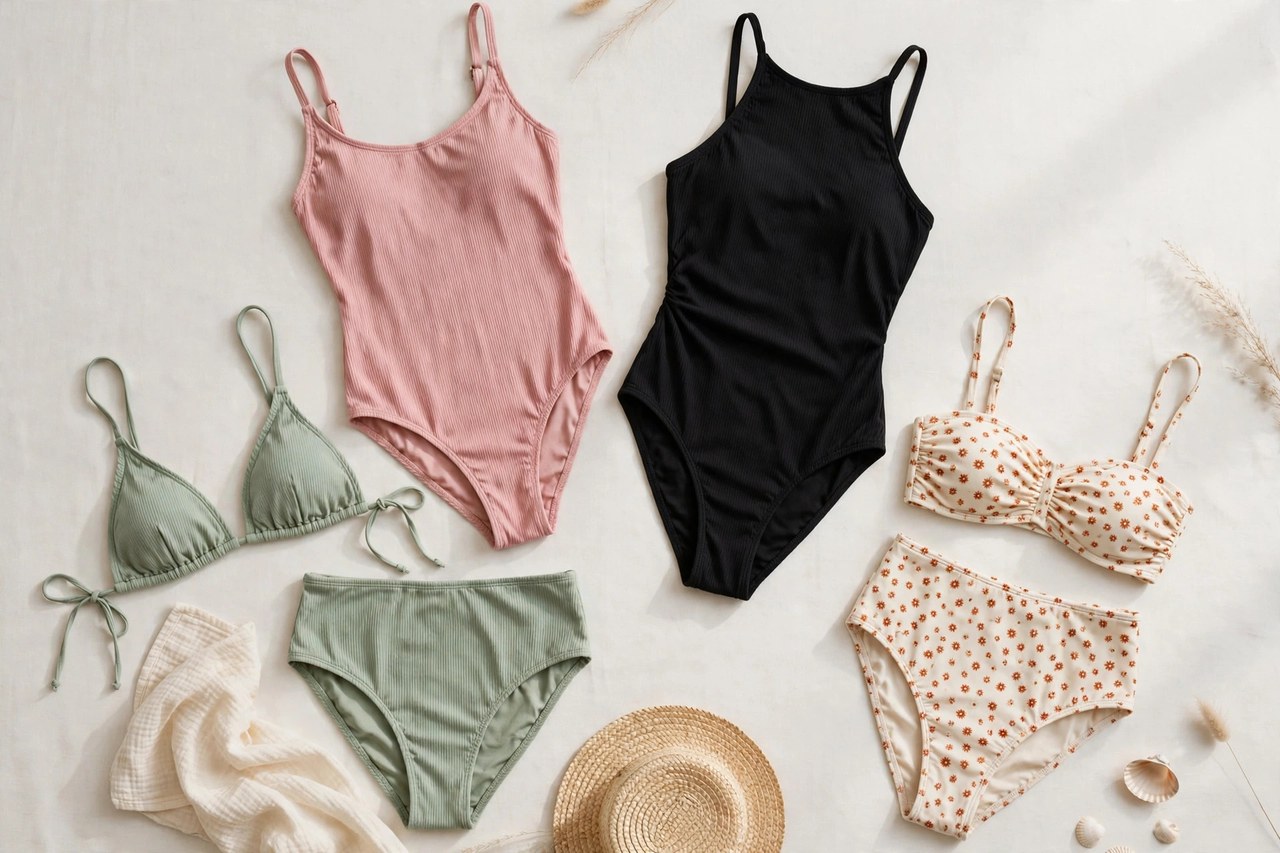
Petite swimwear is swimwear patterned for women 5'4" and under, and the difference that matters most is torso length. A regular one-piece is drafted for a longer body, so on a petite frame the extra length bunches at the waist, the bust sits too low and the leg openings drift down the thigh. A true petite suit shortens the torso measurement, raises the leg cut proportionally, narrows the shoulder straps and scales prints and details down so nothing overwhelms a smaller frame.
This guide stays strictly with the product: the main suit styles, how torso and cup sizing work in petite ranges, the fabrics and support features built into modern suits, and how to care for stretch swim fabrics. Whether you swim laps, sit poolside or pack one suit for a beach week, the right petite cut removes the constant adjusting that a borrowed regular size always demands.
Styles: One-Piece, Tankini, Bikini and Swim Dresses
The one-piece is the most torso-sensitive style, which is why petite versions matter most here: a shortened body, adjustable straps and a leg opening cut for a shorter hip line. Tankinis pair a tank-style top with a separate bottom, which suits petite shoppers well because the two pieces can be sized independently and the top length can be chosen to end at the natural waist rather than mid-hip. Bikinis in petite ranges use narrower strap widths, smaller hardware and cups placed closer together for narrower shoulders.
Swim dresses and skirted bottoms add a short, scaled skirt for coverage, while high-waisted bikini bottoms give a longer leg line without needing extra torso length. Rash guards and swim tees in petite cuts shorten the body and sleeves so sun-protective tops do not hang past the hips. Choose by activity first: secure, close styles for swimming and sport, and more decorative necklines for low-activity sun and social wear.
Fit: Torso Length, Straps and Leg Openings
For a one-piece, the key measurement is the torso loop — from one shoulder, down the body and back up — and petite suits are graded with a measurably shorter loop than regular sizes with the same bust number. If a suit wrinkles vertically at the waist or the straps slide, the torso is too long regardless of the size label. Adjustable and convertible straps help fine-tune a petite fit, and straps set closer together suit narrower shoulders and stay in place better when you move.
Leg openings should sit at the natural crease without cutting in or gaping when you sit and bend. A higher petite leg cut is positioned relative to a shorter torso, so it lengthens the leg visually without exposing more than intended. Cup sizing follows standard band and cup letters in better ranges, with molded, removable or underwire options; choose support by activity, and check that the top edge lies smooth when you raise your arms, the simplest test of a working fit.
Fabrics, Lining and Support Features
Most petite swimwear is knitted from nylon or polyester blended with elastane, typically 15 to 25 percent stretch fiber for recovery and hold. Polyester-rich fabrics resist chlorine and fading best for pool swimming, while nylon feels softer for occasional beach wear. Quality suits are fully or partially lined with a smooth mesh or jersey that prevents show-through, adds light compression and keeps seams from rubbing during a full day of wear.
Support features are construction details, not decoration: power mesh panels smooth the midsection, shelf bras and molded cups shape and separate, underwire in cup-sized styles lifts in the same way a bra does, and wide, cushioned straps distribute weight on the shoulder. Ruching and wrap-front bodices are practical as well as pretty on petite frames, because the texture is scaled small and breaks up the surface without adding bulk. Check that hardware is plastic or coated metal so it will not rust or overheat in sun.
Sizing, Care and Buying Tips
Buy petite swimwear by measurements, not by your dress size alone. Compare bust, waist, hip and, for one-pieces, torso loop against the brand chart, and expect to size the top and bottom separately in two-piece styles. If you fall between sizes, most swimmers prefer the larger size for comfort, since wet stretch fabric tightens visually as it dries on the body. Petite-specific ranges are worth seeking out rather than shortening a regular suit, which cannot be altered through its lined, elastic construction.
Rinse every suit in cool fresh water after each wear to remove chlorine, salt and sunscreen, wash gently by hand with mild detergent, and dry flat in shade — never wring an elastane suit and never machine dry it, because heat is the fastest way to kill stretch recovery. Rotate two suits on a trip so each rests a full day between wears. Stored clean, dry and flat, a good petite suit holds its fit for several seasons instead of one.
Related Women's Guides
More to Explore on Apparel Search
Looking for Women's Clothing Stores?
This guide helps you choose women's petite swimwear. To browse where to buy, visit our women's clothing store directory, where you can find retailers that carry them.