Women's Petite Activewear Guide
Petite activewear fits women 5'4" and under with shorter inseams, a higher knee break and straps and rises that stay put in motion — so leggings, tops and jackets work with your stride, not against it.
Shop Women's Petite Activewear Now
Shop Women's Petite Activewear on Amazon Shop Women's Petite Activewear on eBayThe Amazon and eBay links on this page are affiliate links. If you make a purchase through them, Apparel Search may earn a commission.
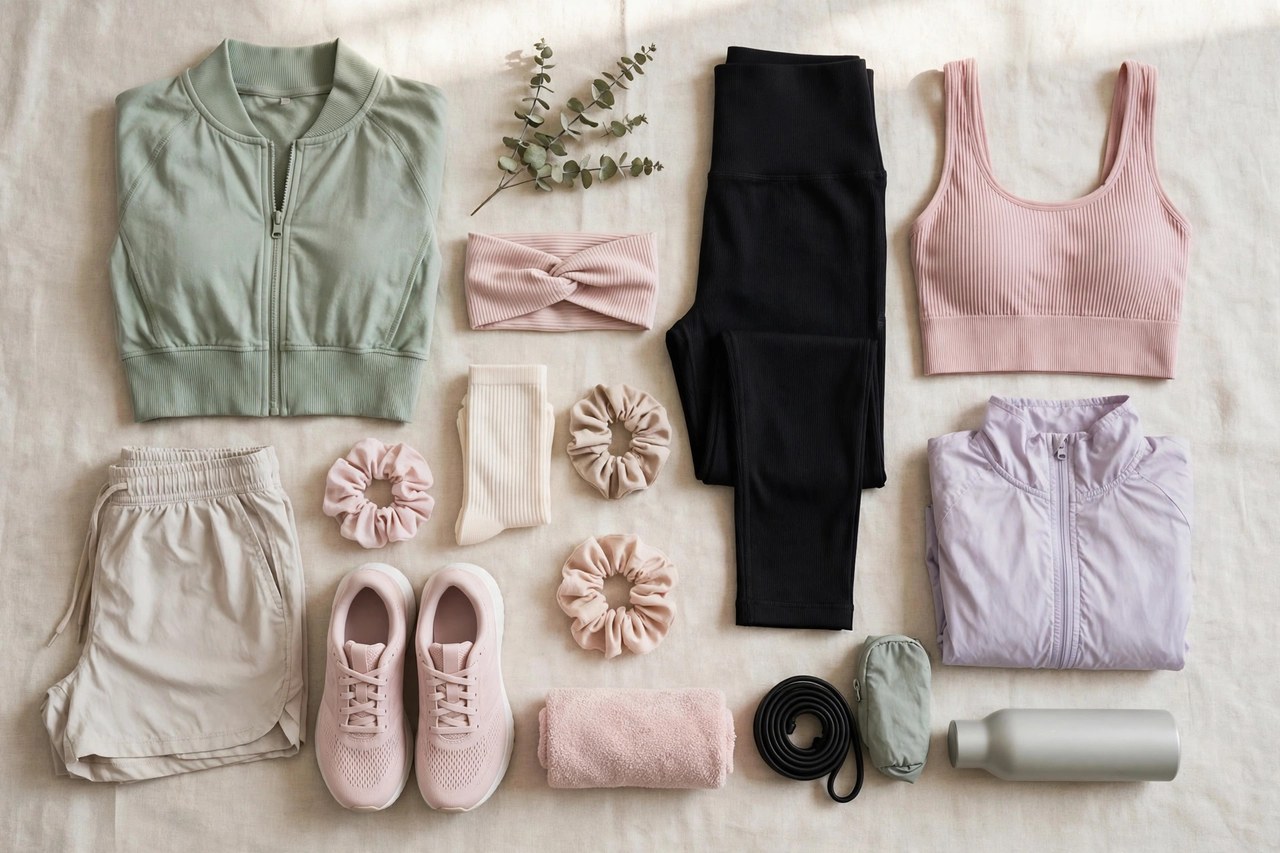
Petite activewear is workout clothing cut for women 5'4" and under, and the changes go well beyond a shorter hem. A true petite legging moves the knee panel up, shortens the rise so the waistband sits at the waist instead of the ribs, and scales the hip-to-ankle taper so compression lands where the muscle actually is. A regular legging simply hemmed still has its knee, calf and ankle shaping in the wrong places, which is why it bunches and slides during a workout.
This guide covers the core petite activewear pieces — leggings and tights, shorts, tanks and tees, sports jackets and layers — the performance fabrics they use, and the movement-based fit checks that matter more than a mirror check. Whether your training is yoga, running, lifting or walking, petite proportions decide whether the clothing disappears during exercise, which is exactly what good activewear should do.
Leggings, Tights and Shorts: Inseam Is Everything
Petite leggings typically offer inseams around 21 to 23 inches for a cropped or 7/8 fit and 25 to 27 inches for full length, compared with 28 to 32 inches in regular ranges. That difference places the ankle opening at the ankle, the calf compression over the calf, and any mesh or reflective detail where it was designed to sit. High-rise petite styles also shorten the front and back rise, so the waistband supports the midsection without folding over when you bend, squat or sit on a bike.
Petite workout shorts use shorter outseams — roughly 3 to 5 inches for run shorts — and a shorter rise, so the leg opening does not land mid-thigh and ride up with each stride. Bike shorts and capri tights follow the same pattern, ending above or just below the knee rather than across it. Check gusset placement and flatlock seams as well: on a shorter leg, a misplaced seam sits directly behind the knee and chafes in a way it never would at the intended length.
Tops, Tanks and Jackets for a Shorter Torso
Petite active tops are cut with a shorter body length, higher armholes and narrower shoulders, so a tank does not hang to mid-thigh, straps stay on the shoulder during overhead movement, and a racerback sits between the shoulder blades rather than below them. Shelf-bra tanks and fitted tees in petite sizes place any bust shaping at the right height. For petite women, a regular top often needs tucking, which adds bulk at the waistband of the legging and works loose mid-workout.
Petite jackets and half-zips shorten both body and sleeve, put thumbholes at the thumb instead of the fingertips, and place zip pockets where a shorter arm naturally reaches. Reflective trims are also repositioned for a shorter back length. When layering for outdoor training, this matters for safety and comfort together: a jacket that ends at the hip instead of the thigh allows a full leg lift, and sleeves that end at the wrist keep cuffs out of equipment, mats and handlebars.
Fabrics, Compression and Support
Most petite activewear uses the same performance fabrics as regular ranges — nylon or polyester blended with elastane for four-way stretch, moisture wicking and recovery. Compression levels run from light, everyday stretch to firm studio and run compression; on a petite leg, correct placement is what makes compression effective, because a panel designed for a longer calf cannot support a shorter one. Look for squat-proof opacity in leggings, a drawcord or wide waistband that prevents roll-down, and fabric weight matched to season.
For high-impact activity, encapsulation and support come from your sports bra rather than the top, so choose petite-friendly designs with adjustable straps and shorter band lengths that close properly on a smaller ribcage. Breathability features — mesh backs, laser-cut vents, lighter panels — should sit over the upper back and behind the knee; in petite cuts they do. Avoid sizing down in regular activewear to get length: it distorts compression, narrows the shoulder, and still leaves the rise and knee in the wrong place.
Fit Checks in Motion and Care
Test activewear by moving, not standing. Squat, lunge, lift your knees, reach overhead and jog in place in the fitting room or at home before removing tags. The waistband should stay level, knees should bend without fabric pulling from the ankle, straps should not need repositioning, and nothing should require a mid-set tug. If you constantly adjust a piece during the test, it will be worse at minute forty of a real workout, whatever the fabric promises.
Wash petite activewear cold, inside out, and skip fabric softener, which coats wicking fibers and traps odor. Air drying protects elastane and preserves compression and reflective details far longer than tumble heat. Rotate at least two sets if you train often, because elastane needs rest days to recover its snap. Buy first for your main activity and your true petite inseam, add seasonal layers second, and your activewear will support the workout instead of becoming the workout's main distraction.
Related Women's Guides
Looking for Women's Clothing Stores?
This guide helps you choose women's petite activewear. To browse where to buy, visit our women's clothing store directory, where you can find retailers that carry them.