Women's Petite Leggings Guide
Petite leggings match a shorter inseam and rise, so the ankle band lands at the ankle, the waistband at the waist, and nothing pools, sags or needs rolling.
Shop Women's Petite Leggings Now
Shop Women's Petite Leggings on Amazon Shop Women's Petite Leggings on eBayThe Amazon and eBay links on this page are affiliate links. If you make a purchase through them, Apparel Search may earn a commission.
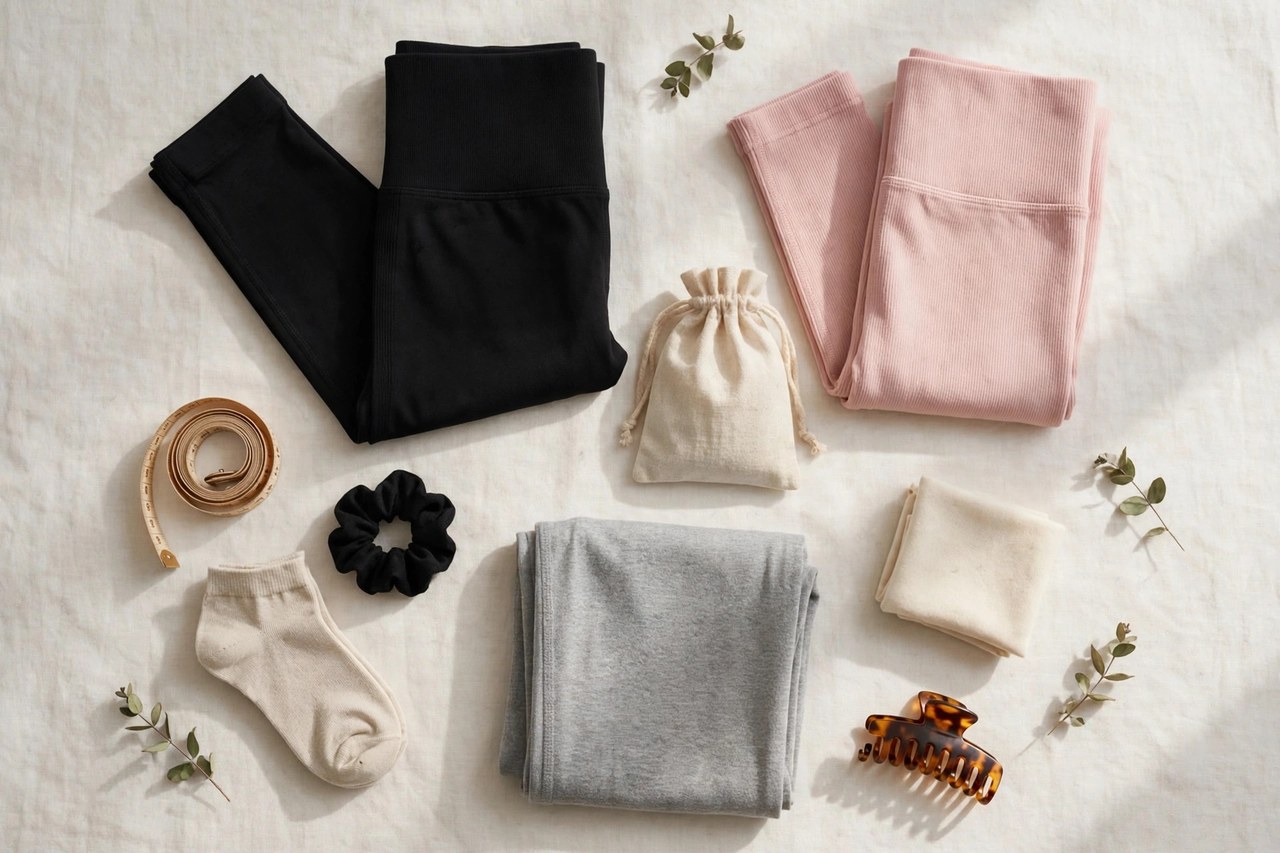
Leggings look like the simplest garment in the store — a stretch tube with a waistband — and that simplicity is exactly why their sizing failures are so common. A regular legging on a petite leg has several inches of surplus knit. It stacks in rings at the ankle, the knee shaping drifts to the shin, the gusset sits low, and the waistband, attached to a longer rise, creeps above the waist or folds over itself. Petite leggings are knitted and cut to a 25-to-27-inch inseam and a shorter rise, so every part lands where it belongs.
This is a straightforward product guide to petite leggings: the lengths and rises, the fabric families from everyday cotton to ponte and athletic knits, the opacity and construction checks that separate a legging from a thick tight, and the care that keeps stretch fabric fitting a shorter leg precisely. It applies to leggings worn as casual wear, as a layer under dresses and tunics, and for exercise.
Lengths and Rises in Petite Sizing
Full-length petite leggings run about 25 to 27 inches in inseam, against 28 to 30 in regular sizing, and the difference shows exactly at the ankle bone: the petite hem ends there, smooth, while the regular hem arrives in folds. 7/8 length — the fashionable just-above-ankle cut — is genuinely 7/8 only in the petite version on a petite leg; in a regular version it is simply full-length with extra bunching. Capri and cropped petite leggings end at the intended mid-calf point rather than just above the ankle, which changes both the look and where the band grips.
The rise matters as much as the leg. Petite rises are shorter front and back, so a high-rise petite legging tops out at the natural waist — the point where it supports without folding — while a regular high-rise can reach the ribs on a short torso and roll down all day. Mid-rise petite leggings suit most everyday wear. Match rise to purpose: exercise rewards the security of a petite high-rise, layering under tunics works with any rise that lies flat, and ponte styles for polished wear usually sit at a true mid-to-high petite waist.
Fabrics: Cotton, Ponte and Athletic Knits
Cotton-elastane leggings are the everyday standard: soft, breathable and matte, ideal for casual wear and layering, with the caveat that cotton knits can fade and lose recovery fastest — a firm, dense cotton knit outlasts a thin one several times over. Ponte leggings are the dressed-up branch: a double-knit, mostly synthetic fabric with real body, sewn with seams, pockets and sometimes a fly detail, thick enough to wear as trousers with longer petite tops. Ponte is the petite-friendly way to get a trouser line with legging comfort.
Athletic knits — nylon or polyester with high elastane content — are engineered for stretch, moisture management and squat-proof opacity, with compression levels from light to firm. In petite athletic leggings the knee articulation, mesh panels and reflective details are placed on the shorter leg, which matters in practice: a mesh panel behind the knee only ventilates if it is behind the knee. Fleece-lined and brushed leggings serve winter, worn as a base layer under petite trousers or alone with boots and long sweaters; their added thickness makes correct length even more visible, since bunched fleece at the ankle is unmistakable.
Opacity, Gussets and Construction Checks
The defining legging test is opacity under stretch. Bend, squat and check in bright light, ideally with a friend or a phone camera, because a knit that is opaque standing can go sheer at the seat and knee when stretched — and a petite leg stretches a correctly sized petite legging less than it stretches a too-small one, so honest sizing is part of the opacity answer. Quality leggings use denser knits and darker, well-dyed yarns; heathered and light colors are the least forgiving and deserve the most careful test.
Look for a gusset — a diamond or triangle panel at the crotch — which distributes stress, improves movement and marks a legging built to be worn as a garment rather than as hosiery. A wide, flat waistband, ideally with internal elastic that does not twist, decides whether the waist stays put; flatlock seams prevent chafing in athletic styles and ridges under dresses in everyday ones. In petite styles, also confirm the pattern scale: prints engineered for a longer leg lose their spacing on a short one unless the maker re-graded the print, which better petite ranges do.
Fit, Care and Buying Tips
A correct petite legging fits smoothly with no horizontal wrinkles at the ankle, no sag at the knee after an hour, a waistband that stays where you put it when you sit and stand repeatedly, and full opacity in motion. If fabric pools anywhere, the inseam is too long for you — try the next petite length down rather than a smaller size, which only adds strain without removing length. Keep your petite inseam number noted; leggings are a repeat buy, and the number makes reordering exact.
Care protects the elastane that does all the work: wash cool, inside out, skip fabric softener on athletic knits (it coats the fibers and traps odor), and air dry or tumble low, since dryer heat is the main cause of lost recovery and pilling. Build the rotation in order: black everyday leggings first, a ponte pair for polished wear, an athletic pair if you exercise, then seasonal or printed pairs. In petite lengths bought correctly, leggings become what they promise to be — the zero-thought garment that simply fits.
Related Women's Guides
More to Explore on Apparel Search
- Petite Clothing Stores
- Cotton Leggings
- Silk Leggings
- Clothes
- Fashion
- Fashion Designers
- Popular Brands
- Apparel
- Women's Clothing Stores
- Petite Fashion
- Petite Clothing 2
- petite size clothing measurements
- about petite size clothing
- Women's Clothing Wholesalers
- Women's Fashion
- Women's Fashion Brands
- Women's Fashion News
Looking for Women's Clothing Stores?
This guide helps you choose women's petite leggings. To browse where to buy, visit our women's clothing store directory, where you can find retailers that carry them.