Women's Petite Hosiery Guide
Petite hosiery is knitted for shorter legs: the length, the rise and the reinforced sections are placed for women 5'4" and under, so nothing bunches at the ankle or pulls at the waist.
Shop Women's Petite Hosiery Now
Shop Women's Petite Hosiery on Amazon Shop Women's Petite Hosiery on eBayThe Amazon and eBay links on this page are affiliate links. If you make a purchase through them, Apparel Search may earn a commission.
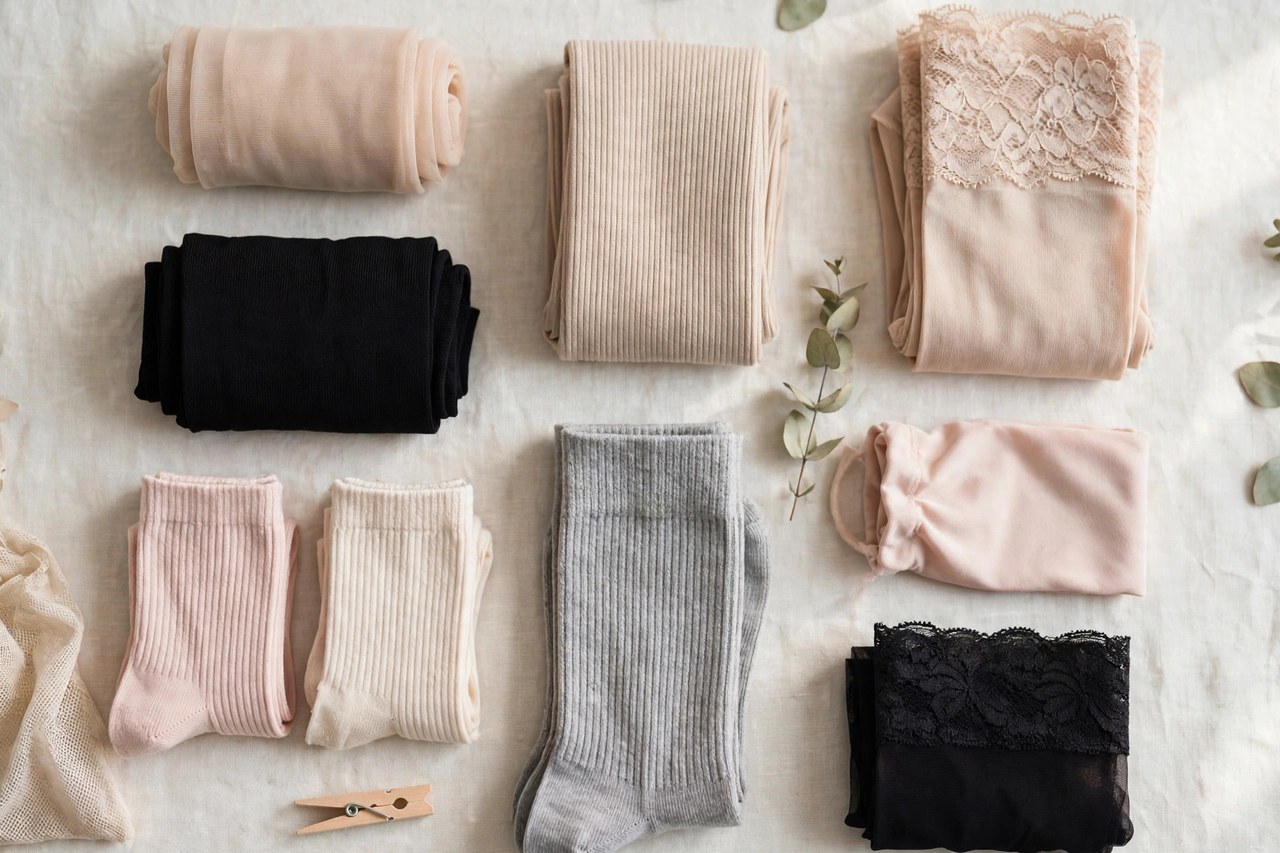
Hosiery is sized by stretch, and stretch hides a multitude of grading sins — until you wear the garment all day. Standard pantyhose and tights are knitted to stretch over legs several inches longer than a petite woman's. The surplus length has to go somewhere: it wrinkles at the ankle, sags behind the knee, over-stretches at the hip, and drags the waistband down by afternoon. Petite hosiery is knitted shorter from the start, with a shorter rise and correctly placed heels, toes and control sections.
This product-focused guide covers the hosiery family — pantyhose, tights, stockings and knee highs — in petite sizing. It explains denier, how to read the height-and-weight size charts that govern this category, the constructions worth choosing, and the handling habits that keep a fragile, precisely sized garment from running on its first outing.
Why Length Is the Whole Point in Petite Hosiery
A petite leg is not simply a shorter version of the same proportions: the distance from waist to hip, hip to knee and knee to ankle all shrink, and hosiery has a feature at each of those points. The rise of petite pantyhose is shorter, so the brief section sits at the waist instead of above it. The control top, where fitted, ends at the true hip rather than mid-thigh. Reinforced heels and toes land on the heel and toe. When any of these drift, the garment feels wrong in a way no amount of pulling up corrects.
The size charts reflect this: hosiery is sold from a grid of height against weight, and petite sizes occupy the shorter rows of that grid with their own letters or a dedicated petite range. If your height puts you on the border between petite and standard, choose by leg length honestly — measure your inseam and compare it with the maker's stated range. An under-stretched standard pair on short legs wrinkles; an over-stretched petite pair on long legs runs. The chart, read carefully, prevents both.
Denier and the Main Hosiery Types
Denier measures yarn thickness and therefore sheerness. Ultra-sheer hosiery around 5 to 15 denier is near-invisible and fragile; everyday sheers run 15 to 30; semi-opaque 30 to 50; and opaque tights above 50 denier add warmth and durability. Denier choice is independent of petite sizing, but shorter legs change the economics slightly: petite tights in mid and opaque deniers are among the longest-lasting hosiery buys, because the knit is neither over-stretched nor pooling and abrading at the ankle.
By type: pantyhose combine brief and legs in one piece and are the formal and office standard. Tights are the opaque, warmer branch, including petite footless tights whose shorter length keeps the ankle band at the ankle. Stockings — thigh-highs with bands or worn with a garter belt — are where petite sizing matters most visibly, since a standard thigh-high on a short leg reaches too high and its band lands on the widest part of the thigh, where it will not stay. Petite stockings are knitted to stop at a true mid-thigh. Knee highs in petite length end below the knee rather than on it, which is where the band can dig and show through skirts.
Construction Details That Matter at Petite Scale
Look for a shaped heel rather than a straight tube leg: on a short leg the unshaped tube's surplus fabric collects exactly at the heel and ankle. A cotton gusset, a wide, flat waistband and flat seams all improve a garment worn twelve hours at a stretch. In control-top styles, check that the firmer knitting covers the tummy and hip zone it is meant for at your proportions — on petite cuts the control panel is shorter, which is the point: a standard panel's firm band can end across the mid-thigh and print through a skirt.
Toe construction deserves a glance: reinforced toes suit closed shoes and extend life, sandalfoot sheers suit open shoes, and run-resistant knits — ladder-resist yarns and denser stitch patterns — are worth their small premium in the sheer deniers. Patterned hosiery brings the petite scale rule with it: small motifs, fine fishnets and subtle back seams suit shorter legs, while large-scale patterns are cut off mid-design by a petite hem or waistband.
Putting On, Care and Buying Tips
Most hosiery damage happens in the dressing. Gather each leg to the toe, ease it over the foot, and work upward in stages, positioning the heel and the gusset before pulling the brief fully up. On petite legs there is less margin for a twisted leg to hide, so check the alignment in the mirror once; it takes five seconds and saves a day of discomfort. Smooth nails, no rings, and moisturized heels prevent most snags before they start.
Wash hosiery by hand in cool water, or in a mesh bag on gentle; never wring; dry draped away from heat; and store each pair in its own small bag so nothing catches. Rotate pairs so elastane recovers between wears. Buy in the petite size even when a standard small seems close — hosiery is the category where an inch of length is the difference between invisible and annoying — and keep a spare pair in your desk or bag, because even perfectly sized sheers remain a limited-life garment and a run respects no schedule.
Related Women's Guides
More to Explore on Apparel Search
Looking for Women's Clothing Stores?
This guide helps you choose women's petite hosiery. To browse where to buy, visit our women's clothing store directory, where you can find retailers that carry them.