Women's Pin Tuck Dress Guide
A pin tuck dress is decorated with the finest stitching in the dressmaker's repertoire: rows of very narrow, parallel sewn folds, a nineteenth-century ornament made practical by the sewing machine.
Shop Women's Pin Tuck Dresses Now
Shop Women's Pin Tuck Dresses on Amazon Shop Women's Pin Tuck Dresses on eBayThe Amazon and eBay links on this page are affiliate links. If you make a purchase through them, Apparel Search may earn a commission.
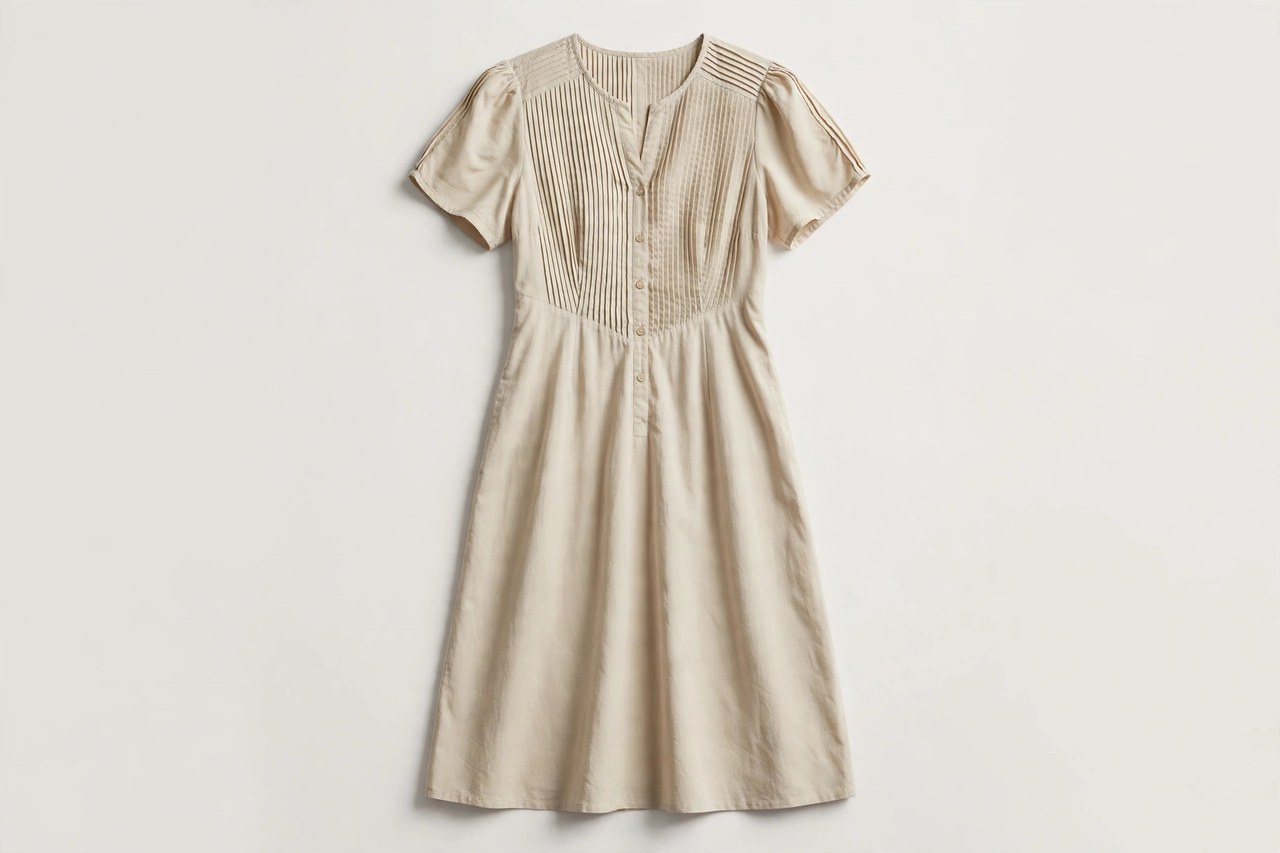
A pin tuck dress is a dress ornamented with pintucks: rows of extremely narrow tucks worked across the bodice, yoke, sleeves or skirt. To understand the dress, start with the stitch itself. A tuck is a fold of fabric stitched down along its length — a deliberate, permanent pleat, sewn flat so the fabric stands in a slim ridge. Tucks can be wide and structural, but when they are made very narrow and set in multiple parallel rows, they earn the special name of pintucks, each one scarcely wider than a pin.
On a dress, pintucks do several jobs at once. This guide traces the technique's history, explains where pintucks sit on a dress and how they are made, and covers choosing, styling and caring for a garment whose beauty is entirely in its stitching.
History: The Sewing Machine and the Nineteenth-Century Dress
Tucks are ancient, but pintucks as popular ornamentation belong to the late nineteenth century, when they became a signature decoration of summer dresses, chemisettes, blouses and lingerie. The white and pale cotton and lawn dresses of the 1880s through the early 1900s are covered with them: bodices crossed by dozens of fine tucks, often combined with lace insertion and whitework embroidery in the style now called heirloom sewing. The chemisette — the detachable blouse-front worn under low necklines — was a classic pintuck showcase, as were the yokes of nightdresses and undergarments, where fine tucking signaled quality in garments meant to last for years of washing.
The timing was technological. Rows of perfectly even, parallel pintucks are painstaking by hand but became practical at scale with the sewing machine, whose even stitching and specialized feet made uniform narrow folds achievable in workshops and at home. Machine tucking democratized the look: what had been a mark of patient handwork became an ornament any competent dressmaker could produce, and pintucks spread from lingerie into day dresses, children's clothes and blouses. The technique has revived in every era that values visible craft, most recently in heirloom, cottage and slow-fashion dressing.
Where Pintucks Sit and How They Are Made
On dresses, pintucks concentrate where flat, visible fabric rewards texture: across the front bodice or bib yoke (the most classic placement), down a button placket, around the neckline and collar, on sleeve cuffs and puff sleeves, and in bands above the hem, where a group of tucks also usefully weights a light skirt. They are usually worked in straight parallel rows, but skilled versions curve them, cross them into grids, or release them partway so the folds open into soft fullness below — release tucks that shape the bodice without darts.
Making them explains their price. The fabric is folded precisely on the grain, stitched a uniform hair's breadth from the fold — often with a twin needle or a dedicated pintuck foot that rides in the previous groove to space the next row evenly — then the process repeats, row after identical row. On a quality dress, check that rows are evenly spaced, stitching is straight, and tucks lie flat without twisting; any wobble multiplies visibly across a parallel group, which is why pintuck quality is such a reliable tell of a maker's overall standard.
Fabrics, Styles and Choosing
Pintucks need fine, stable, preferably natural fabric to read crisply: cotton lawn, voile and batiste are the historic choices and still the best, with linen giving a slightly firmer ridge and silk the most luxurious version for evening and bridal dressing. White and pastel pintuck dresses are the summer classic; the same work in black, navy or deep colors reads more tailored and modern, the tucks showing as shadow lines.
Styles range from the romantic — high-necked, lace-trimmed, heirloom dresses — through shirtwaist dresses with tucked bib fronts, to minimalist modern sheaths where a single panel of pintucks is the only ornament. Choose by placement: bodice tucks draw the eye up and suit most frames; hem tucks balance a plain bodice; all-over tucking is the fullest statement and best in the lightest fabrics.
Styling and Care
A pin tuck dress carries its own decoration, so styling should support rather than compete: simple jewelry, clean shoe lines, and accessories in natural materials suit the dress's crafted character. White summer versions take sandals, espadrilles and straw; tailored dark versions take pumps and a structured bag; heirloom styles are wedding-guest and christening appropriate in a way few dresses are, precisely because their ornament is modest and fine. Keep patterns elsewhere minimal — the parallel lines are the pattern, and they reward an uncluttered frame.
Care is about preserving the ridges. Wash gently in cool water, reshape the tucked panels while damp, and dry flat or on a hanger away from harsh sun. Ironing is the ritual of the pintuck owner: press along the tucks with the iron's tip running in the grooves, on the reverse where possible, so the folds stay sharp rather than being flattened into the cloth. Store the dress un-crushed, with room in the wardrobe. Done faithfully, this is light work for a durable reward — cotton pintuck dresses routinely outlive flashier garments by decades, looking, if anything, better as the fabric softens around its precise little rows.
Related Women's Guides
Looking for Women's Clothing Stores?
This guide helps you choose women's pin tuck dresses. To browse where to buy, visit our women's clothing store directory, where you can find retailers that carry them.