Women's Rhinestone Swimwear Guide
Rhinestone swimwear adds crystal embellishment to a swimsuit — this product guide covers settings, construction, fit and the care that keeps stones attached.
Shop Women's Rhinestone Swimwear Now
Shop Women's Rhinestone Swimwear on Amazon Shop Women's Rhinestone Swimwear on eBayThe Amazon and eBay links on this page are affiliate links. If you make a purchase through them, Apparel Search may earn a commission.
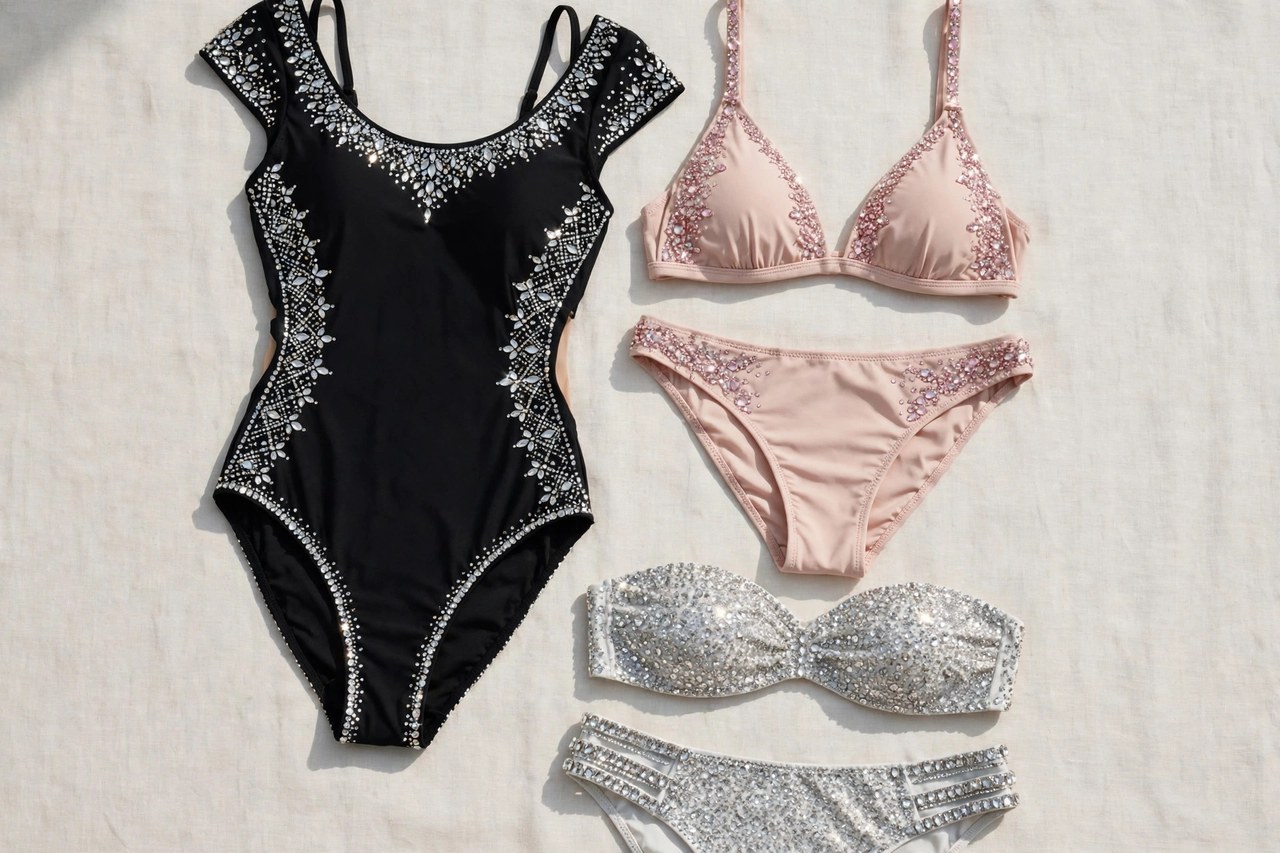
Rhinestone swimwear is swimwear decorated with crystal embellishment: stones applied to straps, necklines, waistbands or panels of a suit to catch light at the pool or beach. This is a strictly product-focused buying guide to that construction — how the stones are attached, where embellishment can and cannot survive on a garment that stretches and gets wet, what fabrics and linings support it, and how sizing and care differ from a plain suit. The garment is the subject throughout, described as a product.
The practical truth of the category is that embellishment and swimwear pull in opposite directions. A swimsuit must stretch, recover, and endure chlorine, salt and sunscreen; glued and sewn decoration must survive all of that without loosening. Well-made rhinestone suits resolve the tension with careful placement and secure settings, and poorly made ones shed stones in the first week. Learning to tell the difference in a product listing or in your hands is the whole skill this guide teaches.
How Rhinestones Are Attached
Stones reach a swimsuit by three main methods. Heat-set or glued stones are bonded to the fabric surface; they give the densest sparkle and the smoothest finish, but the bond is the weak point in hot water and with solvent-heavy sunscreen. Sewn settings stitch each stone or a stone-studded trim onto the suit, which is slower and costlier but mechanically stronger and often repairable. Embellished hardware and trim — stone-set rings, sliders and appliqued bands — confine decoration to components that do not stretch, the most durable strategy of all.
Inspect the method before buying. On a quality garment, stones sit in even rows with consistent spacing, no visible glue overflow, and no sharp edges or exposed prongs against the skin side. Flex the embellished area gently: stones on a trim or strap should not shift, and the backing should feel smooth. Loose-thread ends, stones that rock in their settings, or embellishment glued across a high-stretch panel are warnings to choose a different product.
Placement, Fabrics and Lining
Placement decides longevity. Durable designs put stones where fabric moves least and rubs least: straps, neckline bands, waistbands, side panels and detachable or decorative elements. Designs that scatter stones across the bust, seat or torso stretch zones ask adhesive to survive constant extension, and across friction areas where a cover-up, towel or pool edge rubs — those are the suits that leave a trail. Dense all-over stone coverage also adds noticeable weight to a wet garment, which affects fit.
The base suit should be a standard quality swim fabric — nylon or polyester with elastane — with a lining that covers embellished areas, so stitching and setting backs never sit directly against the skin. Check that embellishment does not prevent the suit from stretching where it must for putting on; a heavily stoned, rigid band can change how a suit fits even when the size is right. Where a product offers the same style plain and embellished, comparing the two descriptions reveals exactly what the decoration adds and costs.
Sizing, Intended Use and Price Sense
Size rhinestone swimwear by the base suit, not the decoration: follow the maker's size chart for bust, waist and hip, and if you are between sizes, the larger size usually serves embellished styles better, because a suit stretched to its limit stresses every stone bond across it. Try sitting and reaching in a fitting room where possible — movement, not standing, is what tests both fit and settings. Note that embellished suits are generally designed for poolside, beach and resort wear rather than lap swimming or water sports.
Price in this category pays for setting labor and base-suit quality in that order. A modestly priced suit with a small, well-set stone trim on the straps will outlast an expensive-looking suit paved with glued stones, so spend on secure construction at a scale you like rather than on maximum coverage. Keep the packaging or listing details for the stone type and care instructions; if a stone is lost, a matching replacement from a craft supplier, re-set by a tailor or dry cleaner who does embellishment, can extend the garment's life.
Washing and Storage That Keep Stones On
Care is where this category is won. Hand wash only, in cool water with mild detergent, turning the suit inside out or using a mesh bag so stones do not strike the basin or each other. Never machine wash, wring or tumble dry an embellished suit, and keep it out of hot tubs, where heat and concentrated chlorine attack adhesives and elastane together. Rinse after every wear, because dried salt and chlorine crystals left in settings work on bonds between wears, not just during them.
Dry the suit flat on a towel, embellishment side up, out of direct sun, and store it flat with tissue over the decorated areas so stones do not catch on other garments or on the suit's own fabric in a drawer. Before each wearing, run a fingertip lightly over settings to catch a loosening stone while re-setting is still a small job. Handled this way, a well-made rhinestone suit keeps its finish through a season of careful use, which is the realistic and perfectly worthwhile promise of the style.
Related Women's Guides
Photos From Our Original Guide

More to Explore on Apparel Search
- Women's Swimwear Stores
- Women's Wholesale Swimwear
- Women's Swimwear Guide
- Swimwear News
- rhinestones
- clothing embellishments
- women's sequin swimwear
- rhinestone definition
- Fashion Designer Directory
- Fashion
- Clothing Retail Stores
- Fashion News
- Fashion Designers
- Popular Brands
- Apparel
- Women's Clothing Stores
- Women's Clothing Wholesalers
- Women's Fashion
Looking for Women's Clothing Stores?
This guide helps you choose women's rhinestone swimwear. To browse where to buy, visit our women's clothing store directory, where you can find retailers that carry them.