Women's Slacks Guide
Slacks are women's trousers that lean toward business casual and business dress — more tailored than casual pants, more relaxed than formal suit trousers.
Shop Women's Slacks Now
Shop Women's Slacks on Amazon Shop Women's Slacks on eBayThe Amazon and eBay links on this page are affiliate links. If you make a purchase through them, Apparel Search may earn a commission.
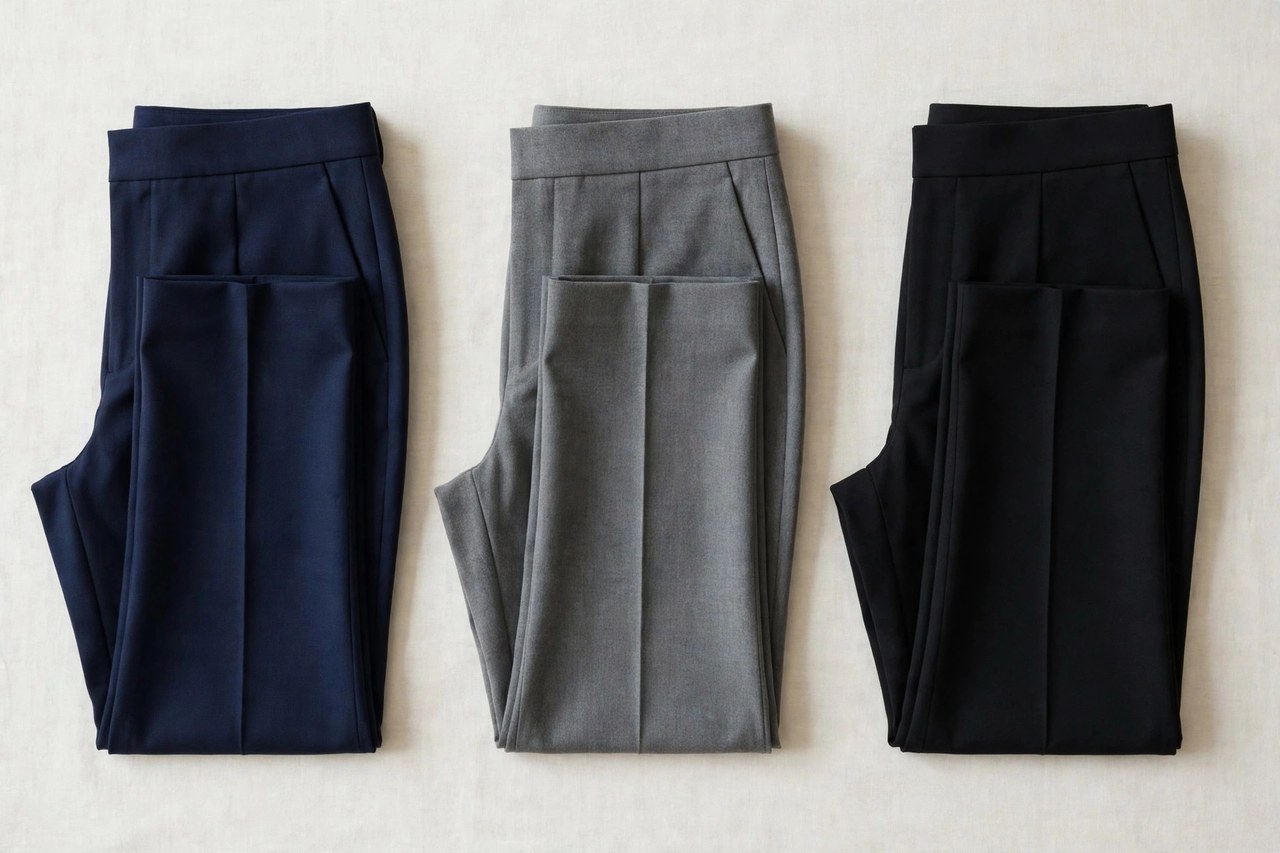
Are slacks the same as pants and trousers? The definitions genuinely vary. Some sources call slacks a casual trouser; others describe slacks with the vocabulary of dress pants — a waistband, belt loops and a fly. The position this site took, and keeps, is that slacks are a type of pant that leans toward business casual or business attire: tailored enough for an office, relaxed enough to sit between jeans and a suit. Trousers, slacks or women's pants, in the underlying definition, are garments worn from the waist to the ankles — in various lengths — covering both legs separately.
This guide treats slacks as that business-leaning middle category: how they are cut, which fabrics define them, how to fit the waist and hem precisely, and how they differ from their neighbors on the formality ladder. If the pants pages are the whole family and the suit pants page is the matched-set formal end, slacks are the versatile separates most working wardrobes actually run on.
Where Slacks Sit: Pants, Trousers, Slacks
The three words form a loose formality ladder. Pants is the American umbrella term for every two-legged garment from jeans to suit trousers. Trousers leans British and tailored, naming the garment in its dressier forms. Slacks occupies the middle landing: originally looser, easy trousers — the word is related to slack, loose — sold as separates rather than as half a suit, in fabrics that dress up or down. A slack is not part of a matched suit, and that separateness is precisely its usefulness: one navy slack serves a blazer, a sweater and a silk blouse in the same week.
Retail usage follows the same map: the term signals a finished waistband, a proper closure and a fabric with some drape or crease retention — no denim, no cargo pockets, no drawstrings. When a dress code says slacks, it is asking for exactly that signal: not jeans, not leggings, but a tailored separate worn with a considered top.
Cuts: Flat Front, Pleats, Leg Shapes
Slacks divide first at the front. Flat-front slacks lie smooth from waist to hip and are the modern default, cleanest under untucked or tucked tops alike. Pleated slacks fold extra fabric at the waist that opens when you sit, trading a sleek line for seated comfort and a more traditional proportion that has returned periodically with wider legs. At the leg, the classic slack is a straight leg falling cleanly to the shoe; tapered and ankle slacks narrow toward a cropped hem; wide-leg and trouser slacks carry the most drape and formality; and bootcut slacks flare slightly to balance heeled shoes.
Closures and waists carry the business signal. A proper slack has a hook-and-bar or button closure with a zip fly, belt loops, and often an extended waistband tab that keeps the front flat under a belt. Pockets are besom or side-seam, sitting invisibly; back welt pockets may be sewn shut at purchase and are best opened only if you will use them. A contoured waistband, higher at the back, is the difference between slacks that stay put and slacks that need a belt to behave.
Fabrics With Drape and Crease
Slack fabrics are chosen for two behaviors: drape, how the cloth falls, and crease retention, how it holds a pressed line and sheds wrinkles. The classics are wool and wool-blend gabardine and crepe, which do both best and span seasons in different weights; polyester and tri-blend suiting, which keep creases almost permanently and travel without complaint; cotton twill slacks at the casual edge, softer and more wrinkle-prone; and ponte and double-knit slacks, the comfort end, which trade a true crease for stretch ease.
Season sorts the shelf: tropical wool and linen-blend slacks for summer, midweight blends for most of the year, flannel and heavier wool for winter. Color follows the working palette — black, navy, charcoal, grey, khaki and brown — because slacks are bought as infrastructure. Pattern stays quiet here, pinstripes and subtle checks at most. A crease pressed down the front of each leg is the finishing signature; a slack worn without it reads one step more casual.
Fit, Hemming and Care
Fit slacks at the waist first: the band should close flat and stay level without the belt doing structural work, with the seat smooth standing and workable seated. Rise follows your proportions — a mid-to-high rise keeps a tucked blouse anchored and is the business standard. Hemming is where slacks are won: the hem should break according to the shoe, kissing the top of a flat or falling to a slight break over a heel, and ankle slacks should end at or just above the ankle bone. Because the category is tailored, slacks accept alteration gracefully — waist in, hem up, taper adjusted — and a modest tailoring budget is part of owning them well.
Care honors the fabric: wool slacks rest a day between wearings, are brushed and hung properly, and are dry-cleaned sparingly; washable blends wash cold and hang dry to keep their crease; a press or steam restores the front crease. Whatever covers your lower half may be in fashion — but a well-fitted pair of slacks is the version of that freedom that is taken seriously in a meeting before a word is said.
Related Women's Guides
Photos

Looking for Women's Clothing Stores?
This guide helps you choose women's slacks. To browse where to buy, visit our women's clothing store directory, where you can find retailers that carry them.