Bucket Bag
Clothing Definitions — definitions of garments and clothing terms from Apparel Search
Search Apparel Search
At a Glance
Definition: A bucket bag is a tall handbag with a round or oval flat base, straight sides rising from it, and an open or drawstring top, deeper than it is wide.
Category: Clothing Definitions
A bucket bag is a handbag built like its namesake: a flat, round or oval bottom, sides that rise straight up from it, and a wide mouth at the top, making a container deeper than it is wide. It is one of the oldest bag shapes in the modern market — designed in 1932 to carry champagne bottles — and one of the most persistent, because a cylinder with a firm base is simply a very good way to carry things.
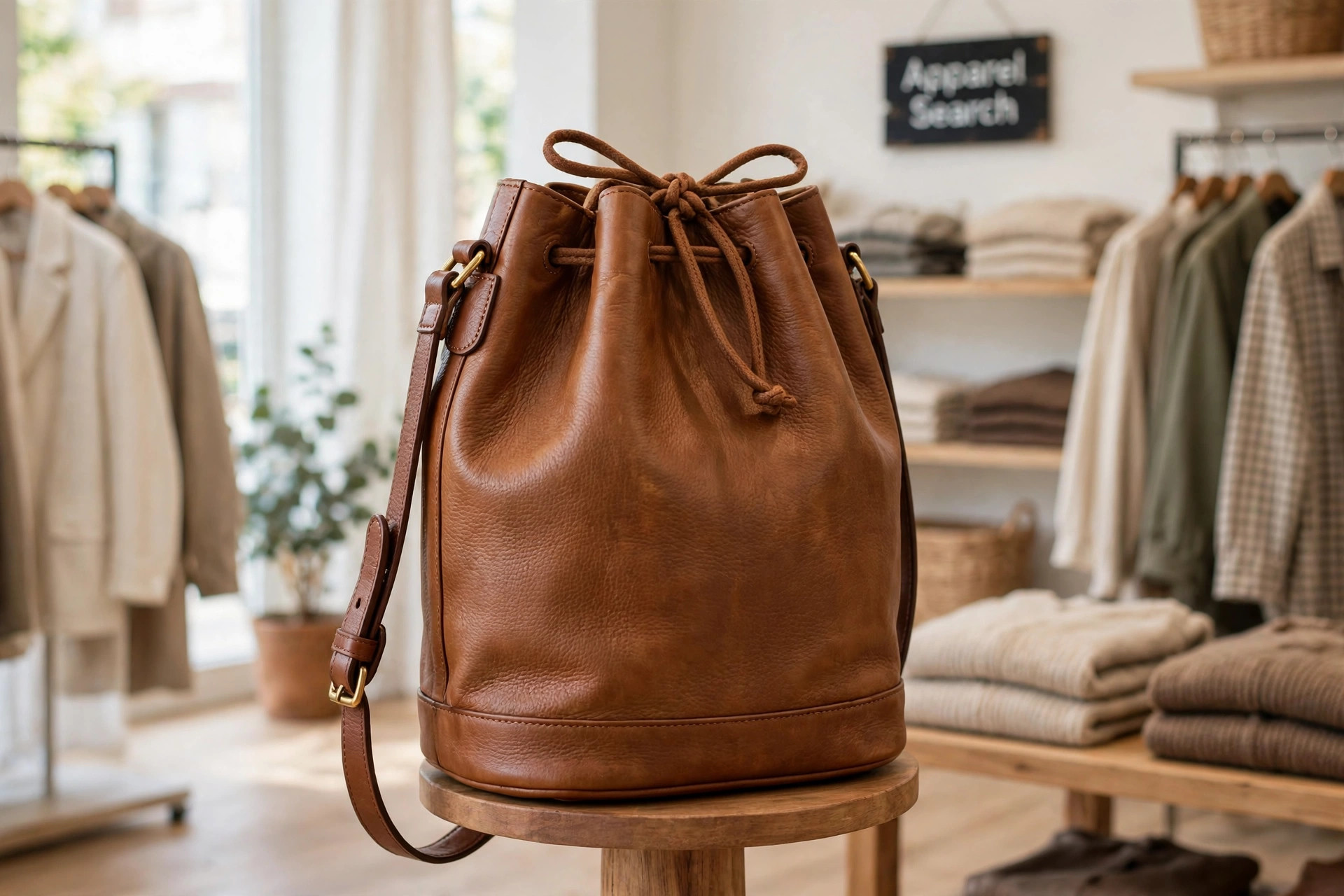
Shape First: Base, Sides and Top
Two features define the bucket bag, and everything else is negotiable. The first is the base: flat, round or oval, and firm enough that the bag stands upright on its own when set down. The second is the depth: the sides rise straight from that base to a height greater than the base's width, giving the tall cylindrical or slightly tapered body that makes the silhouette instantly recognisable. Size, material and hardware vary freely around those two fixed points.
The top is where the variations live. The traditional closure is a drawstring, threaded through eyelets or a casing at the top edge and pulled into a cinch that gathers the mouth closed — a direct inheritance from the bag's bottle-carrying origin. Structured modern versions often leave the top open and rely on an interior zip pouch or a magnetic fastening for security, and many add a short top handle beside the longer shoulder strap, so the bag can be hand-carried or worn over the shoulder or crossbody. Interior linings, pockets and detachable pouches differ by maker; the bucket outline does not.
1932: A Bag for Champagne Bottles
The shape enters fashion history with a practical commission. In 1932 Louis Vuitton was asked by champagne producers for a bag that would transport bottles safely, and the answer was the Noé — named for Noah, who in the biblical story plants a vineyard after the flood. The Noé was sized to hold five bottles, four standing upright around one inverted in the centre, all secured by the drawstring at the top. It remains in production today, and its proportions — the round base, the straight sides, the cinched top — are still the bucket bag's reference standard.
From that working origin the shape passed into ordinary fashion as a casual leather bag in the later twentieth century, valued for the same reason it suited bottles: it swallows bulky contents upright. A prominent revival in 2013, led by the label Mansur Gavriel's simple leather version, returned the bucket to the centre of the market, and it has remained a standard style at every price level since. The product side of the family — drawstring, open-top and structured forms — is covered in the Fashion Influence guide to bucket bags.
Carrying and Caring for a Bucket Bag
The bucket's virtues in use follow from its geometry. The firm base keeps the bag upright on floors and tables and stops contents tipping; the deep, single-volume interior takes water bottles, paperbacks, pouches and small umbrellas standing up rather than stacked. Its corresponding weakness is organisation — a deep cylinder hides small items at the bottom — which is why many designs add an interior zip pocket, a detachable pouch, or both, and why bag organisers sized for buckets are a small industry of their own.
Care is mostly a matter of protecting the base and the drawstring. Keep the base's structure dry and uncrushed, store the bag standing and lightly stuffed so the sides keep their line, and avoid hanging it by a loaded drawstring, which strains the eyelets that do the closing work. In leather, condition as the hide requires; in canvas and synthetics, spot-clean and air-dry. Looked after that way, a bucket bag keeps the quality that has carried it through ninety years of fashion cycles: it is a container first, and it behaves like one.
Sizes divide by the same logic as the original: mini buckets carry the evening essentials and keep the silhouette as a design statement; classic mid-size versions are the everyday carriers the style is known for; and large buckets return to the Noé's territory, taking bottles, laptops and gym kit upright. In every size the test of a true bucket is unchanged — set it down empty and it should stand, open, ready to be loaded, rather than subsiding into a heap of material.
Not to Be Confused With
A tote bag is flat and rectangular — wider than it is deep, with two parallel handles and an open rectangular mouth. A bucket bag is round in plan, deeper than it is wide, and stands on its own base. A drawstring pouch is a soft sack with no base at all, which collapses when empty; drawstring names a closure, bucket names a shape, and many bucket bags simply borrow the pouch's closure for their top. A bowler bag is structured and domed rather than cylindrical — the two are neighbours in the bag family, not the same silhouette.
Common Questions
What is a bucket bag?
A tall handbag with a round or oval flat base, straight rising sides and an open or drawstring top — deeper than it is wide, like the bucket it is named for. The firm base lets it stand upright on its own.
What was the first bucket bag made to carry?
Champagne bottles. Louis Vuitton's Noé of 1932 was designed to carry five bottles — four upright and one inverted in the centre — held safely by the bag's drawstring top.
Is a bucket bag the same as a drawstring bag?
No. Drawstring names a closure and bucket names a shape with a firm, flat base. Many bucket bags do close with a drawstring, but open-top bucket bags exist, and a soft drawstring pouch with no base is not a bucket bag.