Saddle Bag
Clothing Definitions — definitions of garments and clothing terms from Apparel Search
Search Apparel Search
At a Glance
Definition: A saddle bag is a small to medium handbag with a curved, half-round body and a rounded flap, modelled on a single pouch of the paired leather saddlebags hung over a horse's saddle.
Category: Clothing Definitions
Word Origin
The name is taken directly from riding equipment: the fashion bag copies one pouch of a horse's saddlebags, the paired leather bags slung over a saddle, and keeps the pouch's curved outline and buckled flap.
A saddle bag is a handbag defined by its outline: a curved body, flat at the back and rounded at the bottom and front, closed by a flap cut to the same curve. It is a single pouch given a long strap of its own, so that it can be worn on the shoulder or across the body, and it usually carries equestrian details — a buckle fastening, or hardware shaped like a stirrup — that recall the riding original. This page explains the shape, the saddlebags it was copied from, and the designer version of 2000 that turned a casual leather style into a fashion category.
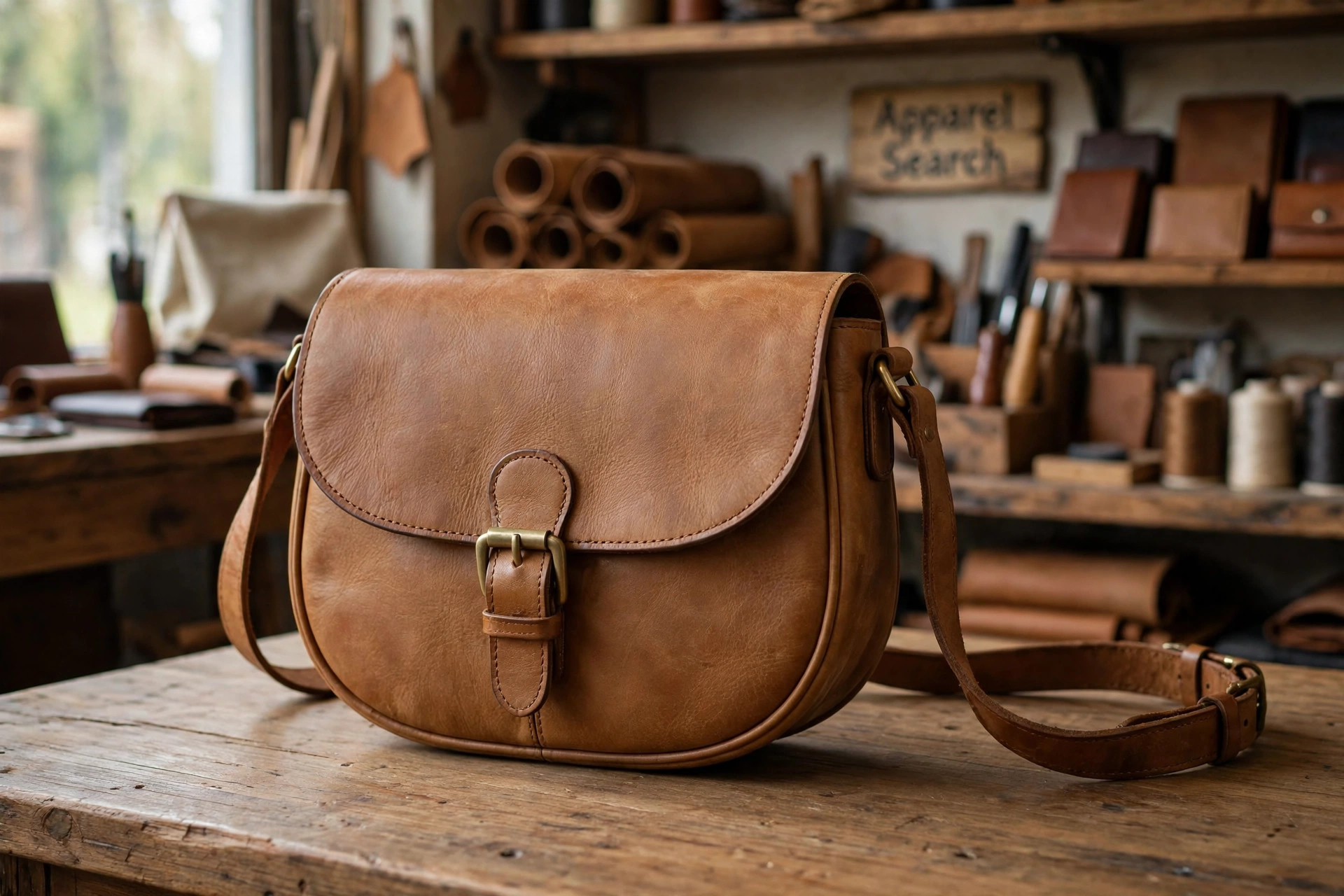
The Shape and Its Details
Everything about the saddle bag follows from the pouch it imitates. The back is flat so the bag sits comfortably against the body, as the original pouch sat against the horse's flank. The bottom and front round away in a half-circle, and the flap follows that curve exactly, dropping over the front and fastening — traditionally with a buckle, in keeping with tack and harness — at the centre. There are no sharp corners and no straight base: a saddle bag that stood square on a table would have lost the feature it is named for.
The strap is long, made for the shoulder or for wearing across the body, and the size is small to medium — a pouch's capacity, not a tote's. Leather is the classic material, again following the original, though the shape is now made in every bag material. Stirrup-shaped rings and charms, buckles and studs appear as decoration long after they stopped being working hardware, and they are the quickest way to recognise the style in a row of flap bags.
Recognising a Saddle Bag
Five features, taken together, mark the style out in a shop or a listing. First, the outline: a half-round body with a flat back and no straight base. Second, the flap, cut to the body's curve and reaching well down the front. Third, the fastening, traditionally a buckle at the centre of the flap. Fourth, the hardware — rings, studs and charms shaped after stirrups and other tack. Fifth, the strap, long enough for the shoulder or the body, where a clutch or a top-handle bag would have a short one.
No single feature is unique to the saddle bag — buckles, flaps and long straps appear on dozens of styles — which is why listings so often apply the name loosely to any curved flap bag. The shape is the test. A bag whose body and flap both follow the pouch's curve is a saddle bag whatever strap it is carried by; a bag that is merely small, brown and rustic-looking is not, however it is described.
From Horseback to Handbag
Saddlebags proper are riding luggage, centuries old: a pair of leather pouches joined by a broad strap, laid over the back of a horse's saddle so that one pouch hangs on each side. They were built of heavy leather with buckled flaps, to keep the weather out and the contents in at speed, and the same paired form later passed to bicycle and motorcycle luggage, where it is still used.
The single handbag version circulated as a casual leather bag through the twentieth century, but the shape's fashion standing dates from 2000, when John Galliano's Saddle bag for Dior — its flap cut to the curve of a saddle and hung with a stirrup-shaped D charm — became one of the defining bags of its decade. Dior revived the design in 2018 under Maria Grazia Chiuri, and the revival restored the shape to the standard range offered by bag makers at every level of the market, where it has remained.
Saddle Bag or Crossbody Bag?
The two terms classify on different axes, which is why they are so often confused in shop listings. Saddle names a shape: a curved body with a rounded flap. Crossbody names a carry: a strap long enough to cross the torso diagonally. Most saddle bags are made with crossbody-length straps and are usually shown worn that way, but a saddle bag carried on the shoulder has not changed its type, and a square crossbody bag is not a saddle bag. Within the shape family, the saddle bag sits closest to the flap-front satchel, from which it differs by its curved rather than straight base. The Not to Be Confused With box below sets the distinction out directly, and the product side of the style is covered in the Fashion Influence guide to saddle bags.
Not to Be Confused With
The two words answer different questions. A saddle bag is named for its shape — a curved, half-round body with a rounded flap, copied from a horse's saddlebag pouch. A crossbody bag is named for its carry — any bag whose strap is long enough to cross the body diagonally. Most saddle bags are worn crossbody, but the carry does not make the shape, or the shape the carry.
Common Questions
What is a saddle bag?
A small to medium handbag with a curved, half-round body and a rounded flap, copied from a single pouch of the paired leather bags hung on a horse's saddle.
What are saddlebags originally?
A pair of pouches joined by a broad strap, slung over a horse's saddle with one pouch hanging on each side — leather luggage for riders, centuries old, later also used on bicycles and motorcycles.
Which designer made the saddle bag famous?
Dior. John Galliano's Saddle bag, launched for 2000, became a defining bag of its era, and Maria Grazia Chiuri revived the design at Dior in 2018.