Jockstrap
Clothing Definitions — definitions of garments and clothing terms from Apparel Search
Search Apparel Search
At a Glance
Definition: A jockstrap, or athletic supporter, is a men's undergarment for sport made of an elastic waistband, a support pouch and two straps, with no seat.
Also known as: Athletic supporter
Category: Clothing Definitions
Word Origin
From the bicycle jockeys the garment was first made for — the delivery riders nicknamed bike jocks — plus strap, for the straps that hold its pouch in place.
The jockstrap is sports equipment in underwear form: the least garment that will do a specific job. Also called an athletic supporter, it is one of the men's undergarments designed not for coverage or warmth but for support during vigorous movement, and for holding a protective cup where the sport demands one. Its design has barely changed since the late 1800s, because the job has not changed. This page explains its three-part construction, the hard and soft cup options, and the variants — swimmer, runner and jock brief — that adapt the same pattern to different sports.
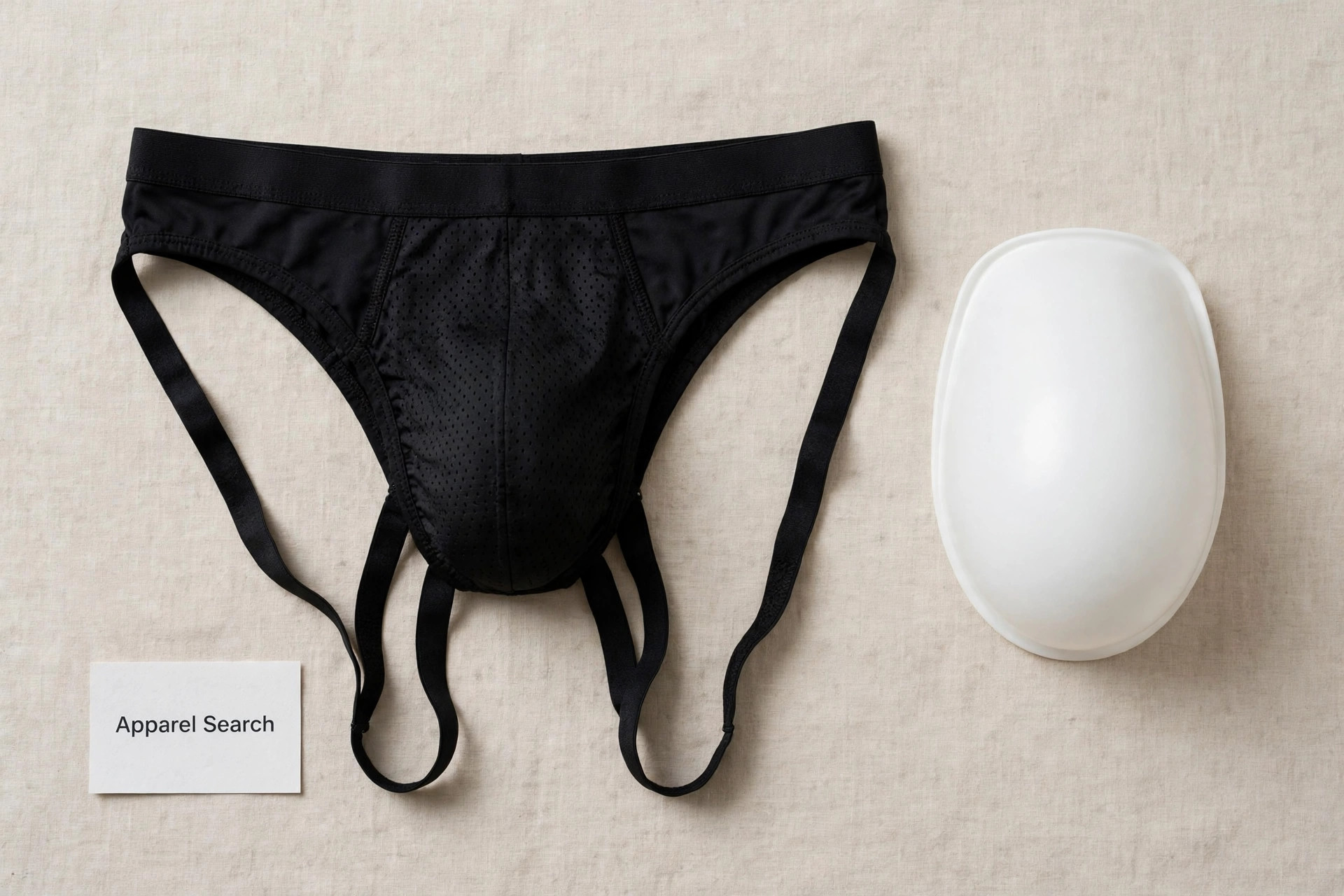
Construction: Band, Pouch and Straps
A typical jockstrap has exactly three parts. The waistband is a band of elastic that carries the whole garment and keeps it in place through running, jumping and contact. The pouch is a shaped fabric cup at the front that holds and supports the genitals, knitted or woven with enough elasticity to stay positioned without binding. And the two straps run from the bottom of the pouch, across the buttocks, to the waistband at the sides — they hold the pouch in place from behind without any seat fabric.
The missing seat is the design's point. With nothing covering the buttocks, the garment traps no heat, binds nowhere and cannot ride up or bunch under a uniform, which is why the pattern survived a century of sportswear innovation essentially untouched. Sizing is by waist measurement, and the fabrics are washable elastic blends chosen to keep their tension through a season of use and laundering.
Fit is functional, not cosmetic. The waistband should sit snugly without rolling, the pouch should support without compressing, and the straps should lie flat without twisting — a supporter that shifts during play is the wrong size or a worn one. Elastic is the garment's working material and also its point of failure: heat and harsh washing destroy its tension, so jockstraps are washed cool, kept out of high dryer heat, and replaced when the waistband no longer recovers its snap. A stretched-out supporter is not merely uncomfortable; it no longer does the job it exists to do.
The Protective Cup
Some jockstraps add a fourth element: a pocket at the front of the pouch that holds a protective cup — called a box in British usage. The cup is usually hard plastic, shaped to the body, with a padded rim where it meets the skin and sometimes ventilation holes through the shell. It is worn where impact is a normal part of the game: by baseball and cricket players, and by others participating in full-contact sports.
Cups come in two grades. A hard cup gives full impact protection and is the standard for ball sports and martial arts. A soft cup — a padded, flexible insert — gives lighter protection with considerably more comfort, and is chosen for sports where support matters more than impact resistance. The jockstrap's role in both cases is the same: it is the harness that keeps the cup exactly where it needs to stay.
Variants and History
The variants adjust the basic pattern to the sport. Swimmer jocks and runner jocks have narrow waistbands, reducing bulk and chafing in endurance sports where the garment is worn for hours. Wide waistbands spread pressure and stay put in contact sports and weightlifting. Jock briefs, or support briefs, replace the two straps with a full seat for wearers who want the pouch's support with a brief's coverage — the shopping guides carry both under the men's jocks guide and the men's support underwear guide, and the modern alternative for many athletes, the compression short, builds similar support into a full short.
The garment's origin is practical and urban. Jockstraps were first developed in the late 1800s, by the Bike Company, for the bicycle delivery boys who rode the rough streets of American cities all day and needed support that ordinary underwear did not give. Bike remained the market leader for generations, alongside makers such as Champion, McDavid, Franklin and Safe-T-Guard. From the delivery bicycle the supporter spread through school and professional sport until it became standard kit — a 19th-century solution that modern elastic fabrics have refined but never replaced.
For much of the twentieth century the supporter was also standard school kit, required wear for boys' physical education in many American schools — the route by which the garment, and its shorter name 'jock', entered general slang for an athlete.
Not to Be Confused With
The two share a pouch front and differ behind. A jockstrap has no seat: two straps run from the pouch to the waistband, leaving the buttocks bare, which keeps the garment cool and completely unrestricted in movement. A jock brief, or support brief, keeps the same supportive pouch but replaces the straps with a full fabric seat, like an ordinary brief — see the Underwear Definition for the brief family. Support and pouch are the same in both; the choice is straps against seat, made on comfort and on what is worn over them.
Common Questions
What is a jockstrap?
A jockstrap, also called an athletic supporter, is a men's undergarment for sport consisting of an elastic waistband, a support pouch and two straps running from the pouch to the waistband at the back, with no seat.
What is a protective cup, and who wears one?
A protective cup is a hard plastic shell, usually with a padded rim and sometimes ventilation holes, that fits into a pocket on some jockstraps. Baseball and cricket players and others in full-contact sports wear one; soft cups give lighter protection.
What are the main jockstrap variants?
The main variants are swimmer and runner jocks with narrow waistbands, wide-waistband models for contact sports and lifting, cup-pocket models for protection, and jock briefs, which replace the straps with a full seat.