Rugby Shirt
Clothing Definitions — definitions of garments and clothing terms from Apparel Search
Search Apparel Search
At a Glance
Definition: A rugby shirt is a long-sleeved shirt of heavy cotton jersey with a stiff collar and a short buttoned placket fastened with rubber buttons, traditionally patterned with horizontal hoops in club colours.
Also known as: Rugby jersey
Category: Clothing Definitions
A rugby shirt is the shirt worn in the game of rugby football. It usually has long sleeves, a stiff collar, and a short buttoned opening at the top in a similar style to a polo shirt but built far more heavily, in thick cotton jersey made to be grabbed, pulled and landed on. Its traditional pattern is five or six horizontal stripes — hoops — in alternating club colours. This page explains how the shirt is built for a contact sport, how the league and union codes differ, and how the garment moved from the pitch into everyday fashion, where Apparel Search's newer rugby kits section takes the story up to date.
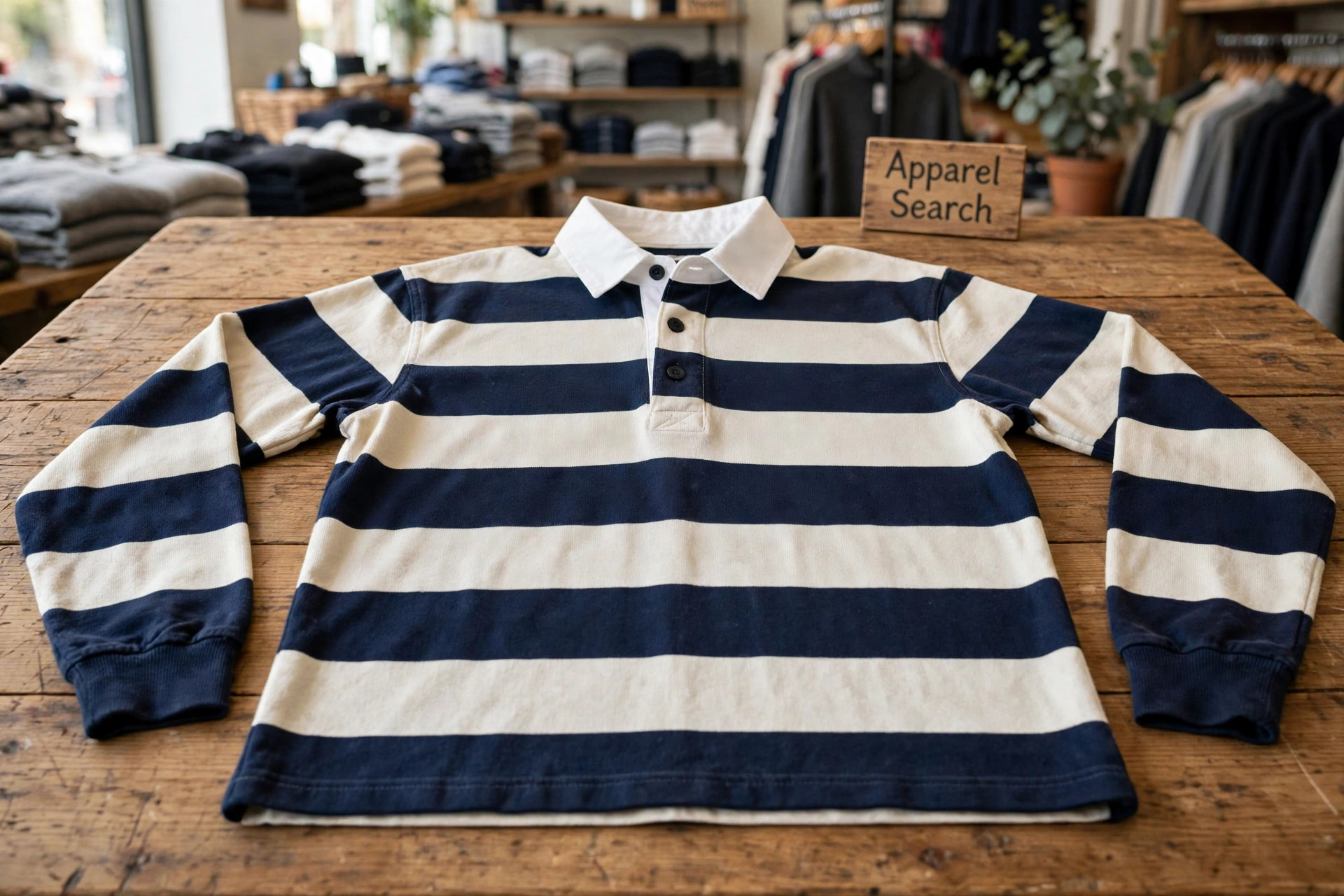
Built for a Contact Sport
Every detail of the classic rugby shirt is a response to being grabbed. The jersey is a heavy cotton knit, far thicker than a polo shirt, because it is hauled on in tackles and scrums; seams are reinforced, and the fabric is expected to stretch rather than tear and to survive being pulled by the collarful. The collar itself is a stiff woven band rather than a soft knit, standing up to repeated grabbing season after season.
The placket fastens with rubber buttons, a traditional detail with a practical reason: hard buttons would injure faces in contact, while rubber buttons flex and give. Long sleeves cover the arms through a winter season played outdoors. Sizing follows chest measure with a playing fit — easy through the body for movement — and the same pattern cut closer gives the fashion fit. Care is heavyweight knit care: wash inside out to protect the stripes, dry flat or on the line rather than stretching the wet weight on a hanger, and expect a good cotton jersey to soften over seasons without losing its shape.
Hoops, Codes and Colours
The hooped pattern — bands running continuously around the body and sleeves — lets players and spectators pick out sides at speed and distance, and identifies the club as surely as any badge. A number of football teams have adopted the same pattern, Queens Park Rangers and Parma among them. Plain shirts exist too: some union clubs play in a single colour, as with the all-white shirts of Cahors Rugby in France.
The two codes of the game cut the shirt differently. Rugby league shirts commonly carry a large V around the neck, while rugby union jerseys keep the more traditional design of collar and placket described here. Both are called rugby shirts, or rugby jerseys — jersey being the older sporting word, shared with the sweater family the heavy knit descends from.
The playing shirt has changed more than the fashion shirt has. Modern match jerseys at the top level are close-fitting synthetic shirts, cut tight so there is little loose cloth for an opponent to grab, with reinforced stitching and panels designed for lifting in lineouts — a different garment in everything but outline from the heavy cotton jersey of the definition. The traditional shirt survives complete at amateur level and in the fashion trade, and the two now coexist: the performance jersey for the match, the hooped cotton jersey for the supporter and the street, each recognisably the same shirt to a spectator.
From Pitch to Fashion
Those playing qualities carried the shirt off the field. A heavy, colourful, hard-wearing casual shirt with a collar reads as dressed without being formal, and the rugby shirt has become a standard fashion item in numerous cultures, sold in club, university and invented colour combinations far from any fixture list. Fashion versions soften the cloth slightly and tidy the fit, but keep the hoops, the stiff white collar and the placket that define the look — and keep the shirt unbranded in design, since its identity comes from the hoops and the cut rather than from crests or sponsors.
For the modern game itself — today's club and national kits, fabrics and fits — see Apparel Search's rugby shirt buying guide and the rugby kits section hub, which cover the current kit of the major teams alongside the other sports-kit sections.
Its fashion route ran largely through the campus and the high street: adopted as informal uniform by students and by American preppy dress in the later twentieth century, the rugby shirt settled into the permanent casual wardrobe alongside the polo shirt it is so often shelved with — heavier, warmer and more emphatically striped, the winter member of the collared-shirt family.
Not to Be Confused With
Two collared shirts, two sports. A rugby shirt is a heavy cotton jersey with long sleeves, a stiff woven collar and a rubber-buttoned placket, made to be grabbed and pulled in a contact sport. A polo shirt is a light knitted shirt with short sleeves and a soft folded collar, made for tennis and golf and adopted as smart-casual dress. If the collar stands stiff, the cloth is thick enough to tackle in and the buttons are rubber, it is a rugby shirt.
Common Questions
How does a rugby shirt differ from a polo shirt?
Both have a collar and a buttoned placket, but a rugby shirt usually has long sleeves and a stiffer, stronger collar than a polo shirt, and it is made of much heavier cotton jersey built to survive a contact sport. The polo shirt is a lighter, short-sleeved garment from tennis and golf.
What are hoops on a rugby shirt?
Hoops are the traditional horizontal stripes of the rugby shirt, five or six broad bands in alternating club colours running around the body and sleeves. The pattern identifies the team at a distance and has been adopted by some football teams, such as Queens Park Rangers and Parma.
How do rugby league and rugby union shirts differ?
Shirts worn by rugby league players commonly have a large V around the neck, while rugby union jerseys keep a more traditional collar-and-placket design, sometimes completely plain, as with the all-white shirts of Cahors Rugby in France. Both are called rugby shirts or jerseys.