Apparel Search»Rugby Kits
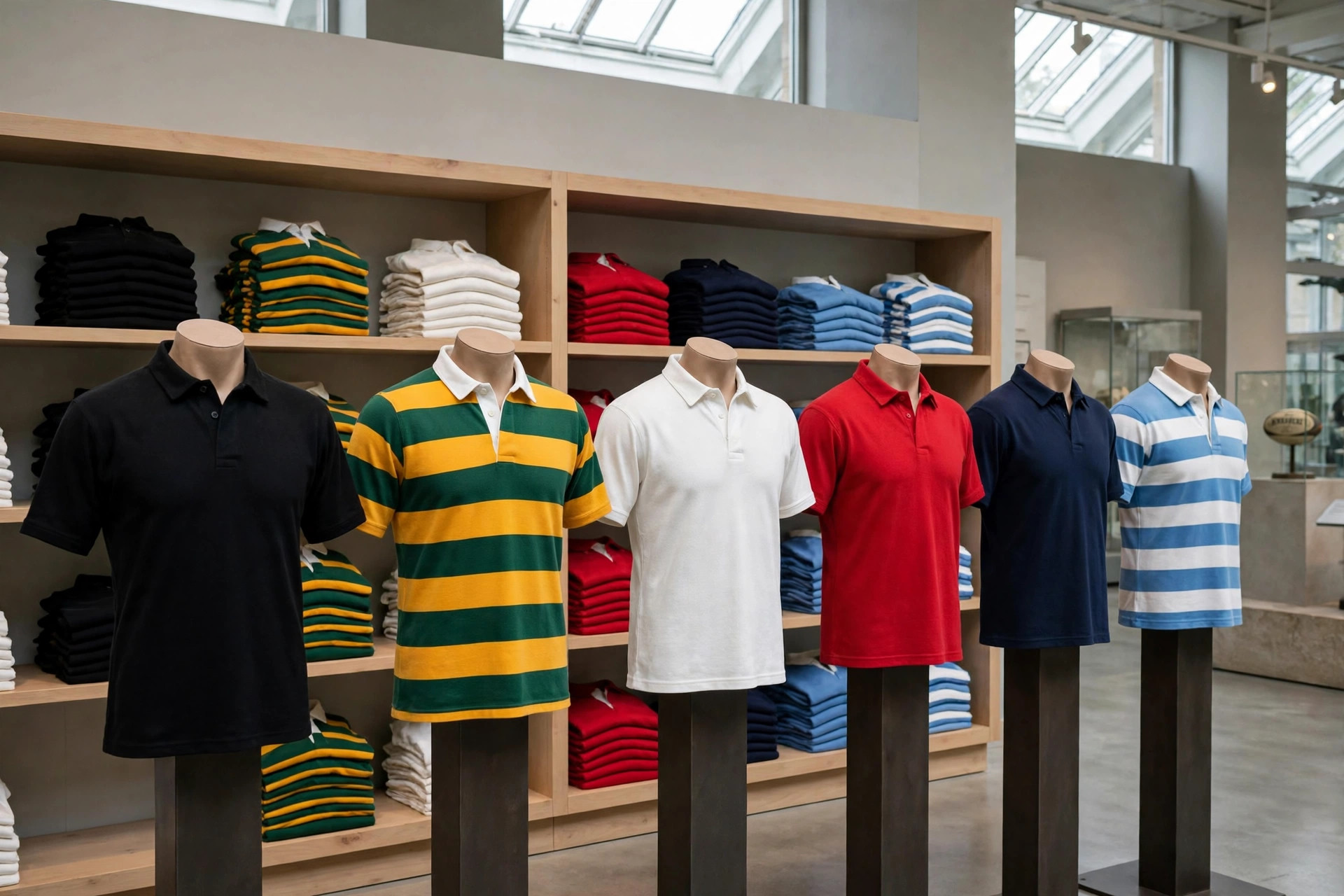
Illustrative image created for this guide by Apparel Search designers — the kit designs are shown without team logos, sponsor logos or manufacturer marks, so details may differ from the official shirts.
Rugby Kits
No garment in team sport carries its history as openly as the rugby jersey. It began as a heavy cotton shirt with a buttoned collar, built to survive being grabbed, stretched and dragged through mud, and its silhouette has never entirely left that shirt behind. Around it, the modern kit has become high technology: skin-tight performance fabrics, grip prints, GPS pockets and designs refreshed on a four-year World Cup cycle. This section treats the rugby kit the way Apparel Search treats any significant garment — what it consists of, the traditions woven into it, who designs and makes it, and what to look for when you buy a jersey of your own.
Search Apparel Search
What Is a Rugby Kit?
A rugby kit is the full set of clothing a team plays in. The core is three pieces in the team's colours: the jersey, the shorts and the socks. Around that core sit the boots — forwards and backs wear different stud patterns — and the optional protective pieces some players choose: a padded scrum cap or headguard, a mouthguard, and light shoulder padding sewn into an under-layer. Unlike cricket, there is no second wardrobe and no protective hardwear beyond the soft headguard: the kit is clothing, almost purely.
The jersey does the identity work. It carries the team's colours in their traditional arrangement — plain black for New Zealand, green and gold for South Africa, sky-blue and white hoops for Argentina — the union's emblem on the chest, and on the back a number from 1 to 15 that states the wearer's position. Replica versions of that jersey are among the most popular supporter garments in world sport, sold in both modern performance cuts and loose, long-sleeved cotton versions that copy the shirts of a century ago.
The Collar: Rugby's Signature Detail
Every sport's kit has one detail that gives it away, and rugby's is the collar. The first rugby shirts were ordinary heavy shirts — flannel or cotton, long-sleeved, with a buttoned collar and rubber buttons that would not injure an opponent. The collar survived every reinvention of the garment because it had become the visual signature of the game: a rugby jersey is a shirt, not a vest, and the distinction matters to the people who wear and buy it.
Modern player jerseys compromise: most now use a low, reinforced crew or loop collar engineered so an opponent cannot get a grip on it, and some are effectively collarless. But the traditional collar never left the supporter market, where the classic cotton rugby shirt — collar, placket and all — is a wardrobe staple far beyond the sport; our definitions section covers that garment's second life as the rugby shirt. When Canterbury gave the British & Irish Lions' 2025 jersey a grandad collar because supporters asked for one, it was acknowledging that the collar is not decoration. It is the point.
Numbers 1 to 15: A Position on Your Back
Rugby's numbering is the oldest in team sport, and it works differently from football's. The number does not belong to the player; it belongs to the position. The loosehead prop wears 1, the hooker 2, the tighthead prop 3. The locks wear 4 and 5, the flankers 6 and 7, and the number 8 wears, simply, 8. Behind the scrum, the scrum-half wears 9 and the fly-half 10; the wings wear 11 and 14, the centres 12 and 13, and the fullback 15. A supporter reading a team sheet can reconstruct the whole formation from the numbers alone.
That is why rugby jerseys are bought by number in a way football shirts are not. A number 10 jersey says something about the wearer — the playmaker's shirt — and a number 1 or 3 carries the front row's particular pride. When you buy a replica, the number on the back is a statement of position first and of a favourite player second, and our buying guide explains how numbering is applied on player and replica versions.
From Cotton to Synthetics: How the Kit Evolved
For most of its history the rugby jersey barely changed: heavy cotton, long sleeves, a collar, and colours that identified the team. Two things transformed it. The first was professionalism in 1995, which turned kits into commercial property — sponsors arrived on the chest, makers competed for union contracts, and the jersey became a designed product with a launch date. The second was fabric technology: the skin-tight synthetic jerseys of the 2003 World Cup era, built so tacklers could not grab loose cloth, replaced cotton entirely at the top level.
Today's player jersey is a piece of engineering — feather-light polyester with elastane, welded seams, silicone grip panels on the chest for holding the ball, and a small pocket between the shoulder blades for a GPS tracking unit. Yet the supporter's favourite version is often the opposite: a heavy cotton classic with long sleeves and a proper collar. Rugby is unusual in selling both garments, the laboratory version and the heritage version, side by side. Our guide to rugby kit design and manufacturers tells the full story.
Replica Versus Player Issue
Like football and cricket kits, rugby jerseys come in two broad versions. The player (or authentic) version is the garment worn in matches: an athletic, body-hugging cut, the lightest fabrics, printed or heat-applied emblems, and a premium price. The replica version is built for supporters: a regular fit that works over a jumper on a cold terrace, sturdier fabric, an embroidered emblem on many ranges, and a friendlier price. Rugby adds a third option neither football nor cricket offers in the same way — the classic cotton jersey, cut loose like the shirts of the amateur era and made to be worn as everyday clothing.
Which one suits you depends on how you will wear it, and the differences in fit are bigger than most first-time buyers expect. Our rugby shirt buying guide walks through versions, fits, sizing and care in full.
The Makers and the World Cup Cycle
Rugby kits are made by a distinctive cast. Canterbury of New Zealand, founded in 1904, dressed generations of players and still makes the Ireland, Japan and Lions jerseys. Macron of Italy has become the volume maker of the modern game, supplying Scotland, Wales and a string of other nations. adidas dresses New Zealand and France, Nike dresses South Africa, Castore has taken England and Australia, and Le Coq Sportif — a maker woven into rugby's early history — returned to dress Argentina in 2024.
Designs turn on a four-year cycle. Each union launches a new kit for the Rugby World Cup — sponsor-free at the tournament itself, by World Cup rules — then refreshes it through the following seasons. The next tournament is the 2027 Rugby World Cup in Australia, where an expanded 24-team field will put more national jerseys on show than ever before. Every current-kit detail in this section's team guides carries its year label, so you always know which edition a description belongs to.
The National Team Guides
Ten national teams and one famous touring side have full guides in this section: their colours and how they settled, their makers past and present, the kits that live in memory, and what to know before buying the jersey.
Shopping for a Rugby Jersey?
Replica jerseys, classic cotton shirts and team training wear for most of the teams in this section are sold through Amazon. The Apparel Search Amazon guide keeps the shopping links in one place.
Shop on Amazon via the Apparel Search GuideThis link opens the Apparel Search shopping guide for Amazon, where the product links are kept in one place.
Common Questions
What is a rugby kit?
A rugby kit is the clothing a rugby union team plays in: a jersey, shorts and socks in the team's colours, worn with boots and, for some players, a scrum cap or headguard. The jersey is the identity piece — it carries the team's colours, its emblem and the player's position number on the back.
Why do rugby jerseys have collars?
The collar is a survival from rugby's nineteenth-century origins, when players wore heavy cotton shirts with buttoned collars. It became part of the sport's visual identity — a proper shirt rather than a vest — and supporters' classic cotton jerseys keep it to this day. Modern player jerseys replace it with a low reinforced collar or collarless neck, but the Lions' 2025 jersey brought back a traditional grandad collar by popular demand.
How often do rugby teams change their kits?
National teams work on a four-year rhythm built around the Rugby World Cup: a new design is launched for the tournament, then refreshed in smaller ways through the cycle that follows. Some unions also release a new home jersey every season or two. The colours and emblem almost never change — it is the cut, collar and detailing that move.