Apparel Search»Rugby Kits»Kit Design & Manufacturers
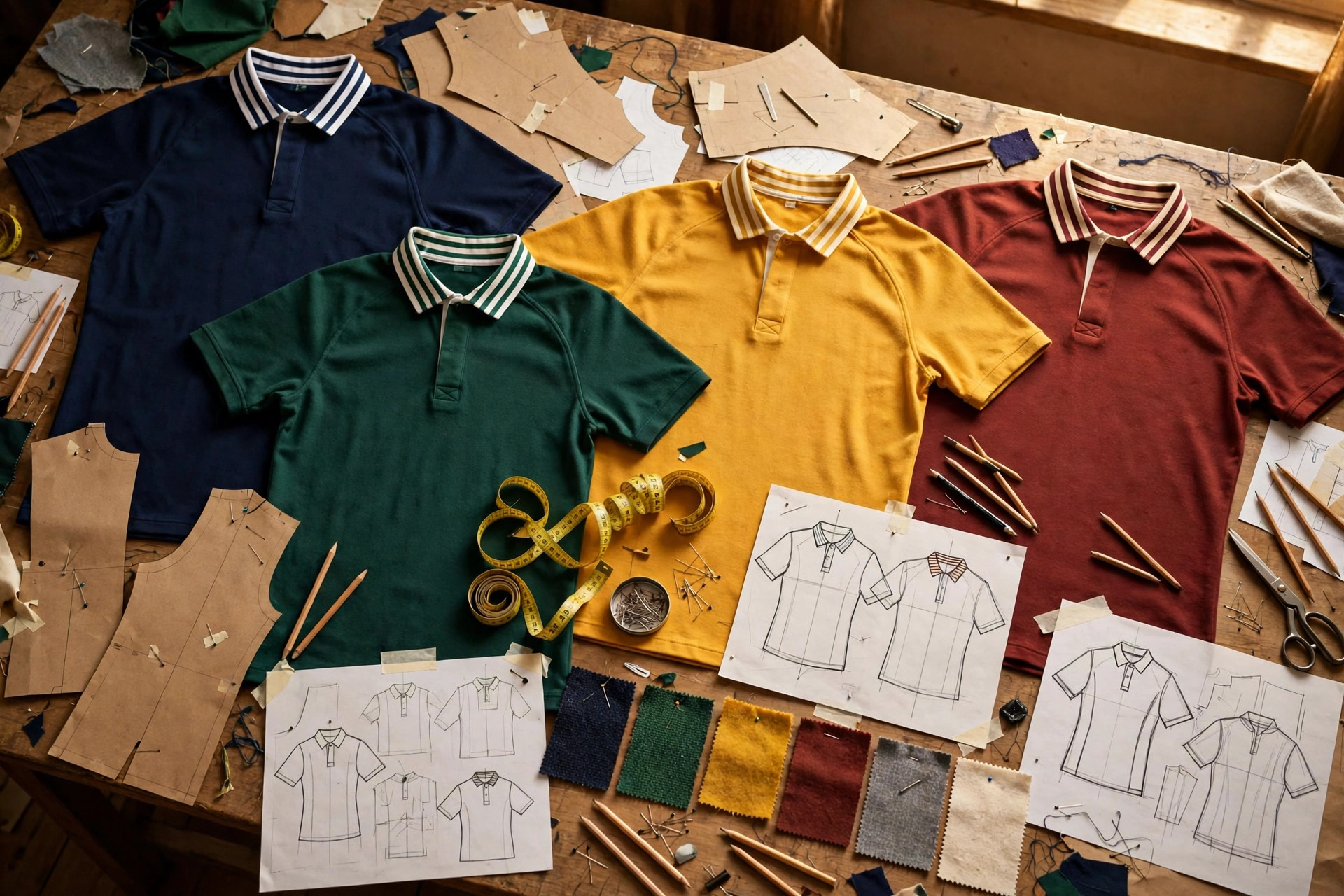
Illustrative image created for this guide by Apparel Search designers — the designs are shown without team logos, sponsor logos or manufacturer marks, so details may differ from the official shirts.
Rugby Kit Design & Manufacturers
A rugby kit looks simple — a coloured shirt, shorts and socks — and is anything but. Behind each national jersey sits a century of settled identity, a maker fighting to keep or win the contract, and a design cycle geared to the World Cup. This guide explains how rugby kits came to look the way they do: the first heavy shirts, the 1905 tour that made black into a brand, the cotton century, the professional revolution that put sponsors on the chest and Lycra on the field, and the modern landscape of makers from Canterbury and Macron to adidas and Nike.
The First Kits
Rugby's first players dressed themselves. In the game's nineteenth-century beginnings there was no kit industry: teams wore whatever shirts, knickerbockers and caps a club could assemble, and the earliest internationals were identified as much by caps and stockings as by jerseys. What the era fixed permanently was the garment's type — a heavy shirt with a collar, long sleeves and a buttoned placket, made to be grabbed without tearing. Every rugby jersey since, however technical, is a descendant of that shirt.
Numbers came later than most people assume. Sides experimented with numbering in the early twentieth century, and by the inter-war years the 1-to-15 positional system had settled into the form the game still uses. The emblem on the chest — a rose, a thistle, a fern, a springbok — became the other constant: the one element of the kit that is never redesigned, only redrawn.
1905: The Black Jersey Becomes an Identity
The most consequential kit in rugby history was assembled for the 1905-06 tour of Britain, Ireland and France by the New Zealand touring team — the famous Originals. The all-black strip — black jersey, black shorts, black socks — with a silver fern on the chest turned a uniform into an identity so complete that the team is known by its kit: the All Blacks. The fern had appeared on New Zealand jerseys in the 1890s; the 1905 tour made the combination famous on the other side of the world.
The lesson every later kit designer absorbed from 1905 is that restraint compounds. New Zealand's jersey has changed makers, fabrics and fits for a hundred and twenty years, but the design brief has never changed: black, with the fern. Our New Zealand kit guide follows that story in full.
The Cotton Century
From the 1920s to the 1990s, the rugby jersey was a cotton garment and Canterbury of New Zealand was its defining maker. Founded in 1904, Canterbury built its name on jerseys tough enough for the game — heavy cotton with reinforced collars and rubber buttons — and dressed the All Blacks from 1924 to 1999 as well as generations of club players. The long-sleeved cotton shirt of this era is the garment supporters still mean by a 'proper' rugby jersey, and the classic replicas sold today copy it stitch for stitch.
Design change in the cotton century was slow and mostly a matter of trim: a collar banded in a second colour, a hoop added or removed, a change of emblem style. Argentina's sky-blue and white hoops, Japan's red and white hoops and France's blue with its tricolour details all settled in this period. The colours the modern game treats as untouchable were, for the most part, chosen before the Second World War.
Professionalism Changes Everything
Rugby union turned professional in 1995, and the kit business changed overnight. Sponsors moved onto the chest — Steinlager had already appeared on the All Blacks' jersey in 1994, and the other unions followed through the decade, France holding out until 2018. Union kit contracts became valuable property, contested by the global sportswear industry: adidas took the All Blacks from Canterbury in 1999 in one of the era's landmark deals, and Nike, Under Armour, Umbro and others all held major national contracts in the years that followed.
The garment itself was reinvented at the same time. Cotton gave way to polyester; the 2003 World Cup in Australia showcased the first generation of skin-tight jerseys, engineered to deny tacklers a handful of cloth, with grip prints for ball handling. Two decades on, the player jersey is a technical product — moisture management, welded seams, GPS pockets, recycled yarns — while the heritage cotton shirt thrives beside it in the supporter market.
The Modern Makers
The current landscape, as of the 2025-26 season, divides among a handful of specialists. adidas dresses the two most valuable jerseys in the game, New Zealand (since 1999) and France (since 2024, in a deal since extended to 2036). Nike returned to the top table with South Africa in 2023. Castore, the British challenger brand, took England in 2025 and Australia from 2026. Canterbury remains the game's heritage maker, dressing Ireland, Japan — a partnership unbroken since 1997, the longest in the sport — and the British & Irish Lions. Le Coq Sportif dresses Argentina, and Macron of Italy, the volume leader, dresses Scotland, Wales, Italy and more top-twenty nations than any other brand.
Below the top table the field widens: Umbro dresses Fiji, Joma dresses Spain, and regional makers hold contracts across the Pacific, the Americas and Asia. The pattern mirrors football's, but with one difference — rugby's specialist makers (Canterbury, Macron, Gilbert on the equipment side) have held the global giants at bay far more successfully than football's tailors did.
The World Cup Design Cycle
National kits now turn on a four-year cycle anchored to the Rugby World Cup. A union and its maker treat the World Cup jersey as the flagship design of the cycle: it launches in the tournament year, carries the cycle's new collar, fabric and detailing, and — by World Cup commercial rules — carries no sponsor logos, which is why World Cup jerseys look cleaner than the same team's Six Nations or Rugby Championship shirt. The following seasons' kits are variations on that flagship.
The cycle gives collectors a natural taxonomy: a jersey can be dated to its World Cup the way a football shirt is dated to its season. The current cycle runs to the 2027 Rugby World Cup in Australia — the first with 24 teams — and the kits described in this section's team guides are labelled with their cycle and year accordingly.
What Designers Decide
Strip away the marketing and a kit designer's real decisions are few and consequential. The collar: traditional, grandad, loop or crew — the Lions' 2025 jersey restored a grandad collar after supporter consultation, while most player jerseys use a low reinforced neck. The fit block: the same design is cut three ways, for players, for replica buyers and, in the classic ranges, for the cotton heritage market. The motif: the best recent designs weave a quiet cultural pattern into the fabric — Japan's 2025 home jersey draws its red styling from kabuki kumadori face paint, and the Lions' 2025 shirt carries a jacquard of the four home unions' emblems woven into the red.
And the colours, which are barely a decision at all. A maker's designers work inside identities that were settled generations ago — which is precisely why the rare change of shade, like the deeper red of the 2025 Lions jersey, is news. For how those decisions reach the shop rail, see our rugby shirt buying guide.
Shopping for a Rugby Jersey?
Replica jerseys, classic cotton shirts and team training wear for most of the teams in this section are sold through Amazon. The Apparel Search Amazon guide keeps the shopping links in one place.
Shop on Amazon via the Apparel Search GuideThis link opens the Apparel Search shopping guide for Amazon, where the product links are kept in one place.
Common Questions
Who makes the most national rugby kits?
By count of leading nations, Macron of Italy makes the most — Scotland, Wales, Italy and a string of other top-twenty teams wear Macron. Canterbury dresses Ireland, Japan and the British & Irish Lions, adidas dresses New Zealand and France, Castore dresses England and Australia, Nike dresses South Africa and Le Coq Sportif dresses Argentina.
When did sponsors appear on rugby jerseys?
Shirt sponsorship arrived with the approach of professionalism in the 1990s. Steinlager's name appeared on the All Blacks' jersey in 1994, and France — which held out longest among the major unions — carried no front sponsor until Altrad in 2018. At Rugby World Cups, team jerseys are sponsor-free by tournament rules.
Why did rugby jerseys become skin-tight?
The tight fit of the 2003 World Cup era was a defensive measure: a tackler cannot grab cloth that is not loose. Makers such as Canterbury and adidas built figure-hugging jerseys with reinforced fabrics that stretched rather than tore, and the silhouette has stayed athletic ever since, though modern cuts have relaxed slightly from the extreme of 2003.
Related Reading
Search Apparel Search