Slip
Clothing Definitions — definitions of garments and clothing terms from Apparel Search
Search Apparel Search
At a Glance
Definition: A slip is a smooth, lightweight undergarment worn under a dress or skirt so the outer garment hangs and moves freely, made in two forms: a full slip hanging from shoulder straps and a half slip hanging from the waist.
Category: Clothing Definitions
A slip is a woman's undergarment worn beneath a dress or skirt to help the outer garment hang smoothly, to keep coarse cloth from rubbing the skin, and to give a measure of modesty and warmth. It is a purely functional layer: a well-chosen slip is never seen in wear, yet it changes how the dress above it falls, moves and lasts. This page covers the two forms of the garment, the smooth fabrics it depends on, and how it differs from the petticoat, camisole and chemise it is often confused with.
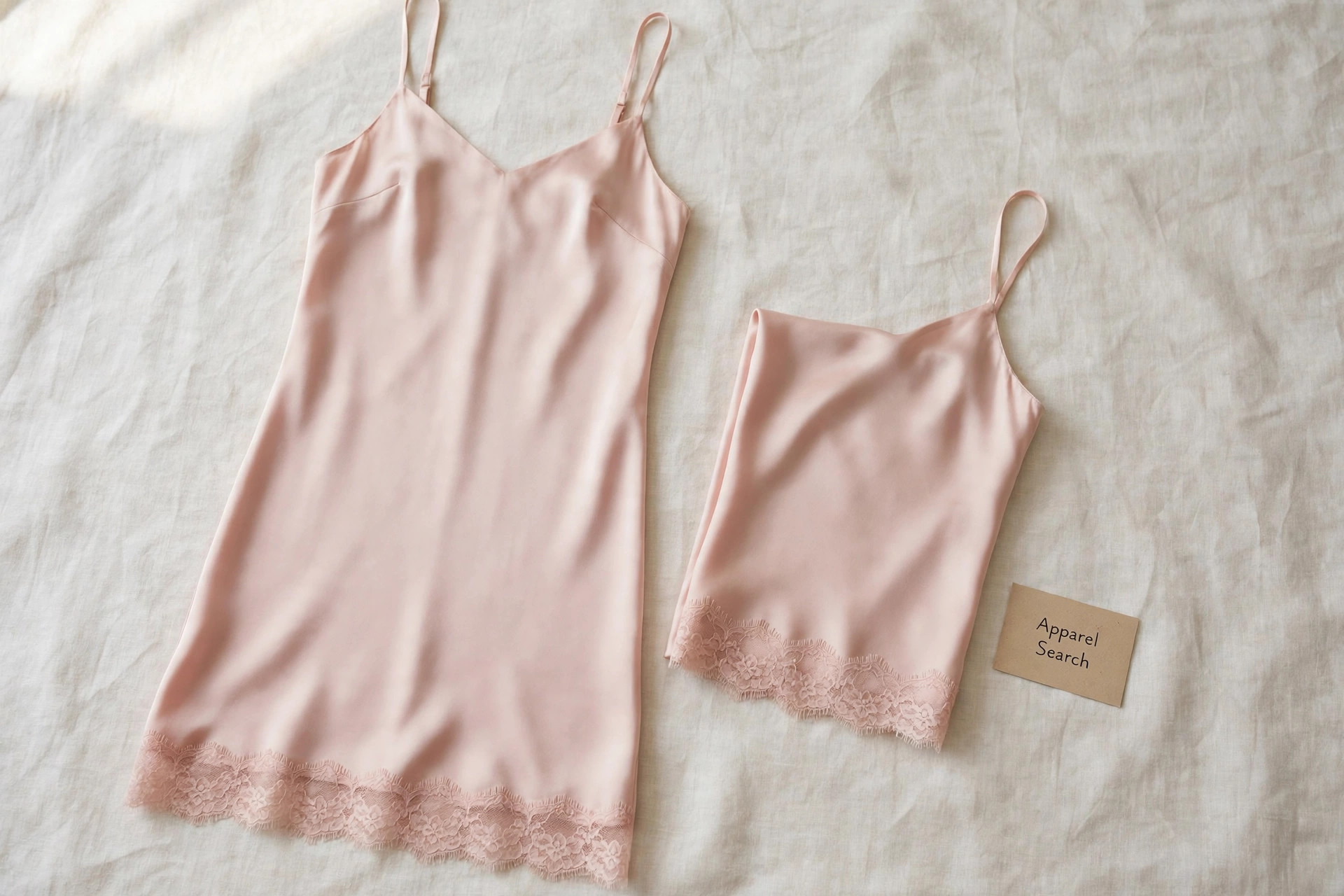
Full Slips and Half Slips
The full slip hangs from the shoulders, usually on narrow straps, and covers the body from the bust to about the length of the skirt it serves. It is the form worn under dresses, because it gives an unbroken smooth surface from shoulder to hem. The half slip hangs from an elasticated waist and covers only the lower body, which makes it the form worn under skirts. A half slip is sometimes loosely called a petticoat, although the true petticoat is a separate underskirt, as the box below explains.
Because a half slip covers only the lower half, it is often paired with a matching camisole — a short, strapped top — and the two together do the work of a full slip while letting each piece be worn separately. Slips sit in the middle of the underwear order: they are worn over the more intimate items of underwear and under everything else, and they belong to the wider family catalogued as lingerie. Lengths follow skirt fashion, so slips are sold in several lengths and a wardrobe spanning short and long dresses generally needs more than one.

Fabrics and Construction
A slip does its work through its surface, so smoothness matters more than almost anything else. The classic materials are silk and satin, which let a dress glide rather than catch; polyester and nylon give much the same smoothness at lower cost and wash more easily. The practical case for the layer is clearest against coarse outer fabrics: a slip keeps a rough wool skirt from chafing the skin, adds a little warmth in cold weather, and shields fine dress fabrics from perspiration, sparing garments that are harder to clean.
Construction follows the same logic of invisibility. Seams are finished flat so that nothing ridges through the dress above them, straps are narrow and usually adjustable, and lace at the neckline and hem is both a decoration and a soft edge against the skin. A slip that bunches, twists or shows through has failed at its one job, which is why fit — close enough not to bunch, loose enough to slide — is judged in wear rather than on the hanger.
Choosing and Caring for a Slip
The right slip disappears under the dress. Its colour should vanish beneath the fabric above it — pale tones under light dresses, darker tones under dark ones — and its length should end above the hem it serves while still covering what it is meant to cover. Under translucent outer garments the slip also supplies modesty, one of its oldest stated purposes. Its one common nuisance is static: in dry air a synthetic slip can make a dress cling instead of hang, worst of all under wool in winter, and anti-static fabrics and sprays exist for exactly that problem.
Care is gentle, because slips are light garments of fine fabric. Silk slips are washed by hand or on a delicate cycle and are not wrung hard; synthetic slips machine-wash well and dry quickly. The economy of the garment is part of its appeal: a slip takes the friction and perspiration that would otherwise reach the dress, and it is far cheaper and easier to launder than the clothing it protects.
The Slip Dress
The slip has one famous second career. A slip dress is a dress for ordinary outer wear cut on the lines of the undergarment: close-fitting, with narrow shoulder straps, usually in a smooth fabric and often trimmed with lace at the neckline or hem. It borrows the slip's cut and simplicity and wears the underlayer as the look itself. The distinction is one of intent and finish — a slip is made to be worn under something, a slip dress is made to be seen — but the shared pattern is why the two share a name.
Not to Be Confused With
Four smooth underlayers, four different jobs. A slip is a smooth layer worn under a dress or skirt so the outer garment hangs freely — full-length from shoulder straps, or a half slip from the waist. A petticoat is an underskirt proper, worn under a skirt for warmth or to give the skirt shape and fullness; the name is sometimes loosely applied to a half slip, which is where the confusion starts. A camisole covers the upper body only, a short strapped top that pairs with a half slip in place of a full slip. A chemise is the older, looser underdress from which the slip developed — a simple shift rather than a smooth, close layer chosen to disappear under a particular dress.
Common Questions
What is the difference between a full slip and a half slip?
A full slip hangs from the shoulders on narrow straps and covers the body from the bust to the skirt hem, suiting dresses. A half slip hangs from an elastic waist and covers only the lower body, suiting skirts, and is sometimes loosely called a petticoat. A half slip can be worn with a matching camisole as an alternative to a full slip.
Why wear a slip under a dress?
For four practical reasons: the smooth fabric lets the dress hang and move without catching on the body or on other undergarments; it prevents chafing from coarse outer fabrics such as wool; it adds modesty under translucent garments; and it protects fine dress fabrics from perspiration, extending the life of clothing that is harder to clean than the slip itself.
What is a slip dress?
A dress for outer wear styled like a slip: close-fitting, with narrow shoulder straps, usually in a smooth fabric with lace trim at the neckline or hem. The slip dress borrows the undergarment's cut and simplicity and wears it as outerwear.