Camisole
Clothing Definitions — definitions of garments and clothing terms from Apparel Search
Search Apparel Search
At a Glance
Definition: A camisole is a sleeveless women's undergarment covering the top part of the body, hanging from thin shoulder straps and ending at the waist or over the hips.
Also known as: Cami
Category: Clothing Definitions
Word Origin
Camisole is French, a diminutive of camise — a shirt — from the Late Latin camisia, the word that also gives us the chemise. The two garments are linguistic as well as wardrobe relatives: both names descend from the same word for the simple linen shirt worn next to the skin, and they separated as the garments themselves separated by length.
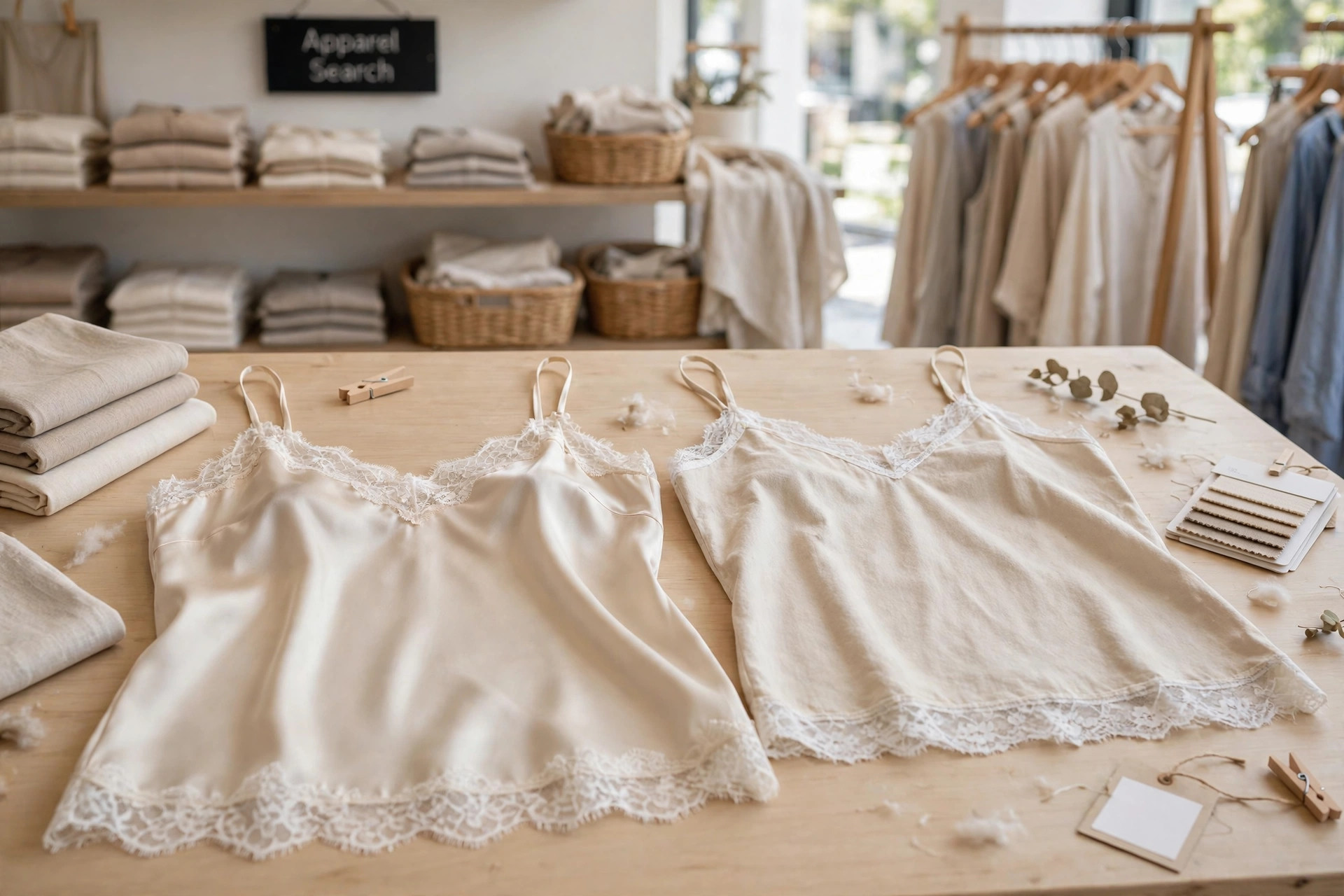
A camisole — cami for short — is a woman's undergarment that covers the top part of the body: sleeveless, hanging from thin shoulder straps, traditionally cut looser than the tight-fitting tops of similar shape, and ending at the waist or extending over the hips. It began as the light layer worn over a corset, and it now works three wardrobes at once — as lingerie and underwear, as sleepwear alongside the negligee and nightgown, and as an outerwear top in silk and satin. Apparel Search also follows the style in its camisole blog posts.
From Corset Cover to Cami
The camisole's ancestor is the corset cover: a light, strapped top worn over a corset to protect the dress from the corset's edges and boning, to smooth its line under clothing, and to fill in a low neckline modestly. It was a working layer of nineteenth- and early twentieth-century dress, made in cotton and lawn with buttons or drawstring necklines, and it belonged to the same drawer as the chemise — the longer undergarment worn beneath the corset itself.
When corsets left everyday dress, the camisole stayed and simplified. Through the twentieth century it settled into its modern form — straps instead of sleeves and shoulders, a straight or lightly shaped body, lengths at the waist or hip — first purely as underwear, then, from the late twentieth century, as a top worn openly. That double life explains its present range, from a plain cotton undershirt sold in multipacks to a lace-trimmed silk piece priced and worn as evening wear.
Forms and Fabrics
The pattern barely varies — two straps, a straight body — so fabric and finish do the differentiating. Cotton and modal knits breathe best as everyday layers under blouses and knitwear. Silk and satin camisoles are the visible kind, their sheen the decoration and lace at the neckline and hem the finishing edge. Stretch blends with a little elastane give a closer fit for wearing alone, and many casual camisoles build in a shelf bra; some add underwire cups, which let the camisole replace a brassiere entirely under a dress.
Details worth checking are the straps and the length. Adjustable straps set the neckline exactly where the outer garment needs coverage, and a body that ends over the hip stays tucked and smooth where a waist-length one can ride up. In the nightwear drawer the camisole pairs with shorts or tap pants as a pajama alternative, sitting between the slip worn under dresses and the fuller sleep garments such as the nightshirt and the gown.
Wearing the Camisole Today
As a layer, the camisole's job is invisibility with benefits: a smooth surface under a sheer or low-cut blouse, a modesty panel at a neckline, a warm extra layer in winter knits. As outerwear, the rules reverse — the camisole is the visible garment, worn with tailoring, denim or a skirt, and the fabric has to justify being seen: silk, satin, lace trim and a clean finish at every edge. The same garment crosses between the two roles purely on fabric and styling, which is why it is one of the hardest-working pieces in a wardrobe.
Fit is the difference between the two uses. A layering camisole should be close enough to lie invisible but not so tight it rides up or shows its straps' tension; an outerwear camisole needs enough ease to drape rather than cling. Either way it belongs to the wider family of women's underwear and lingerie covered across this section — from the hospital gown's namesake straitjacket sense of the word (in older psychiatric usage, 'camisole' was a nickname for a restraint jacket) to the ball gown and frock it is worn beneath. Retail production is covered under women's nightwear factories.
Choosing and Caring for Camisoles
Choose by job first. For layering, pick smooth, close fabrics in a color near your skin tone or the outer garment, with straps that adjust. For sleep, soft cotton or modal and a looser cut. For wearing out, silk or satin with finished lace, and check the garment sitting and standing — a camisole that only works standing still will not survive an evening. A built-in bra simplifies dressing but fixes the support level, so it suits smaller busts or relaxed fits better than formal support.
Wash camisoles gently and reshape them while damp. Thin straps stretch if a wet garment is hung by them, so dry flat or folded over a rail; silk and satin want cool water and no wringing. Treated that way, a camisole's simplicity is its durability — there is almost nothing on it to break.
Not to Be Confused With
A camisole and a chemise are the pair most often confused in this family — historically the words overlapped, but in modern use the difference is length: the camisole is a short top ending at the waist or hip, while the chemise is a longer, dress-length undergarment reaching toward the thighs or knees. Our Fashion Terms section treats the pair side by side, with photographs, in Camisole vs. Chemise — a comparison in Fashion Terms, a fuller comparative treatment than a definition can give. The camisole is also looser and longer than a cropped tank top, and softer than a babydoll, which flares from an empire waist and is sold as sleepwear.
Common Questions
What is a camisole?
A camisole is a sleeveless undergarment for women that covers the top part of the body, suspended from thin shoulder straps and traditionally cut looser than a tight-fitting top. Modern camisoles are made in cotton, silk, satin and stretch fabrics, often with lace edging, and are worn as underwear, sleepwear and outerwear tops.
How is a camisole different from a chemise?
Length. The modern camisole ends at the waist or hip and is a top only, while a chemise is a longer, dress-length undergarment reaching toward the thighs or knees. Historically the words overlapped, but in current retail the camisole is the short strapped top and the chemise the longer, slip-like garment.
How are camisoles worn today?
Camisoles are worn as a smooth layer under blouses and low necklines, as sleepwear, and as outerwear tops in dressier fabrics such as silk or satin with lace trim. Versions with a built-in shelf bra or underwire cups can be worn without a separate bra.