Negligee
Clothing Definitions — definitions of garments and clothing terms from Apparel Search
Search Apparel Search
At a Glance
Definition: A negligee is a decorative form of women's nightwear: a loose gown for the night and bedroom, made in light, often sheer fabrics and trimmed with lace or ribbon.
Pronunciation: NEG-li-zhay
Category: Clothing Definitions
Word Origin
From French négligé, "neglected" or "careless" — the past participle of négliger, to neglect. The name describes the dress, not the wearer: negligee was informal undress, the clothing of hours when formal dress was neglected.
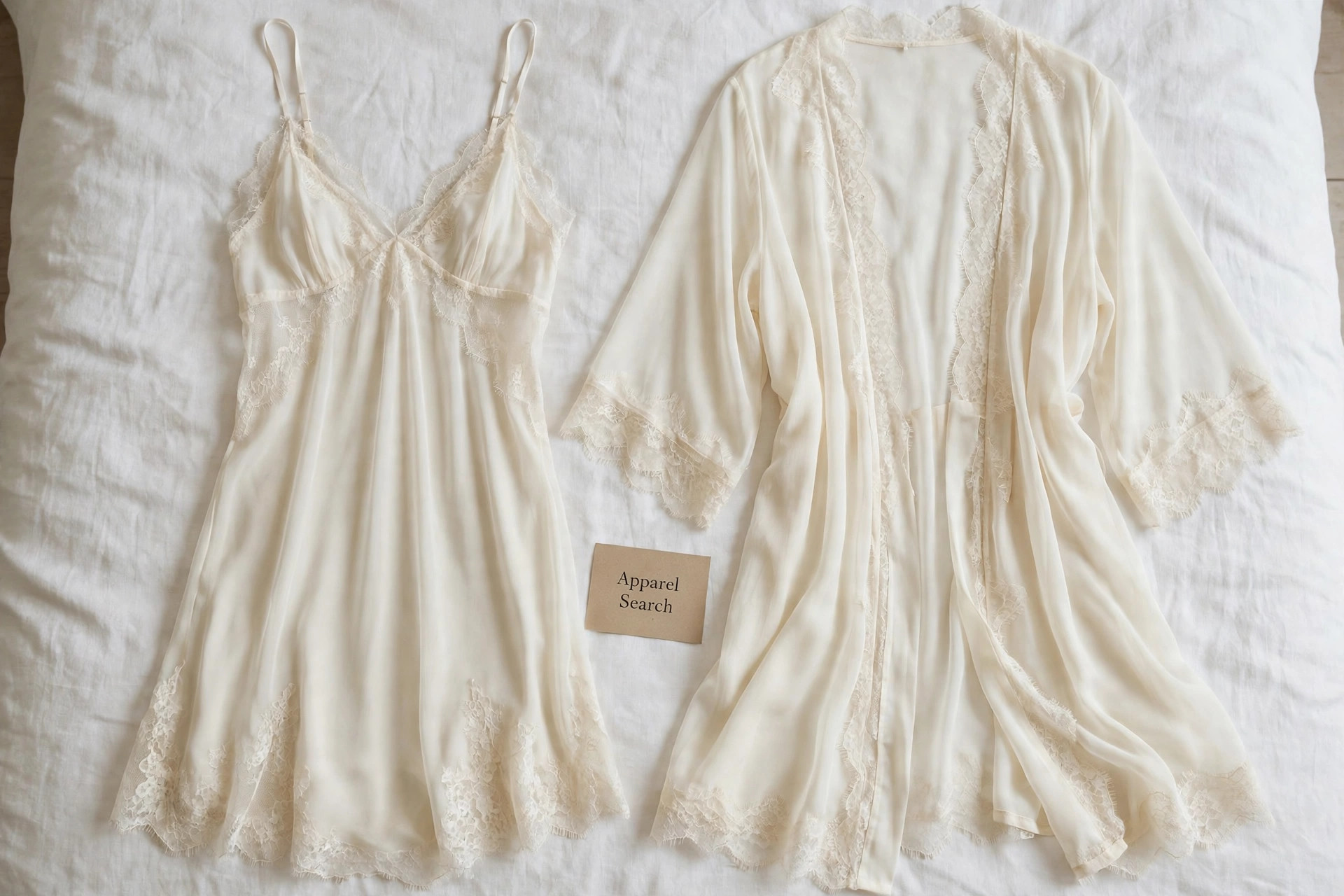
The negligee is the decorative end of women's nightwear: a loose gown for the night and the bedroom, distinguished from the ordinary nightgown by its fabrics and its trimming rather than by its cut. Where a nightgown is made to sleep in, a negligee is made to be seen — in chiffon, satin and fine sheers, edged with lace, and often sold with a matching loose robe as a set. It began in eighteenth-century France as the informal dress of the boudoir, and its name still carries that meaning. This page describes the garment in plain product terms: its form, its fabrics and its history.
The Garment: A Nightgown Made Decorative
In construction a negligee is a gown: it hangs loosely from the shoulders, may be sleeveless or have small sleeves, and falls anywhere from above the knee to the floor. What separates it from the nightgown it derives from is treatment. The fabrics are light and fluid, frequently sheer or semi-sheer, sometimes in several layers so the sheerness is softened; the neckline, bodice and hem carry the trimming — lace edging or insertion, ribbon bows, appliqué, fine pleating — that plain sleepwear does without. Many negligees are sold as sets with a matching open robe, the peignoir, worn over the gown; the set, rather than the single gown, is the classic form of the garment in shops.
The short, flared negligee of the postwar decades has its own name, the babydoll, and the negligee sits within lingerie as much as within nightwear: retailers shelve it with both. Its near relation the slip — the plain under-dress in silk or rayon trimmed with lace — supplied much of its early twentieth-century styling, when the negligee took the cut of the single-layer satin evening dresses of the 1920s and remade it for the bedroom.
Length and coverage sort the modern range. Full-length negligees in chiffon over a matching slip-gown are the formal end; knee-length styles are the volume of the market; and the short babydoll form, with its high empire waist, is the youngest in styling. Sleeves, where present, are usually sheer and loose. None of these forms is structured — there is no boning, padding or fastening beyond a tie or a button at the robe — because the garment's effect depends on drape, and drape is what its fabrics are chosen for.
From Boudoir Dress to Mass Market
The negligee was introduced in France in the eighteenth century as informal home dress: a loose gown that imitated the heavy, draped day dresses of the period in soft, light fabrics, worn in private hours when full dress was set aside — the "neglected" dress its name describes. Through the nineteenth century it remained a boudoir garment, closer to a dressing gown than to sleepwear. The twentieth century moved it into the bedroom and then into the shops: the 1920s gave it the slip-like satin form, and after the Second World War nightwear design shifted from the purely practical toward the decorative, and the negligee became a standard lingerie product.
Cheap fine synthetic fabrics made the mass market: nylon and its finer successors could be woven into sheers that imitated silk chiffon at a fraction of the price. From the 1940s to the 1970s hemlines rose, the babydoll being the extreme of the trend, and negligees of those decades are now collected as vintage lingerie. Pajamas took the larger share of women's nightwear sales from the 1980s onward, and the negligee settled into its present position: a smaller, occasion-led part of the womenswear nightwear range, bought as a set, for a trousseau, or as a gift, rather than as everyday sleepwear.
Fabrics, Trimming and Care
The fabric list is short and consistent: silk and silk chiffon at the top of the market; satin, usually polyester or silk; fine nylon and polyester sheers and meshes for the volume ranges; and lace — as edging, insertion or whole bodice panels — on nearly everything. Marabou and other feather trims appear on robe hems and cuffs in the more theatrical styles. Because the fabrics are sheer, colour is part of the design: the traditional palette of ivory, blush, black and pastel is joined each season by fashion colours.
Care follows the fabrics. Sheers and lace snag and tear at seams, so negligees are washed gently, by hand or in a mesh bag on a delicate cycle, and dried flat or on a hanger away from heat; silk wants the same treatment as any silk garment. The matching robe is cared for with the gown. Bought well and washed gently, the garment's weakness is not wear but delicacy — which is, in the end, its definition: the nightgown with the practicality deliberately trimmed away and replaced by decoration.
Not to Be Confused With
Three bedroom garments overlap, and the differences are fabric and purpose. A nightgown is the general sleeping gown — opaque cotton, lawn or flannel, made for warmth and sleep. A negligee is the decorative form of the same gown: light, often sheer fabrics, lace trimming, frequently sold with a matching robe, made to be seen rather than simply slept in. A robe or dressing gown is a separate wrap garment worn over either — the peignoir of a negligee set is a robe, not the negligee itself.
Common Questions
What is a negligee?
A negligee is a form of women's nightwear, a loose gown for the night and bedroom, first introduced in France in the 18th century. It is a type of nightgown made in light, often sheer fabrics with lace or other trimming.
What is a negligee made from?
Negligees are made from light, fluid fabrics such as chiffon, silk, satin and fine synthetic sheers, usually trimmed with lace, ribbon or marabou. Matching loose robes are often sold with them as sets.
How does a negligee differ from a nightgown?
A nightgown is any loose sleeping gown, usually in opaque cotton, lawn or flannel for warmth. A negligee is the decorative version: lighter, sheerer fabrics and trimming, intended as elegant bedroom dress rather than plain sleepwear.