Bedgown
Clothing Definitions — definitions of garments and clothing terms from Apparel Search
Search Apparel Search
At a Glance
Definition: A bedgown is a women's upper-body garment, usually thigh-length, that wraps or ties closed at the front and is cut to a simple T-shaped pattern.
Also known as: Also called a shortgown in its working-dress form, and a bedjacket in its later bedroom form; in Welsh, betgwn.
Category: Clothing Definitions
Despite its name, the bedgown was not mainly sleepwear. It was a practical wrap top for the upper body, generally reaching the thigh, closing by overlap and ties at the front, and cut so simply that a household could make one without a dressmaker. In light printed cotton it served as informal morning dress at home; in hard-wearing cloth it became everyday working dress, and its history is really the story of one economical pattern serving both.
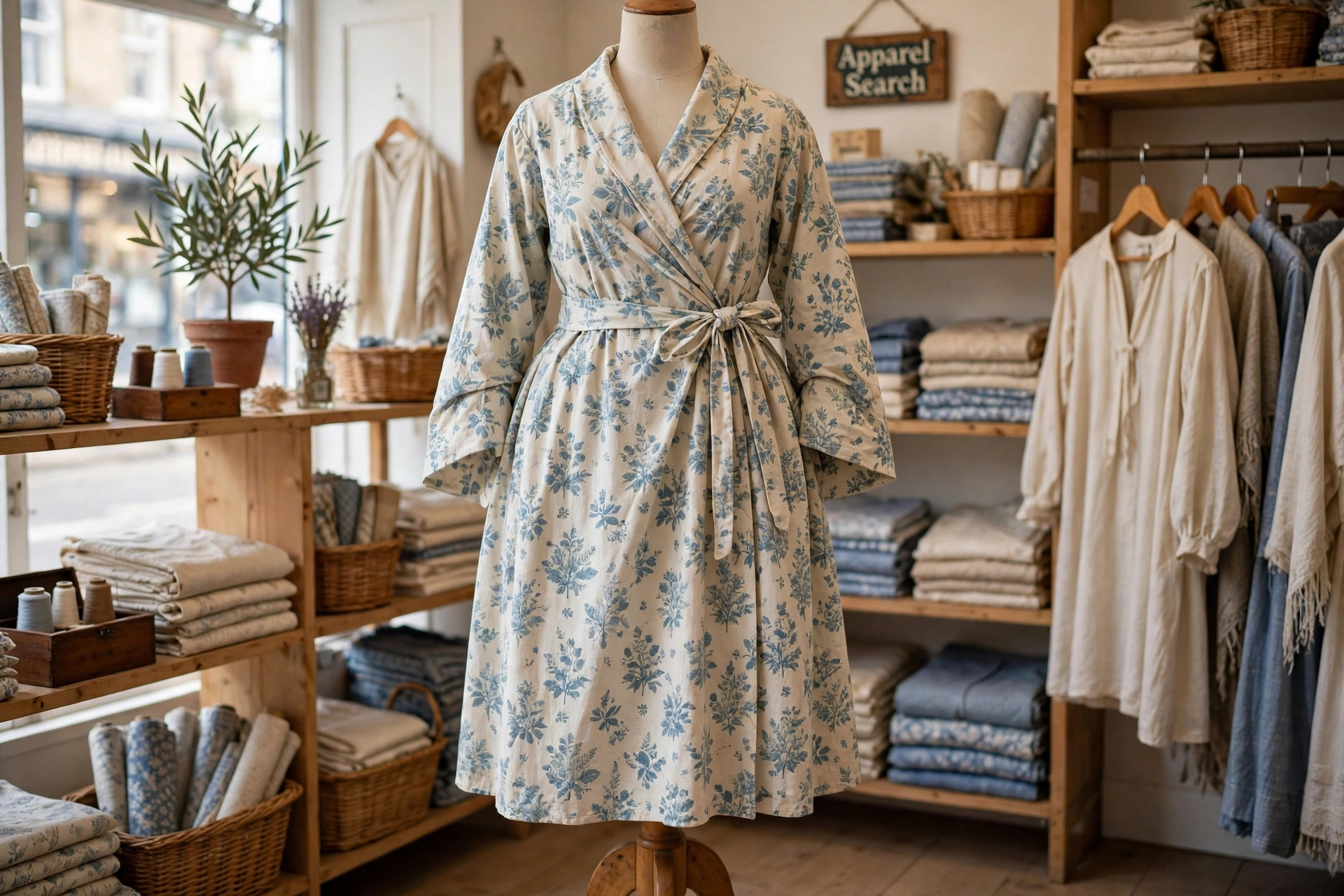
A Pattern That Asked Very Little
The whole design is a T. The body and sleeves come from a layout with almost no shaped cutting, so little cloth is wasted and no complicated fitting is needed. Worn, the fronts cross over each other, or the front skirts are cut away so the garment sits open below the waist, and ties or fastenings hold it in place. That economy explains the bedgown's reach: a garment that can be cut at home, adjusted at the front as the body changes, washed hard and mended easily will travel further than a fashionable shape that needs professional tailoring.
Fabric followed the job. Fashionable morning versions used lightweight printed cotton. Working versions used sturdy cotton, linen, wool, or linsey-woolsey, a coarse mixed cloth of linen and wool that was cheap, warm and slow to wear out. The same pattern in different cloth is two different garments socially, which is why the bedgown appears in accounts of both genteel domestic life and labouring women's dress.

Morning Wear, Then Working Dress
In the 18th century the bedgown began as at-home dress: an informal garment for the first part of the day, worn in the house before dressing fully, in the same spirit as the loose robes and wrappers of the period. Because it wrapped and tied, it dressed quickly and comfortably, and printed cotton made it pretty as well as useful.
Its longer life, though, was as workwear. From the 18th century into the early 19th, the bedgown — often called the shortgown in this setting — was the standard top for working women in Britain and America. It was worn over petticoats, frequently with an apron over the top, forming a complete, washable, free-moving outfit for domestic work, farm work and trade. When historians reconstruct what ordinary women actually wore in that period, this simple wrapped top, not the silk gown, is the garment that keeps appearing.
The Welsh Betgwn
In Wales the bedgown survived under its Welsh spelling, betgwn, and took on a second meaning. As everyday dress faded elsewhere, the betgwn was kept, standardised and celebrated as part of Welsh national dress, worn with a petticoat, apron and tall hat in the costume now recognised as a symbol of Wales. A working garment thus became heritage dress: its value shifted from usefulness to identity, which is a common final chapter for regional clothing.
The Bedjacket: The Bedgown Moves Upstairs
The bedgown's other survival changed its name and its room. As the bedjacket, it became a short robe or wrapper worn over a nightgown or negligee, giving warmth and modesty to someone sitting up in bed to eat breakfast, read or receive a visitor. In that form it remained a familiar part of a woman's wardrobe into the middle of the 20th century. By the 1960s it had largely fallen from fashion, closing a run of about two centuries for one of the simplest garments in women's dress — first as morning wear, then as working dress, and finally as bedroom dress.
Why the Bedgown Still Matters
Today the bedgown is met mainly in museum collections, in costume studies and on re-enactors — and in Wales, where the betgwn is still worn with pride. It repays the attention. Most histories of dress are written around garments that were expensive, tailored and preserved; the bedgown is the opposite evidence: a garment that survives in the record because it was worn by thousands of ordinary women, in versions cheap enough to be used up and thrown away. Its T-shaped economy also speaks to modern makers. A pattern that wastes almost no cloth, fits without tailoring and can be sewn by a beginner is, in current language, a zero-waste, size-flexible design — arrived at two centuries early, not from theory but from necessity.
Not to Be Confused With
Bedgown vs. nightgown: a bedgown was wrapped day clothing — morning wear and working dress — while a nightgown is loose sleepwear worn to bed. The names overlap only in the bedgown's late form, the bedjacket, which was worn over a nightgown.
Common Questions
What is a bedgown?
A bedgown is a women's upper-body garment, usually thigh-length, that wraps or ties closed at the front. Cut to a simple T-shaped pattern, it was worn as 18th-century morning dress and then as the standard working top of British and American women into the early 19th century.
Is a bedgown the same as a nightgown?
No. Despite the name, the bedgown was day clothing: morning wear at home and then everyday working dress worn over petticoats. Only its later form, the bedjacket, belonged in the bedroom, worn over a nightgown for warmth and modesty while sitting up in bed.
What is a betgwn?
Betgwn is the Welsh spelling of bedgown. In Wales the garment was preserved as part of Welsh national dress, worn with a petticoat and apron, long after it stopped being ordinary everyday clothing elsewhere.