Straw Bag
Clothing Definitions — definitions of garments and clothing terms from Apparel Search
Search Apparel Search
At a Glance
Definition: A straw bag is a bag whose body is woven from straw or a similar plant fibre such as raffia, seagrass or cane — a material category rather than a shape, covering totes, baskets, clutches, bucket bags and crossbody bags.
Category: Clothing Definitions
A straw bag is a handbag whose body is woven from straw or a similar plant fibre. The term names a material, not a shape or a way of carrying: the woven body may be a tote, a basket, a clutch, a bucket or a crossbody bag, usually finished with leather handles and trim at the points of wear. Straw bags are the classic summer bag — light, dry and breathable — and equally the classic holiday bag, descending from the market baskets of the Mediterranean. This page separates the fibres that share the name and distinguishes the straw bag from the basket bag.
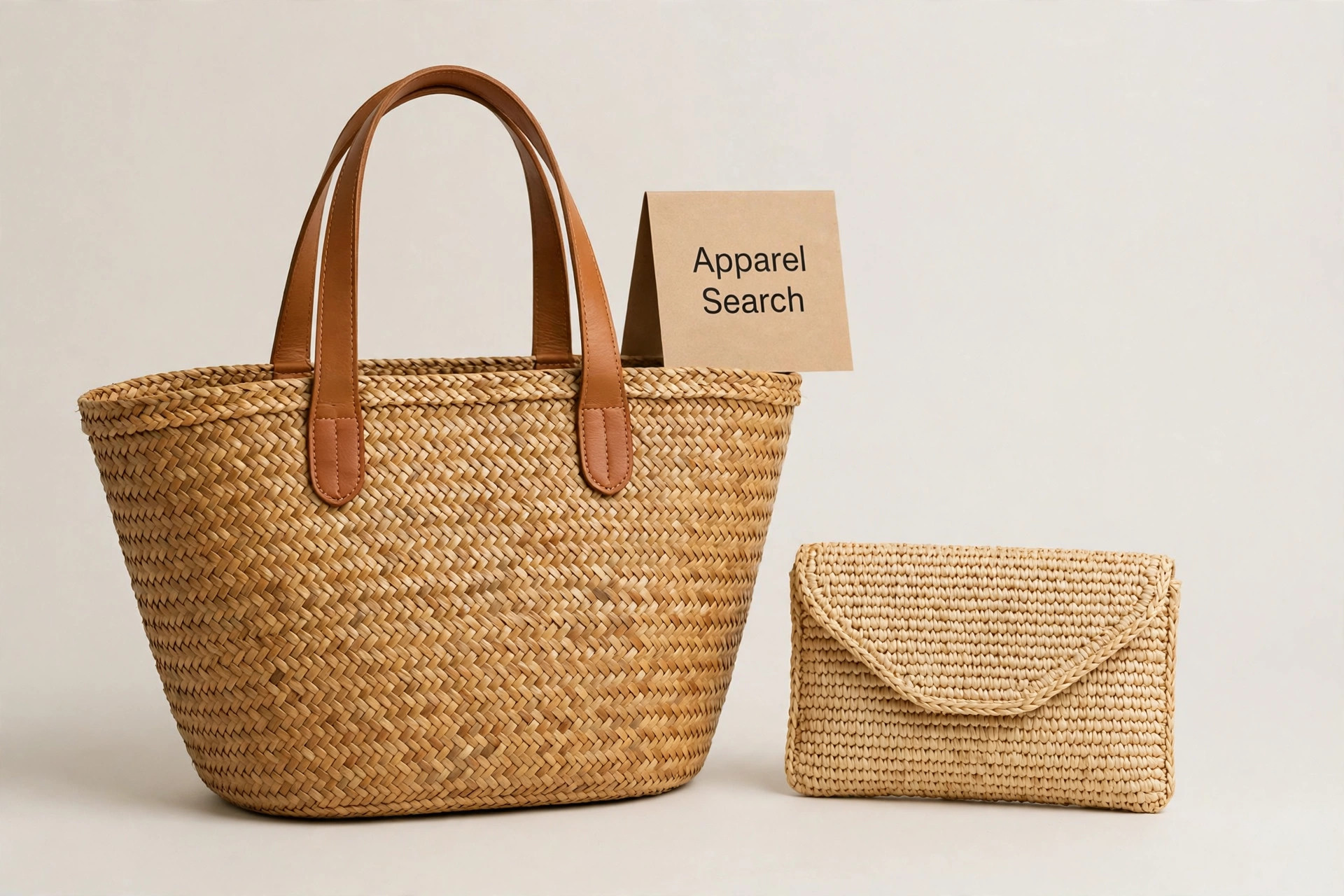
Straw, Raffia, Seagrass and Wicker
The word straw in shop use is a family name for several fibres. True straw is the dried stem of wheat, rye or rice, braided into plaits and sewn into shape. Raffia is the flat fibre stripped from the raffia palm's leaves, crocheted or plaited into softer, more supple bags. Seagrass is woven into tougher, rustic bodies. Wicker is a method rather than a material — the weaving of rigid canes of willow or rattan — and produces the stiff, fixed shapes of basket bags. Modern production also uses paper yarn and synthetic raffia under the same name, gaining durability at some cost in character.
The distinctions matter when buying or describing. A straw bag in the strict sense is braided stems, stiff and smooth; a raffia bag is leaf fibre, soft enough to fold; a wicker bag is cane, rigid enough to stand as furniture does. All three are sold as straw bags, and all three share the material's limits — water spots and warps woven fibre, and an unlined weave lets small items work through — which is why better examples are lined and leather-bound.
Shapes and Finishing
Because the term is a material, the shapes are the whole range of bag shapes. The woven body appears as the open market tote, the structured basket with a lid or drawstring top, the flat clutch, the crossbody worn against the hip, and the bucket bag, drawn up at the top. What changes from shape to shape is the finishing: woven plant fibre frays and crushes at points of wear, so handles, bases, rims and closures are commonly reinforced or made outright in leather, and a fabric lining is fitted to keep contents from working through the weave and to give the bag a finished interior.
That combination — a light woven body with hard-wearing trim — is the practical definition of a good straw bag. The fibre provides the look, the lightness and the summer character; the leather and lining provide the service life. A straw purse or clutch follows the same construction at a smaller scale.
Care is part of the definition in practice, because woven fibre sets the terms. A straw bag should be kept dry, wiped rather than washed, and stored stuffed with tissue so the weave holds its shape; crushing and damp are the two things that end its life, warping the body and spotting the fibre. Those limits are the price of the material's virtues — the same open, dry, breathable weave that makes the bag light in summer is what water and pressure damage — and they explain why the straw bag remains a seasonal bag rather than an everyday carrier.
History and Style
The straw bag descends from the working baskets of the Mediterranean — the market and harvest carriers woven wherever suitable fibre grew. Its fashion history turns on one of those baskets: the simple lidded basket carried by Jane Birkin through the late 1960s and 1970s became a lasting style reference, and the basket form has returned to fashion repeatedly ever since. Designers reissue woven bags each summer in raffia, seagrass and straw, but the appeal is constant: a natural, textured, lightweight bag that reads as holiday and warm weather wherever it is carried.
Shapes, care and the style's history are covered in the Fashion Influence guide to straw bags. Care follows from the material: keep the bag dry, store it stuffed to hold its shape out of season, and treat leather trim as leather — the woven body will outlast several summers if it is kept out of the rain and not crushed in storage.
Not to Be Confused With
A straw bag is not necessarily a basket. Straw bag is the wider, material term: any bag woven from plant fibre, including soft totes and clutches that fold. A basket bag is the rigid member of the family — a straw bag built like a basket, with a fixed shape that stands on its own and an open or lidded top. Every basket bag is a straw bag; most straw bags are not baskets. Both belong to the wider handbag family.
Common Questions
What is a straw bag?
A bag whose body is woven from plant fibre — straw, raffia, seagrass or cane. It is a material category rather than a shape: totes, baskets, clutches and crossbody bags are all made as straw bags.
Is raffia the same as straw?
No. Straw is the dried stem of a cereal grass; raffia is fibre stripped from the leaves of the raffia palm. Raffia is softer and is usually crocheted or plaited, while straw is stiffer and often braided and sewn. Shops label both as straw bags.
What is the difference between a straw bag and a basket bag?
A basket bag is a straw bag built like a basket — rigid, with a fixed shape and an open or lidded top. Straw bag is the wider term; soft woven totes and clutches are straw bags but not baskets.