Crocs
Clothing Company Definitions — United States clothing company definitions from Apparel Search
Search Apparel Search
At a Glance
Definition: Crocs, Inc. is a shoe manufacturer founded by entrepreneur George B. Boedecker, Jr. to produce and distribute a plastic clog originally acquired from a Canadian company, first unveiled as the Crocs Beach in 2002 and made from the proprietary foam resin Croslite.
Category: Clothing Company Definitions
Crocs, Inc. is a shoe manufacturer founded by entrepreneur George B. Boedecker, Jr. to produce and distribute a plastic clog originally acquired from a Canadian company. Originally developed as a spa shoe, the first model, the Crocs Beach, was unveiled in 2002 at the Ft. Lauderdale Boat Show, selling out the 200 pairs produced at that time. The product line has remained popular and has the characteristics of a sustained fad, with both ardent support and disapproval. Crocs has been the title sponsor of the Association of Volleyball Professionals (AVP) Tour since 2006. The company's official website is crocs.com, and Apparel Search carries a fuller Crocs, Inc. company page.
The Croslite Material and the Patents
Crocs is built on a material. In June 2004 Crocs purchased Foam Creations and its manufacturing operations to secure exclusive rights to the proprietary foam resin "Croslite", which is made using ethylene vinyl acetate. The foam forms itself to a wearer's feet and offers purported medical benefits, according to a number of podiatrists. Crocs holds one patent covering various utility aspects of its footwear, U.S. Patent No. 6993858 B2 issued February 7, 2006, and three design patents covering ornamental aspects, U.S. Patent Nos. D517788, D517789 and D517790 issued March 28, 2006, and it filed complaints with the U.S. International Trade Commission and the U.S. Federal District Court against 11 companies making products it believed infringed its patents. As of December 31, 2007, it had applied to register Crocs and the Crocs logo as trademarks in over 40 jurisdictions, and extended the scope of its trademark registrations to non-footwear products such as sunglasses, goggles, knee pads, watches and luggage.
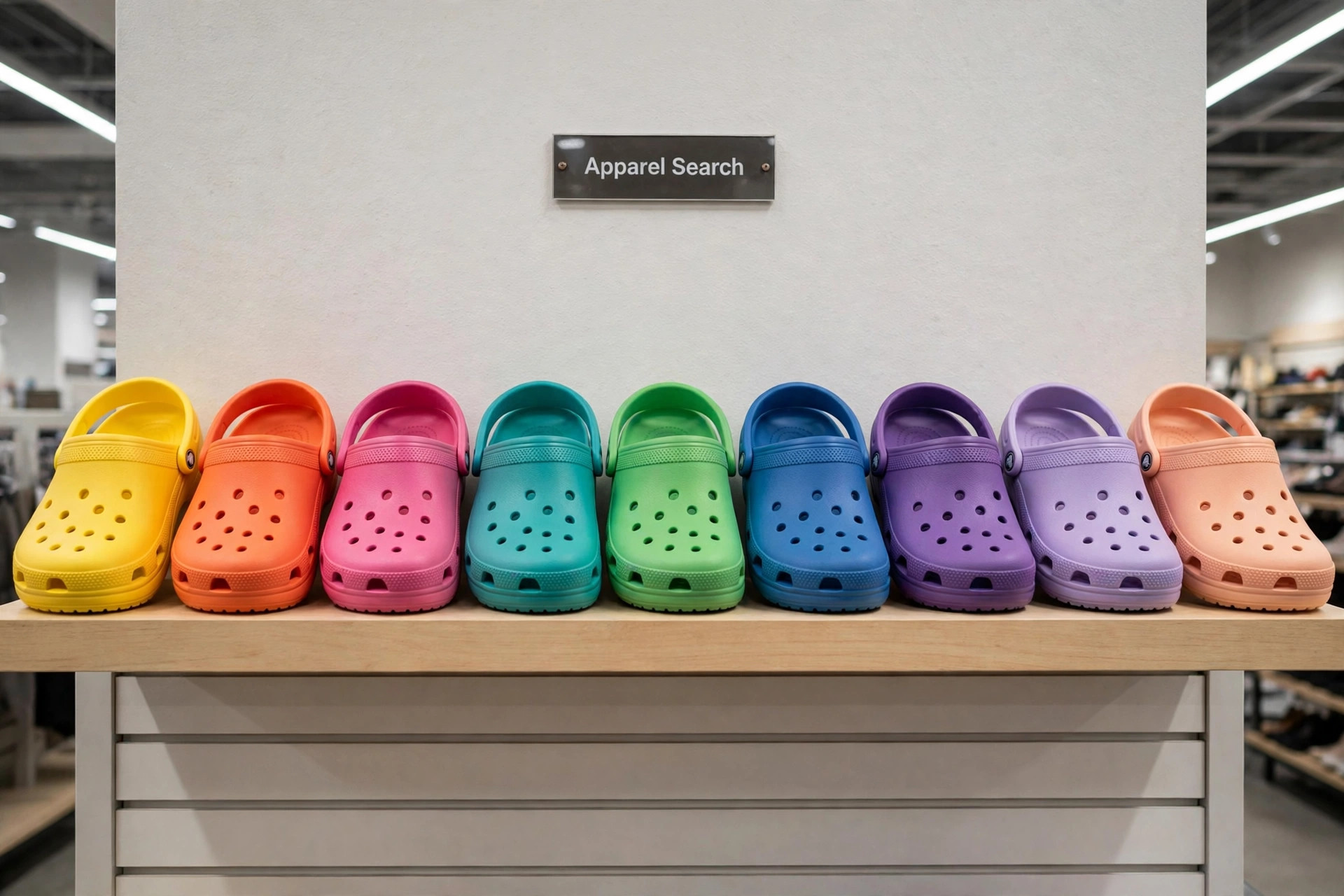
The shoes are produced in a wide array of colours depending on the model: the Beach and Cayman styles are available in more than 20 colours, and most other styles in a palette of four to six colours or two-colour combinations. They were usually manufactured in the company's own facilities in Canada and Mexico, as well as by contract manufacturers in Italy, Romania and China; in 2008 the Canadian factory closed. Around the clog grew an ecosystem: a line of purses in the same material and colours, and an entry into the golf shoe marketplace through the acquisition of Bite Footwear and the Crocs Ace golf shoe.
Health, Safety and Acquisitions
The Centers for Medicare and Medicaid Services has approved a model of Crocs with molded insoles as diabetic footwear, which helps wearers avoid foot injuries, and Crocs are certified by the U.S. Ergonomics Council and the American Podiatric Medical Association. The same softness drew scrutiny: footwear such as Crocs and flip-flops came under scrutiny in 2006 when children suffered injuries after the shoes became caught in escalator mechanisms. Rapid City Regional Hospital in South Dakota changed its dress code in 2007 to prohibit the sandal variants, along with those with Jibbitz holes, while still allowing closed-top "Professional" and healthcare-focused "Rx" Crocs; Blekinge hospital in Sweden banned the shoes for staff over static electricity concerns, and Vienna's city hospitals also moved to ban the clogs for nursing staff.
Acquisitions extended the company beyond the clog. On October 3, 2006, Crocs purchased Jibbitz, the manufacturer of accessories that snap into the holes in Crocs, for $10 million. On January 31, 2007, it acquired substantially all the assets of Ocean Minded, a designer and manufacturer of leather and EVA-based sandals for the beach, adventure and action sports markets, for $1.75 million in cash plus a potential earn-out of up to $3.75 million. On July 30, 2007, Crocs agreed to buy Bite Footwear of Redmond, Washington. In April 2008 it acquired substantially all the assets of Tidal Trade, Inc., its third-party distributor in South Africa, for $4.6 million, and of Tagger International B.V. of the Netherlands, a messenger bag manufacturer, for $2.0 million; in June 2008 it decided to liquidate Fury, Inc. after efforts to sell the entity were unsuccessful.
Fashion, Media and the Share Price
While some regard Crocs shoes as comfortable and colourfully decorated, others see them as a fashion disaster, and a subculture emerged of people who vocally oppose the shoes — an "I Hate Crocs" blog, a Facebook group with over 1.4 million members dedicated to eliminating the shoes, satire on Real Time with Bill Maher and The Daily Show, and a #6 place on the "Worst" list of Maxim's "The 10 Best & Worst Things to Happen to Men in 2007". Yet in 2008 Crocs was ranked the number one casual brand in the athletic specialty sporting goods channel for men, women and children by the NPD Market Research Group. The split — ardent support from wearers who prize the comfort, open disapproval from critics of its looks — kept the brand in public conversation far beyond footwear.
The stock told the same boom-and-correction story in the period covered. On October 31, 2007, the stock CROX dropped from $75 per share to slightly under $40 when the company announced decreased revenue projections. On April 14, 2008, the stock dropped 30% in after-hours trading after the company significantly guided down earnings estimates for the first quarter, and said it would close its Quebec City factory as retailers reduced orders, with CEO Ron Snyder citing an increasingly challenging US retail environment. By October 10, 2008, the share price was $1.90, having steadily fallen through the Credit Crunch period. These figures are the original's period account, kept here as the record of the fad cycle the product itself was living through.
Apparel Search also carries Crocs brand guides for women's Crocs, men's Crocs and children's Crocs.
Common Questions
What is Croslite?
Croslite is the proprietary foam resin, made using ethylene vinyl acetate, that Crocs shoes are made from. In June 2004 Crocs purchased Foam Creations and its manufacturing operations to secure exclusive rights to Croslite, which forms itself to a wearer's feet.
When and where were Crocs first shown?
The first model, the Crocs Beach, was unveiled in 2002 at the Ft. Lauderdale Boat Show, selling out the 200 pairs produced at that time. The clog was originally developed as a spa shoe and was acquired from a Canadian company.
What companies has Crocs acquired?
Crocs purchased Foam Creations in June 2004, Jibbitz for $10 million in October 2006, Ocean Minded in January 2007, and agreed to buy Bite Footwear in July 2007. In April 2008 it acquired Tidal Trade in South Africa and Tagger International in the Netherlands.